6 min read

The Angel Who Lifted Sodom's King From Tar

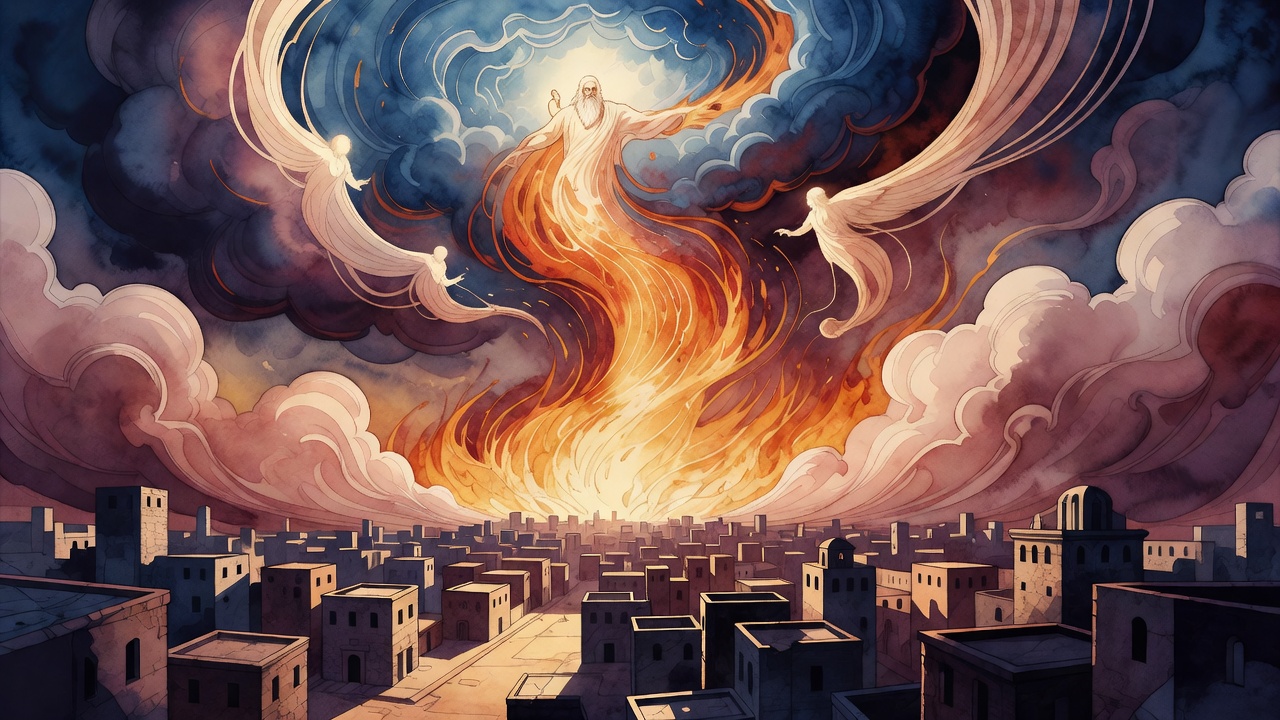
Four invading kings dig tar pits as traps in the Vale of Siddim. Sodom sinks into clay until an angel hauls the king up for later judgment.

Curated by Arthur · Told by Maggid ·
Table of Contents
  1. Clay That Waited for Boots
  2. The Hand That Refused to Let Him Die
  3. When Kingdom Is Uprooted and Fed Again
  4. Rods and Trees That Stand Trial
  5. Abraham Walks In After the Pit
The Angel Who Lifted Sodom's King From Tar Click for full size

Clay That Waited for Boots

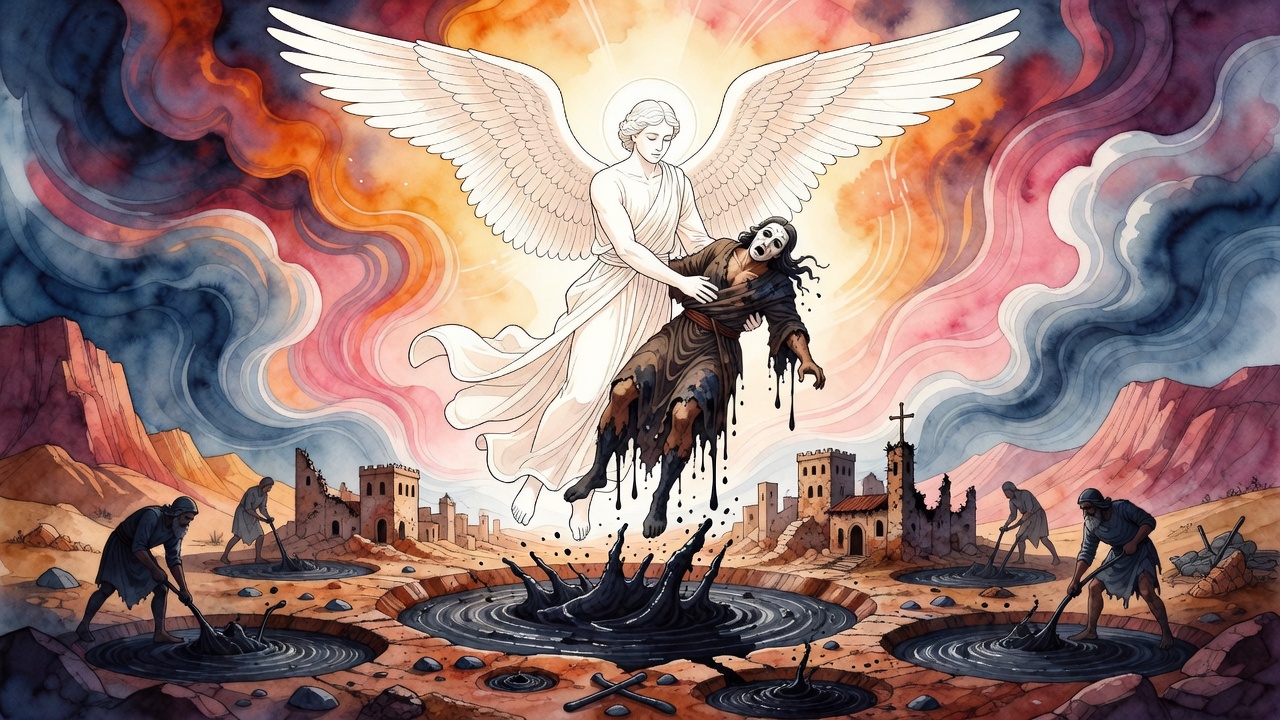
Before the five kings marched, the four invaders worked like engineers of cruelty. In the Vale of Siddim they did not trust open battle alone. They dug pits and packed dust and clay over them so that the ground looked solid until a boot found the hollow. Men swung tools under a hard sky. Sweat ran into their eyes. They measured distances the way hunters measure the place where an animal will step. When Scripture says the valley was "full of slime pits," the sages refuse to call it only nature. The four kings themselves made the snare (Genesis 14:10).

The trap worked with ugly precision. The king of Sodom and the king of Gomorrah plunged straight into the clay. Other rulers of the five fled toward the mountains, sandals tearing on rock. Three of their number never fell at all. A single verse, read hard, splits the coalition: two swallowed, three free, and one man who should have drowned in tar and did not. War looks simple from a throne. In the valley it is mud, weight, and the sound of a body failing to find air.

The Hand That Refused to Let Him Die

An angel came down into the mess and pulled the king of Sodom free. Not because Sodom had earned mercy. Heaven still had reckoning left for that city, and a dead king cannot face the fire that will come later. Fingers of light, or of whatever form a messenger wears when he wades into pitch, closed on a royal arm and hauled. The king came up coughing black, alive against his own deserts. The midrash holds the image without softening it. Divine justice sometimes keeps a wicked man breathing so the next chapter can find him standing.

Abraham would soon enter the same valley of politics with swords and oaths, but first the clay has its story. Power digs pits for rivals and discovers that the ground does not stay loyal. Authority over another person, Ecclesiastes already warned, tilts toward harm: "when man had authority over man, it was to his detriment" (Ecclesiastes 8:9). The four kings held that authority for a season. They used it to hollow the road under other men's feet. The angel's rescue was not a prize for the pit-diggers. It was a stay of sentence for one survivor whose city had not yet finished its crimes.

When Kingdom Is Uprooted and Fed Again

The pattern does not end with Siddim. Generations later the rabbis watch Edom's thrones rise and fall in the genealogies of Genesis. Kingdom had already been uprooted from Edom, they say, when Botzra stepped in and supplied kings, feeding a weakened rival back into strength. Rabbi Abbahu pictured a prince in a lawsuit whose opponent is starving for funds until a third party restocks him. The king then turns his anger on the supplier: "I will contend with the one who gave him sustenance." The parable is cold and clear. Neutrality dies the moment you re-arm the side Heaven has begun to empty.

So Heaven turns toward Botzra in the prophets. "For the Lord has a sacrifice in Bozrah, a great slaughter in the land of Edom" (Isaiah 34:6). Feeding a fallen empire is not neutral charity when the empire's trade is oppression. Rabbi Berekhya notes that Edom still takes a blow even when Botzra is the main target. The client does not walk free because the sponsor draws the first fire. Siddim's clay and Botzra's crown are two chapters of one book about power that will not leave well enough alone.

Rods and Trees That Stand Trial

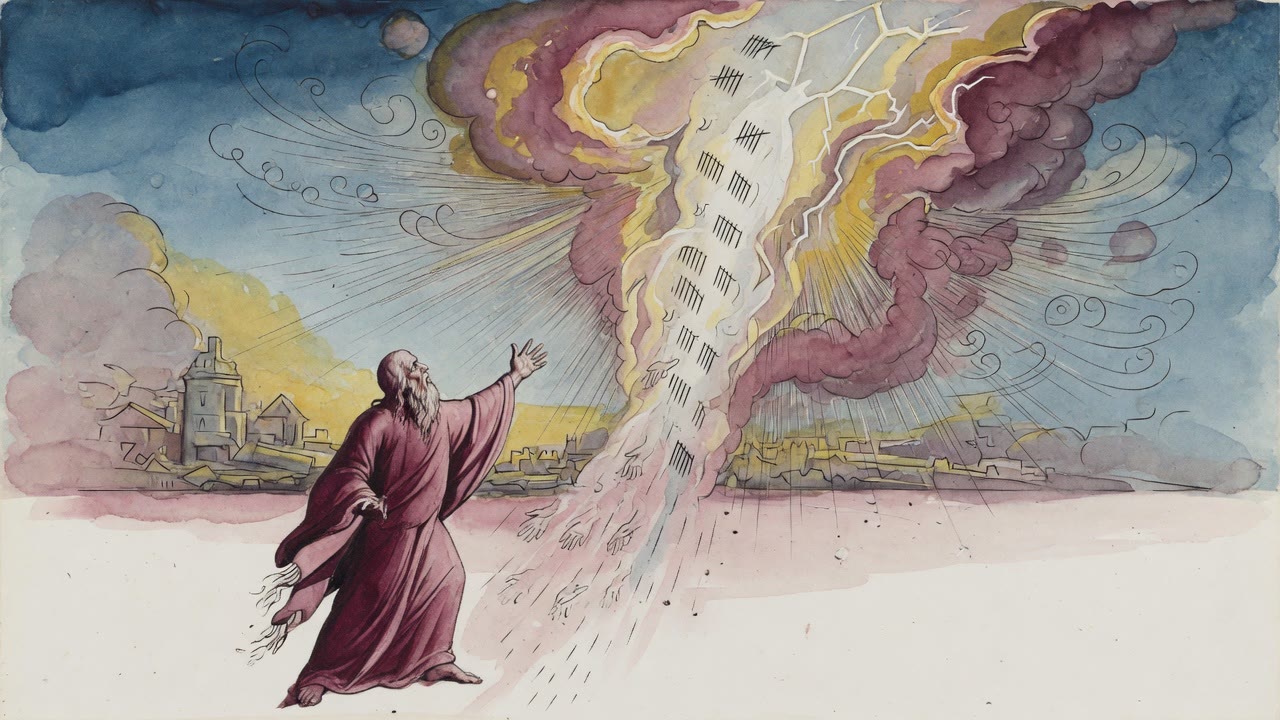
Kohelet Rabbah presses the danger further into the tools themselves. Rabbi Elazar says one person can drag another into liability only within a shared human measure, yet the moral heat stays high. Rabbi Yonatan says even a rod or strap used to inflict suffering will face reckoning. Isaiah's "day of Midian" becomes, in their hearing, a day of judgment for instruments as well as hands (Isaiah 9:3). Rabbi Hama bar Guryon hears trees summoned to give account from the strange question, "Is the tree of the field a man?" (Deuteronomy 20:19). Wood that beat a back must answer. Soil that hid a trap must answer.

If wood can answer for the pain it delivered, what of kings who dig clay pits under a public road of war? What of a capital that reinstalls thrones for a people Heaven had already begun to uproot? The sages do not write modern politics. They write a cosmos where power leaves fingerprints that last longer than the campaign. A pit is an argument in the ground. A supplied king is an argument in history. Both arguments return to their authors.

Abraham Walks In After the Pit

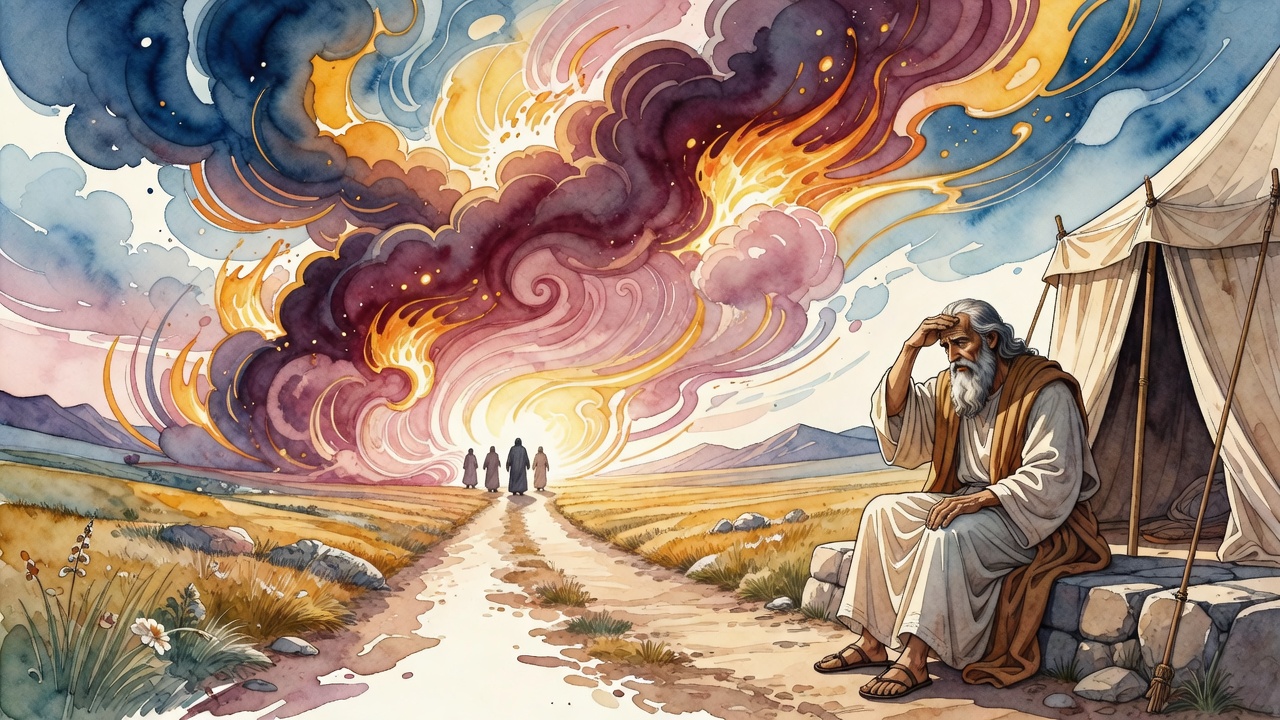
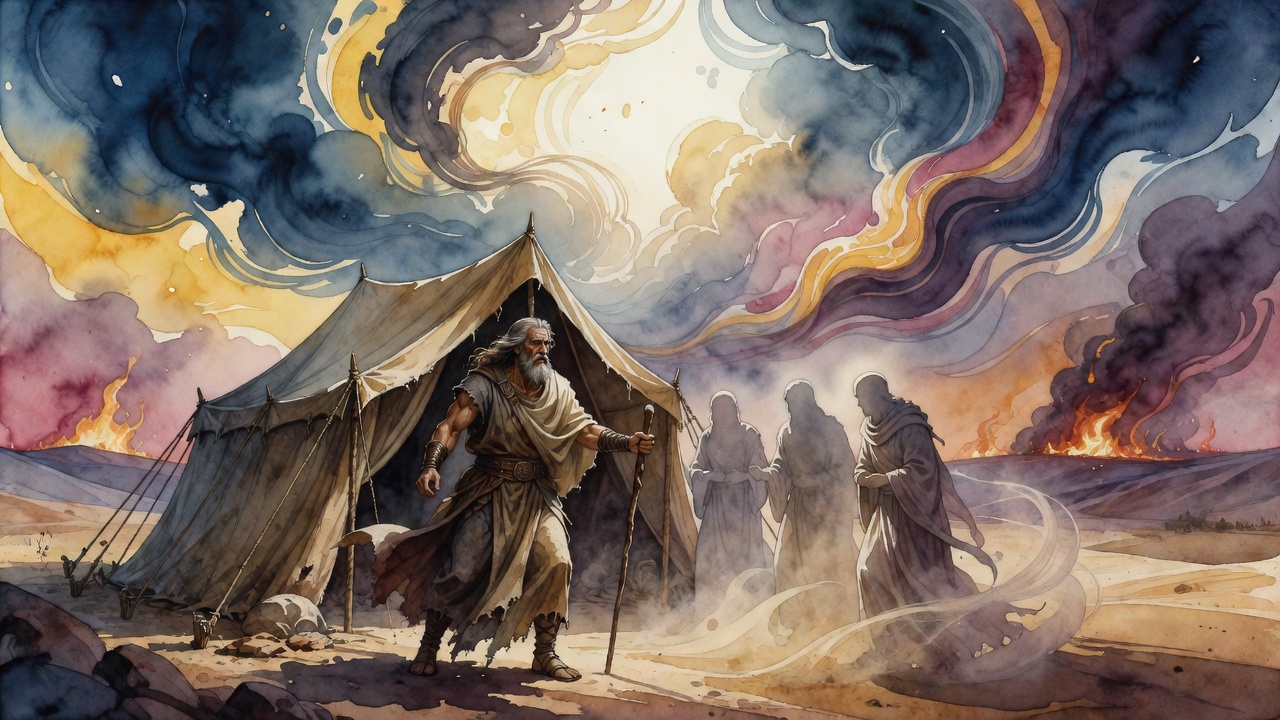
When Abraham finally moves, he does not dig traps. He gathers trained men, pursues as far as Dan, recovers captives, and refuses the king of Sodom's offer of spoil, so that no one can say a mortal made him rich (Genesis 14:14-23). The man pulled from tar still stands in the story, still ruling a city whose sins are ripening toward sulfur. The angel's grip was not a blessing. It was a calendar entry. Sodom will meet its fire with a king who remembers the taste of clay and still does not change.

Read the vale again. The pits were human work. The rescue was divine strategy. The later slaughter in Bozrah is the same argument written on a larger map: do not underwrite the strong when the strong live by harm. In the world of Midrash Aggadah and Midrash Rabbah, kings are measured by what they dig, whom they feed, and whom they leave breathing for the wrong reasons. Abraham's sword and Abraham's refusal of Sodom's gold both answer the same question the pits asked. How do you hold power without hollowing the road under someone else's life?


← All myths
From the tradition

Sources

3 sources

The texts behind this telling. Some cards carry a translation of the source; others are our own retelling of it, and each card says which. Every card links out to the original.

Midrash Aggadah, Genesis 14:10Midrash Aggadah

Translation of the source text.Midrash Aggadah (Buber), Public Domain, on Sefaria · CC-BY-SA

"And the Vale of Siddim was full of slime pits" (Genesis 14:10). For the four kings made there pits and filled them with dust and clay, so that if the five kings should come to make war with you, they would fall there. And so there fell there the king of Sodom and the king of Gomorrah; and an angel came and brought out the king of Sodom, and the remaining ones fled to the mountain, concerning the king of Admah and the king of Zeboiim and the king of Bela, who did not fall there.

Full source
Bereshit Rabbah 83:3Bereshit Rabbah

Retold in our words. Read the original at the link below.The Sefaria Midrash Rabbah, 2022 · CC-BY

Bereshit Rabbah turns to The Rise and Fall of Kings in the Land of Edom.

Rabbi Abahu, a prominent sage of the 3rd century, offers a powerful analogy. His opponent is running out of resources, struggling to stay in the fight. Then, someone steps in and provides that opponent with what they need. Now, the king, seeing this, declares, "I will contend only with the one who provided him with sustenance!"

So, how does this relate to Bela's death and the rise of Yovav from Botzra? Well, according to Rabbi Abahu, God, blessed be He, saw it the same way. Kingdom, the rabbis say, had already been uprooted from Edom. Edom was weakened, vulnerable. And then Botzra stepped in, providing them with kings, giving them renewed strength.

God essentially says, "Kingdom had already been uprooted from Edom, and Botzra came and provided them with kings? That is why I will contend only with Botzra." This idea, that providing sustenance to an adversary makes you a target, is both intriguing and a little unsettling.

The connection doesn't end there. The rabbis point to (Isaiah 34:6): "For there is a sacrifice to the Lord in Botzra..." This verse, they argue, is direct evidence of God's focus on Botzra because of their support for Edom. The Tanakh is nothing if not a network of interconnected ideas, prophecies, and narratives.

But here’s a twist! Rabbi Berekhya adds another layer. Even though God's anger is primarily directed at Botzra, the verse continues, "…and a great slaughter in the land of Edom." So, while Botzra might be the primary target, Edom doesn't escape unscathed. As it were, Edom is not blameless in its reliance on Botzra.

It's a fascinating glimpse into the rabbinic mind. They weren’t content with a simple reading of the text. They saw layers of meaning, connections between seemingly disparate verses, and moral lessons woven into the historical narrative.

What does this all mean for us? Maybe it's a reminder that our actions have consequences, not just for ourselves, but for those we support. Or perhaps it's a cautionary tale about getting involved in other people's battles. Either way, it's a story that makes you think – and isn't that what the best stories do?

Full source
Kohelet Rabbah 9:1Kohelet Rabbah

Retold in our words. Read the original at the link below.The Sefaria Midrash Rabbah, 2022 · CC-BY

Power over another human being is one of the most dangerous things a person can hold, and Ecclesiastes names this danger directly. In (Ecclesiastes 8:9), it says, "All this I have seen and taken to my heart, for every action that is performed beneath the sun, when man had authority over man, it was to his detriment." Heavy stuff. And Kohelet Rabbah, the rabbinic commentary on Ecclesiastes, digs even deeper into this unsettling verse. It asks: whose detriment are we talking about here? Is it the ruler who suffers, or the ruled? The commentary suggests it can be both.

Rabbi Elazar offers a fascinating perspective. He says that one person can only cause another to incur liability – that is, be held responsible for something – if they are of "the same stature," as it's put in the verse: "When man had authority over man." In other words, the ruler persecutes someone, but God makes sure that the persecuted individual was also deserving of punishment.

It doesn't stop there. Rabbi Yonatan takes this concept even further. He says that even a rod or a strap can incur liability if used to inflict suffering! He brings a verse from Isaiah (9:3) as support: "For the yoke of its burden…like the day of Midian." He connects the "day of Midian" to the day of judgment, din in Hebrew. So, even inanimate objects, instruments of oppression, will ultimately face destruction if used to cause pain. It’s a powerful image.

Then Rabbi Ḥama bar Guryon adds another layer. He argues that even non-fruit-bearing trees are destined to give an account and a reckoning. Where does he get this idea? From (Deuteronomy 20:19): "For is the tree of a field a man?" Now, the simple reading of this verse is a rhetorical question. But the Rabbis, in their beautiful way of finding hidden meanings, read it as a statement: "For the tree of a field is a man." Just as a person will be held accountable for their actions, so too will these seemingly insignificant trees.

What does it all mean? It seems the Rabbis are trying to tell us that everything is connected. Every action, every exercise of power, no matter how small or seemingly insignificant, has consequences. Whether you're a ruler, a common person, or even an inanimate object, you're part of a larger web of responsibility. And ultimately, justice will be served.

So, the next time you see someone wielding power, or even the next time you hold a seemingly insignificant amount of power yourself, remember the words of Kohelet Rabbah. Remember the rod, the strap, and the non-fruit-bearing tree. Everything counts. Everything matters. And ultimately, we are all held accountable.

Full source