Parshat Vayetzei6 min read

The Angels Compared Jacob's Sleeping Face to the Face on the Throne

Fleeing Esau, Jacob pillows his head on the stones of Moriah, and the angels race up the ladder to match his sleeping face against the Throne.

Curated by Arthur · Told by Maggid ·
Table of Contents
  1. The Twelve Stones Became One
  2. The Ladder Fell Across the Sleeping Man
  3. Michael Knew the Face on the Throne
  4. The Hosts Came Down to Look
  5. The Kingdoms Climbed and Edom Would Not Come Down

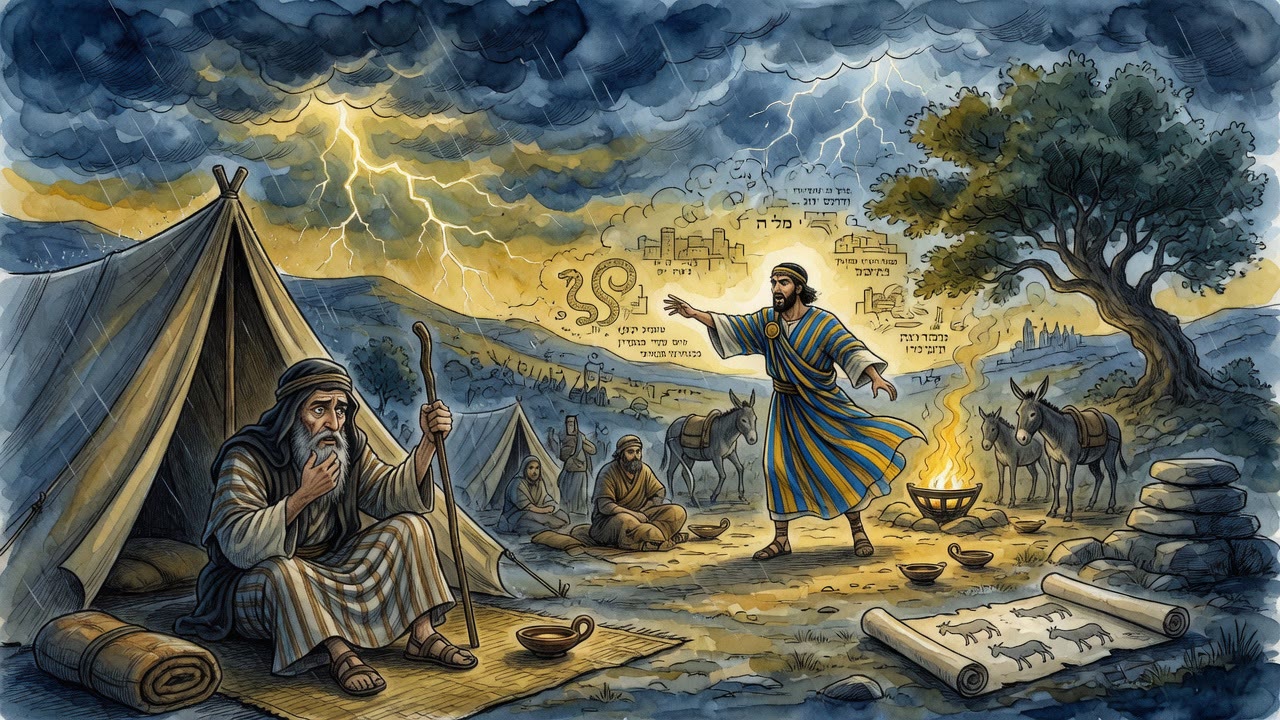
Jacob ran with nothing but a walking staff and the memory of his brother's face. Esau had sworn to kill him. Behind him lay the tent where he had taken a blessing meant for another. Ahead lay Laban and years of labor he could not yet imagine. Night caught him on the mountain, and he had no pillow but the ground.
The Angels Compared Jacob's Sleeping Face to the Face on the Throne Click for full size

So he reached for stones. Not any stones. He gathered twelve of them from the altar on Moriah, the same rock where his father Isaac had once lain bound beneath a raised knife. He set them under his head like a vow he was making to himself in the dark, that twelve tribes would rise from a hunted man sleeping alone in the hills.

The Twelve Stones Became One

While he slept, the stones moved.

They had been twelve. By the time the night turned they were one. The rock pressed itself together beneath his skull, twelve stones closing into a single stone, and the meaning was written into the fusing itself. Twelve sons. One people. A nation that would stand alone on the earth and not dissolve into the nations pressing in around it. Jacob felt none of it. His breath stayed slow. His eyes did not open. The sign was being carved beneath his head while he lay unconscious between two men who wanted him gone.

The Ladder Fell Across the Sleeping Man

Then the sky opened a road.

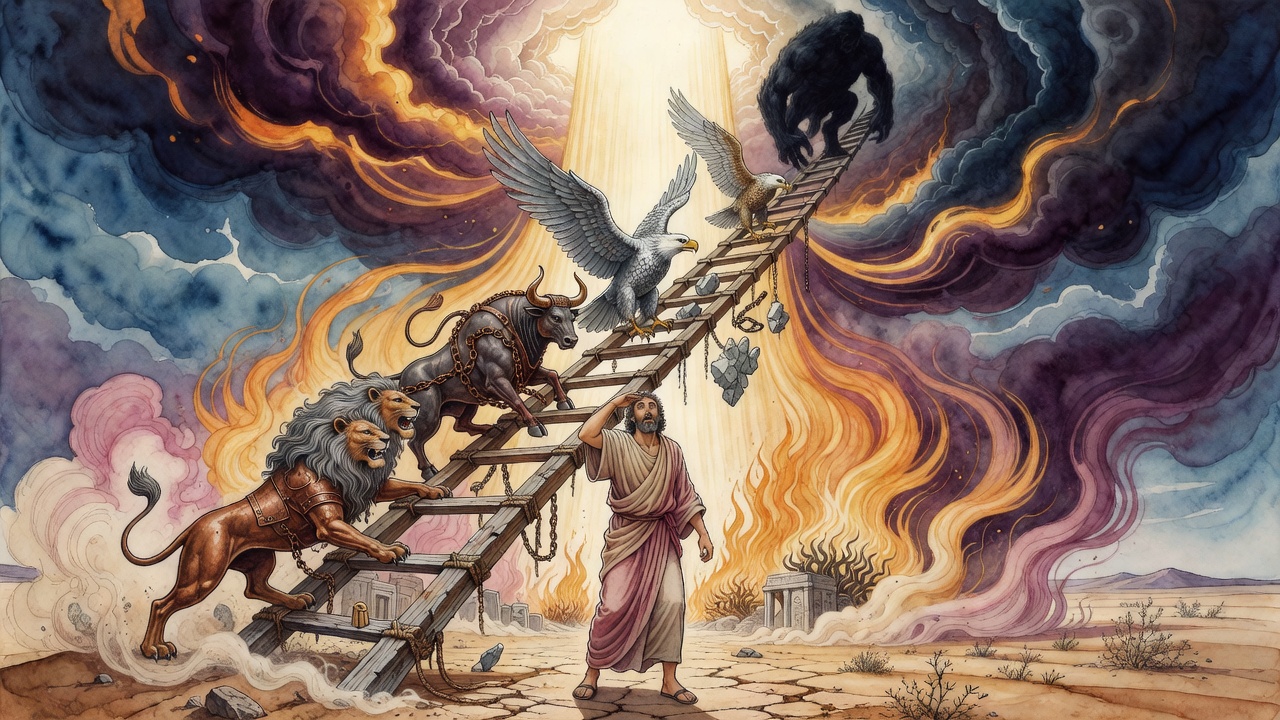
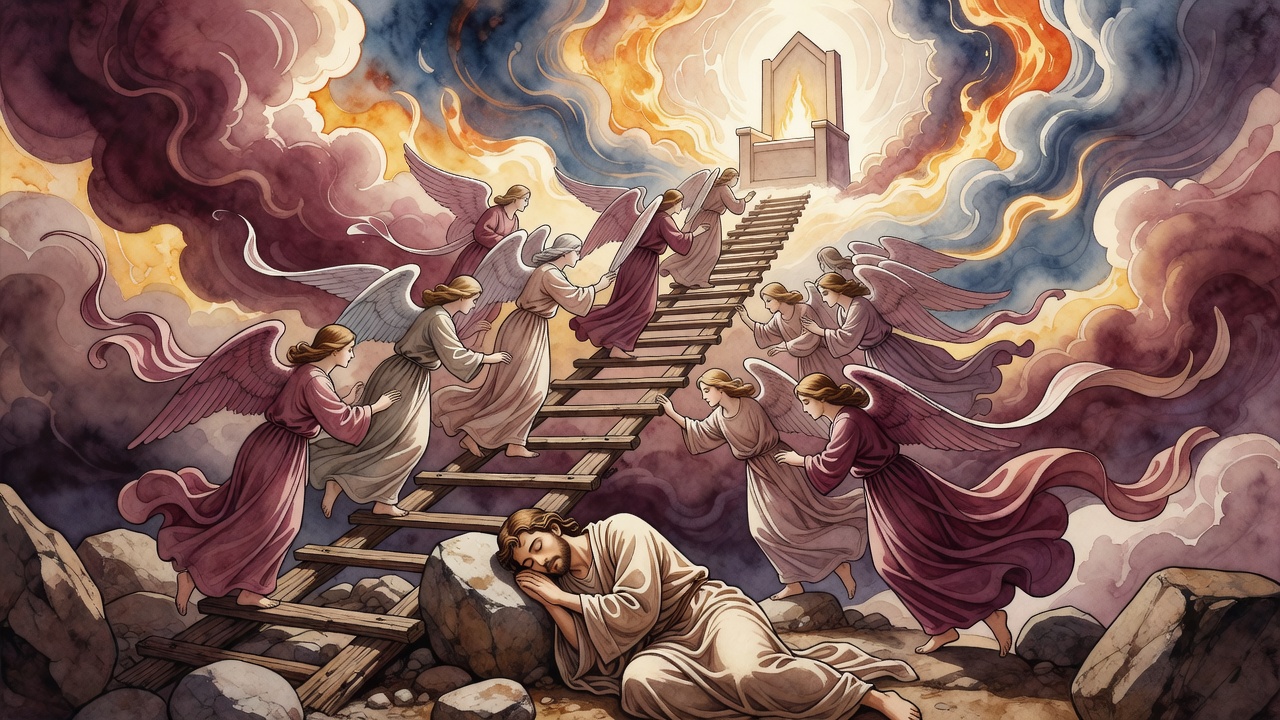
A ladder stood on the earth where Jacob lay, and its top leaned into heaven. On its rungs the angels were moving, some climbing, some coming down, and every one of them turned toward the man asleep at its foot. They were not passing him by. They were coming for the sight of his face.

Something in that sleeping face stopped them. It was familiar. Not the way a stranger's face turns out to be familiar after a moment. Familiar the way a thing is familiar when it has stood before an angel every hour of that angel's existence. They had seen this face in the highest place there is, and they had never once seen it wear dust.

Michael Knew the Face on the Throne

Among them came Michael.

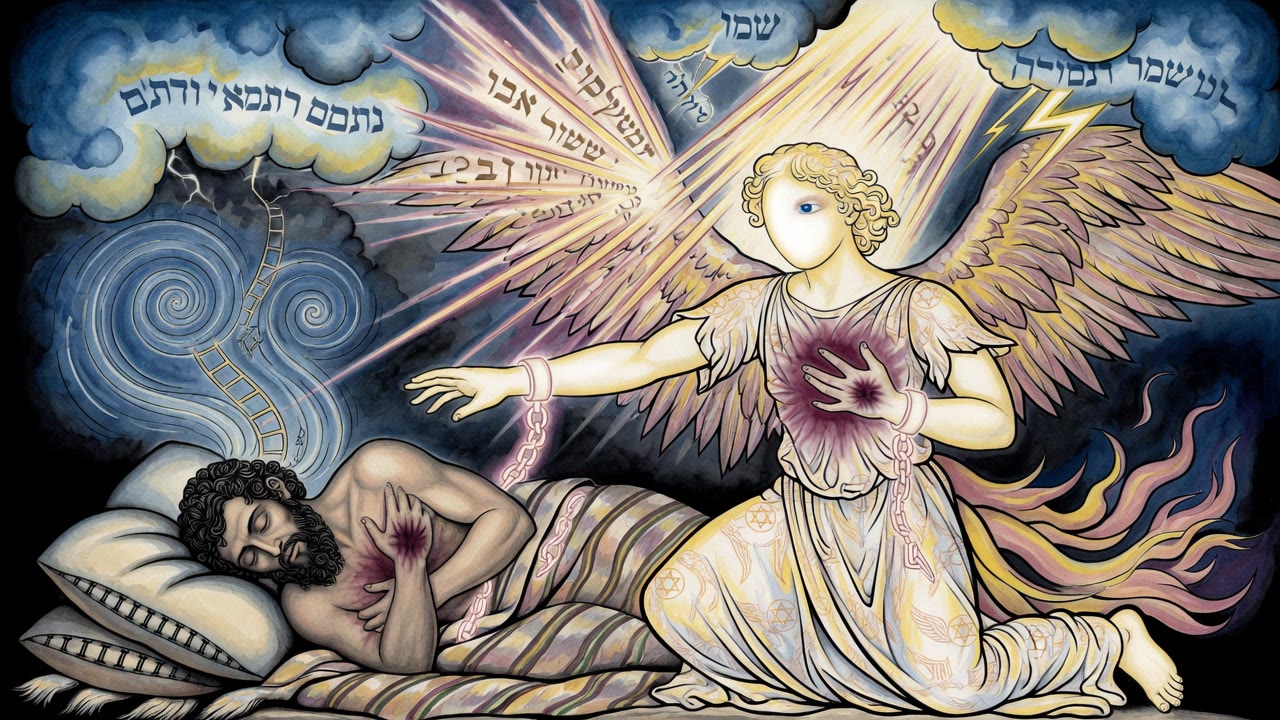
Michael knew the road between the earth and the Throne better than any of them, because he was the one who carried the chosen up it. He had lifted mortals from the ground, set them before the seat of glory, and spoken for them there. He knew what stood at the center of heaven. Beneath the Throne the living creatures that bear it lift their faces without rest, and one of those faces belongs to a man. That face is graven into the very seat of God, kept in the place nothing unclean can reach.

Now Michael looked at the fugitive on the stones, and then at the face he had served beneath since before the world held any people at all, and they were the same face. The exile bleeding hours on a cold mountain was the man engraved into the Throne of Glory.

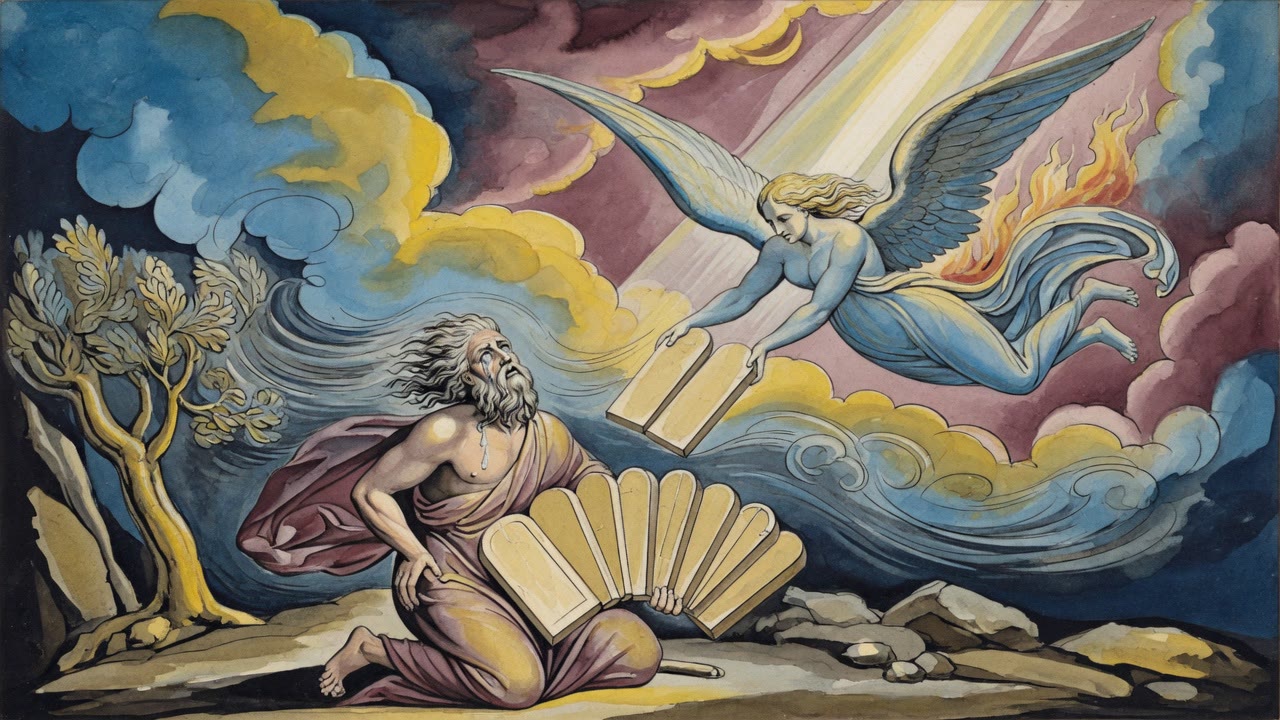
One day Michael would come down this same ladder for a son not yet born. He would gather up a child of Jacob's line and carry him before the seat and say, "Sovereign of all the universe, this is Thy lot and the portion of Thy works." One day the right hand of God would stretch out over one of this sleeper's sons and set him to minister before the Throne the way the angels minister. All of it was folded into the tired face on the rock, and Michael had recognized the first of it.

The Hosts Came Down to Look

The angels raced.

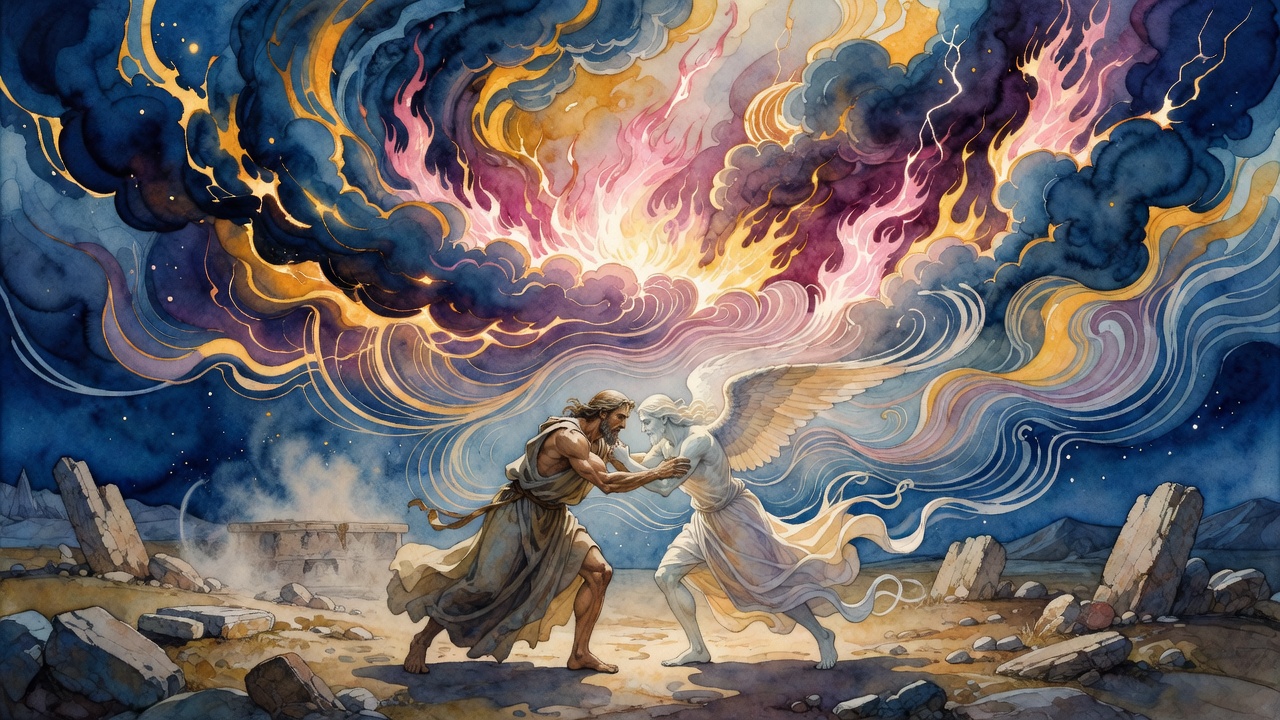
They climbed to set the two faces side by side, the one below and the one above, and then they streamed back down to look again, up and down the rungs, checking the sleeper against the image they had always known. The man did not stir for all the traffic passing over his body. He never learned that heaven had crowded the ladder to see whether a hunted shepherd could truly be the face at the center of everything. Above him it was carved into the Throne. Below him it breathed in the dirt. The same face, exactly.

The Kingdoms Climbed and Edom Would Not Come Down

Then the ladder showed him more than angels.

On its rungs the guardian princes of the kingdoms began to climb, and Jacob watched each one rise and each one fall. The prince of Babylon went up seventy rungs and came down. The prince of Media climbed fifty-two and came down. The prince of Greece rose one hundred eighty and came down. Every ascent had its number, and every number had a floor waiting beneath it.

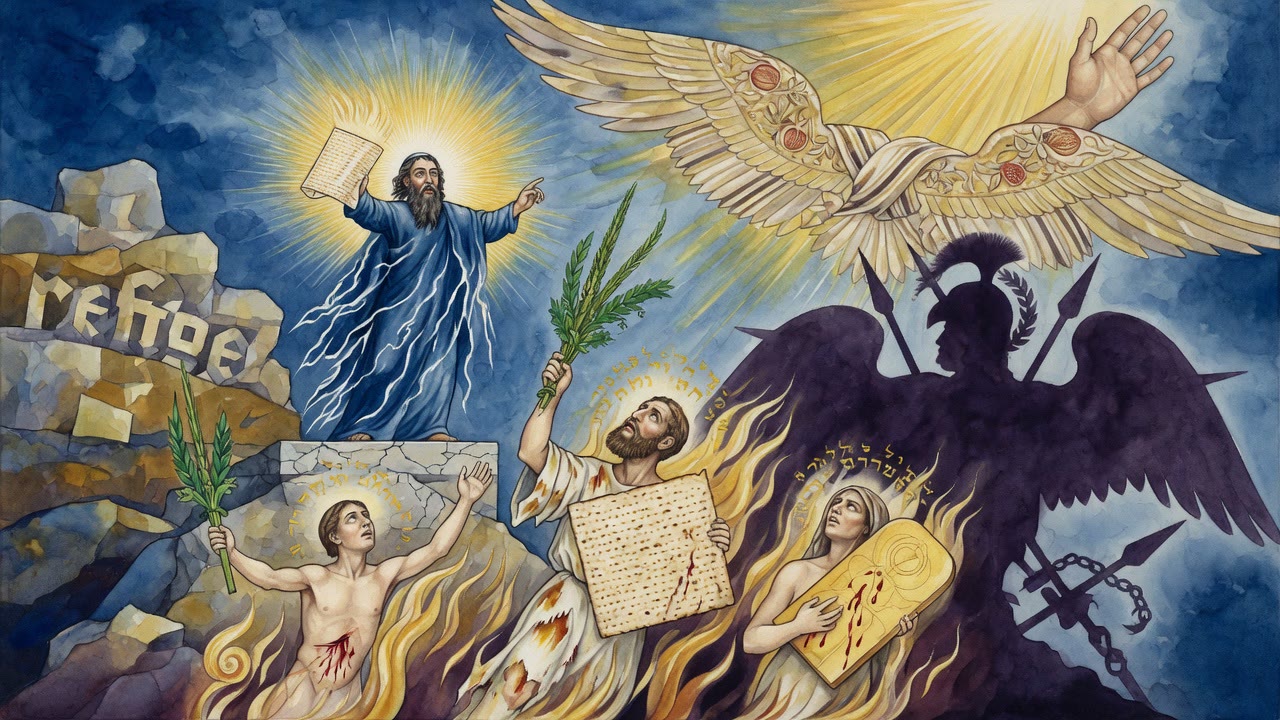
Then the prince of Edom began to climb, and he did not stop. Higher than Babylon. Higher than Greece. He kept rising, and from the rungs he cried out, "I will ascend above the heights of the clouds. I will be like the Most High." He would not come down. He meant to hang there above every other power forever, in the place kept for one seat only.

Jacob answered him from the ground. "You will be brought down to Sheol, to the lowest parts of the pit." And a voice above the ladder answered as well, that though Edom set its nest as high as the eagle among the stars, it would be torn down from there.

Jacob woke on the mountain with one stone under his head where twelve had been. His brother still wanted him dead. The road still ran toward Laban. He gathered himself up poor and afraid and alone, and he carried out of that night the one thing the angels had come down to confirm. His face was already in heaven. It had been there the whole time.


← All myths
From the tradition

Sources

2 sources

The texts behind this telling. Some cards carry a translation of the source; others are our own retelling of it, and each card says which. Every card links out to the original.

Pirkei DeRabbi Eliezer 35:6Pirkei DeRabbi Eliezer

Retold in our words. Read the original at the link below.Pirke de Rabbi Eliezer, trans. Rabbi Gerald Friedlander, London (1916) · CC-BY

Tonight, It centers on Jacob, later known as Israel, and a pivotal dream he had while resting his head on a rather unusual pillow.

The story goes that Jacob, in his travels, took twelve stones from the altar where his father Isaac had been bound – a site imbued with profound spiritual significance. These weren't just any stones. They were stones from the very place where his father nearly became a sacrifice. He arranged them beneath his head, intending them as a reminder that twelve tribes would descend from him. And then, something incredible happened. These twelve individual stones miraculously fused into one. This was a sign: that all twelve tribes were destined to become a unified people, unique and singular on the earth. As it says in (1 (Chronicles 17:2)1), "And who is like thy people Israel, a nation that is alone on the earth?"

In Rabbi Levi, that very night, God revealed profound visions to Jacob. He showed him a ladder stretching from earth to heaven. As (Genesis 28:12) describes, "And he dreamed, and behold a ladder set up on the earth, and the top of it reached to heaven." Angels were ascending and descending, beholding Jacob's face.

Why his face, specifically? The text offers an incredible detail: the angels recognized a resemblance between Jacob's face and the face of the Chayyah – the holy creatures that support God's Throne of Glory. Angels ascending from earth, catching a glimpse of Jacob's face, and seeing reflected there the divine image itself. This suggests a profound connection between Jacob, his descendants, and the divine realm.

The vision didn't stop there. God revealed to Jacob the rise and fall of the four kingdoms that would dominate Jewish history: Babylon, Media, Greece, and Edom (often associated with Rome). He saw the "princes" or perhaps we can think of them as the spiritual representatives of these kingdoms, ascending and descending on the ladder.

Babylon ascended seventy rungs, then descended. Media climbed fifty-two, only to fall. Greece soared to 180 ascents before its decline. But then came Edom. This prince ascended, and unlike the others, he did not descend. Instead, he proclaimed, "I will ascend above the heights of the clouds; I will be like the Most High" (Isaiah 14:14).

This is a powerful image of arrogance and ambition. The prince of Edom seeks to usurp God's place, to remain perpetually elevated. Jacob, witnessing this, retorts, "Yet thou shalt be brought down to Sheol, to the uttermost parts of the pit" (Isaiah 14:15). And God Himself adds, even if Edom "shouldest make thy nest as high as the eagle" (Jeremiah 49:16), it will not last.

What are we to make of this dream? It’s more than just a prediction of future events. It’s a revelation of the spiritual forces at play in history. It's a reminder that even the most powerful empires are ultimately subject to God's will. It's a promise that even when darkness seems to prevail, there is hope for redemption.

And it all began with a man, a dream, and twelve stones that became one. A reminder that unity, destiny, and the divine are often intertwined in the most unexpected ways. What "stones" are you carrying with you? What dreams might they unlock?

Full source
Pirkei DeRabbi Eliezer 37:7Pirkei DeRabbi Eliezer

Retold in our words. Read the original at the link below.Pirke de Rabbi Eliezer, trans. Rabbi Gerald Friedlander, London (1916) · CC-BY

It’s a fascinating story that takes us from the biblical Jacob to the very Throne of Glory, with a little help from the angel Michael.

In Pirkei DeRabbi Eliezer, a fascinating work of aggadic literature, the key lies in the concept of the tithe – the offering of one-tenth. Rabbi Ishmael points out that, generally, the tithe is only taken from things that can be seen. But Jacob, our patriarch, was different. He anticipated the law.

He started tithing even with Benjamin, who wasn't even born yet, still nestled safely in his mother’s womb! And then there was Levi. Levi was reckoned as holy to the Lord, with scripture declaring, "The tenth shall be holy unto the Lord" (Leviticus 27:32). But what made Levi so special?

This is where the story gets truly amazing. The angel Michael, no less, descends from the heavens. He takes Levi, a mere mortal child, and brings him before the Throne of Glory! Can you imagine?

Michael then speaks before the Holy One, blessed be He, saying, "Sovereign of all the universe! This is Thy lot, and the portion of Thy works." Levi is presented as belonging to God.

And God responds! He extends His right hand and blesses Levi, decreeing that the sons of Levi will minister on earth before Him, just like the ministering angels in heaven. That’s quite the promotion, wouldn’t you say?

But it doesn't end there. Michael, ever the insightful advocate, continues, "Sovereign of all worlds! Do not those who serve the king have provision of their food given to them?" A fair point. You can't expect someone to serve without providing for their needs.

And so, God bestows upon the sons of Levi all the holy things which accrue to His Name. As (Deuteronomy 18:9) says, "They shall eat the offerings of the Lord made by fire, and his inheritance." They were to be supported by the offerings brought to the Temple, ensuring they could dedicate themselves fully to their sacred duties.

So what does it all mean? This passage from Pirkei DeRabbi Eliezer beautifully illustrates the special relationship between the tribe of Levi and God. It shows us how Levi's dedication, acknowledged and blessed by God Himself, led to the Levites' unique role in serving in the Temple and being supported by the community. It's a powerful reminder that dedication and service to something greater than ourselves can lead to unexpected and profound blessings. And sometimes, even a trip to the Throne of Glory!

Full source