Parshat Emor6 min read

The Evil Inclination Asked Who Fed God Before the Altar

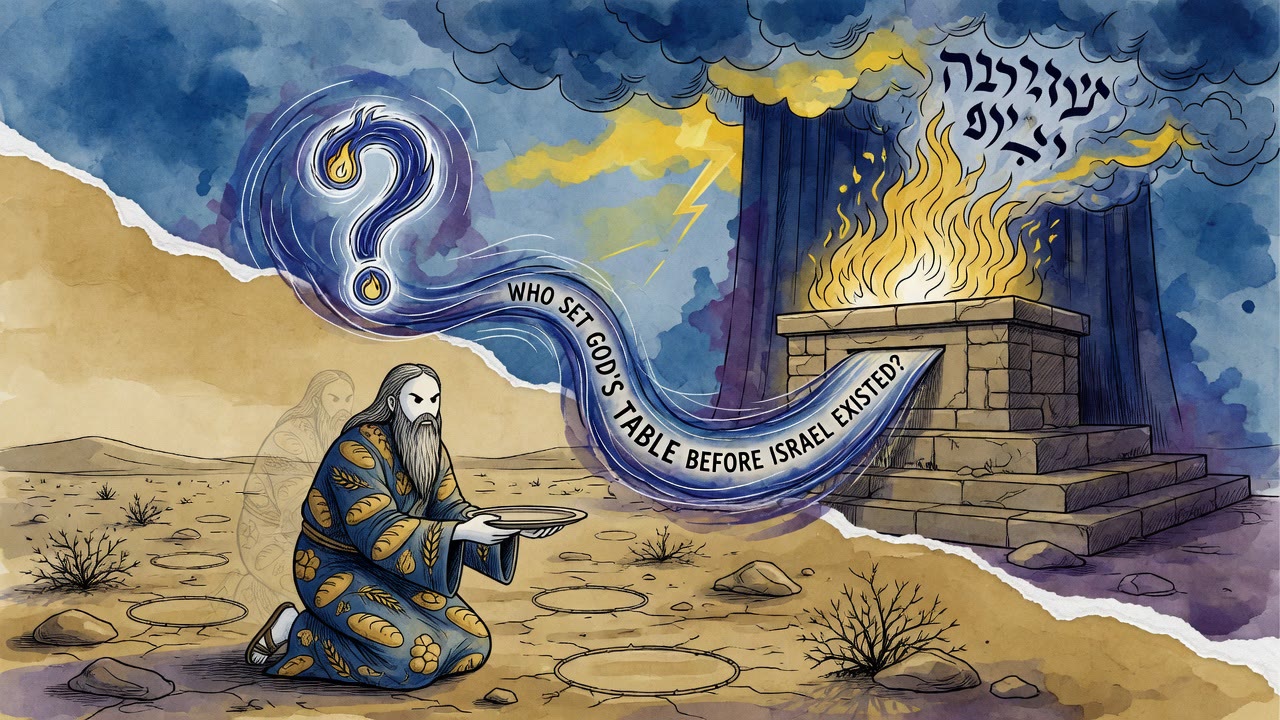
A voice at the ramp asks who set God's table before Israel existed. The answer is a man of bread who spent a hundred and twenty days where nothing eats.

Curated by Arthur · Told by Maggid ·
Table of Contents
  1. The Whisper Beside the Eight-Day Calf
  2. The Man of Bread Who Went Up Past the Clouds
  3. The Second Whisper and the Altar Nobody Built on Sinai
  4. Water Enough for the World in One Cupped Hand
  5. The Lamp Kindled Out of the Darkness on the Deep
  6. The Smoke That Nothing Leaned Down to Take
The Evil Inclination Asked Who Fed God Before the Altar Click for full size

The Whisper Beside the Eight-Day Calf

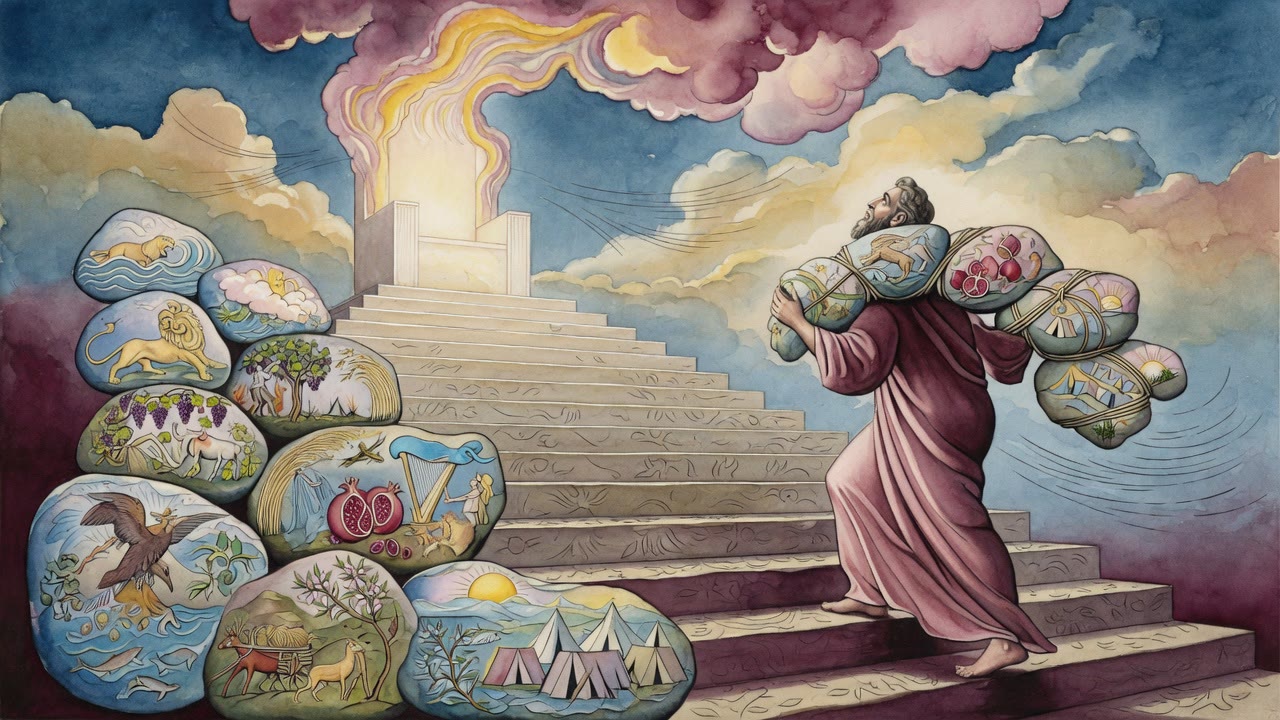
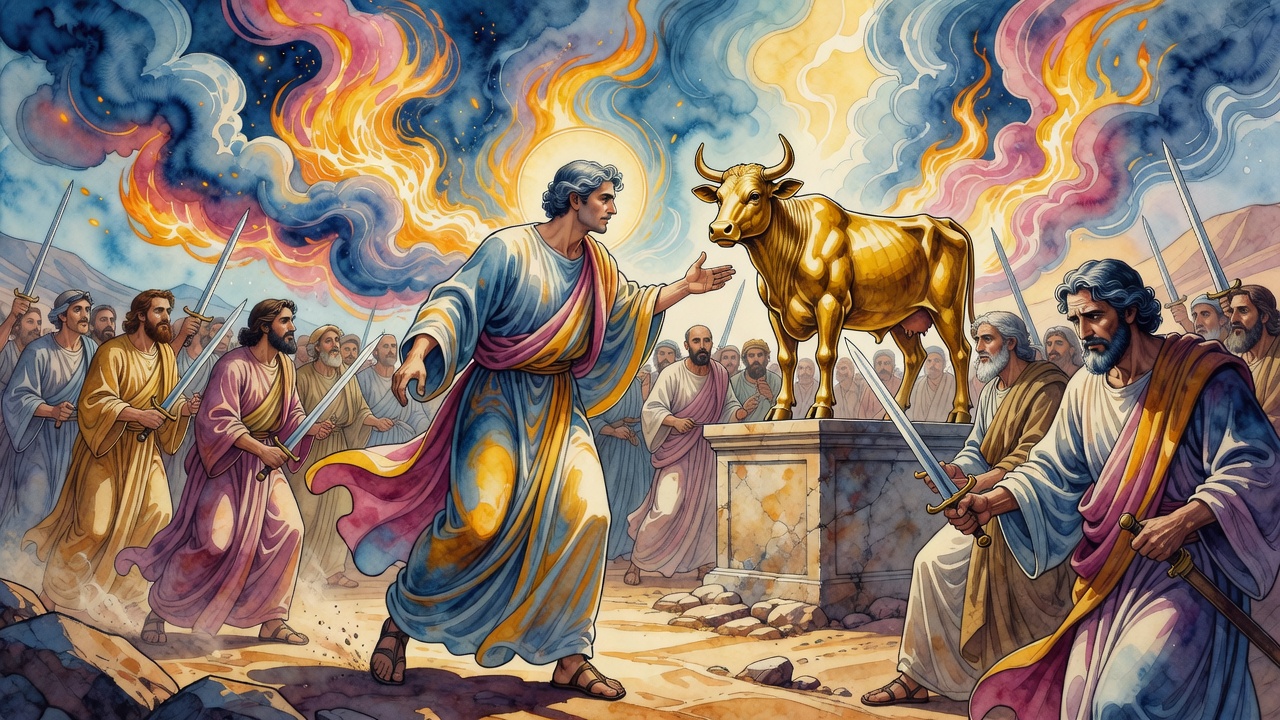
The calf was eight days old and walked badly. Twice on the ramp the man had to push a hand under its chest to keep it off the stones. Smoke from the dawn offering hung low over the court of God. It smelled of cedar and burnt fat.

Something climbed the ramp beside him carrying nothing.

"Who fed Him before you were born?" it asked.

The man kept climbing.

"Before Israel. Before there was a court, or a ramp, or a man with a calf under his arm. Who slaughtered for Him then? Who arranged His table?" The yetzer hara (יצר הרע), the evil inclination, never shouts. It waits until a man's arms are full. "If He ate then, somebody cooked for Him. If He did not eat then, why does He want this out of you now?"

The man had no answer. What he was given instead was a witness.

The Man of Bread Who Went Up Past the Clouds

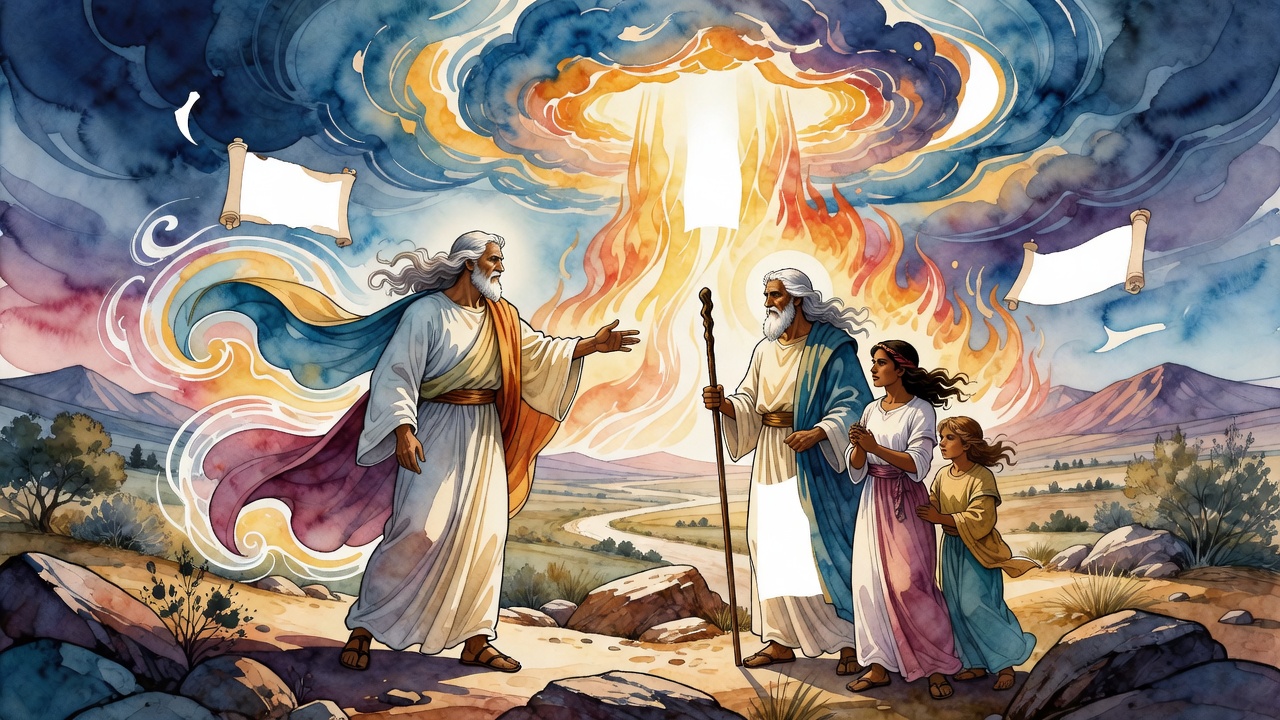
Moses ate. He had eaten in Pharaoh's house off painted dishes and in Jethro's tent in Midian, and when he climbed into the cloud on Sinai his body came with him, appetites and all.

The cloud closed behind him.

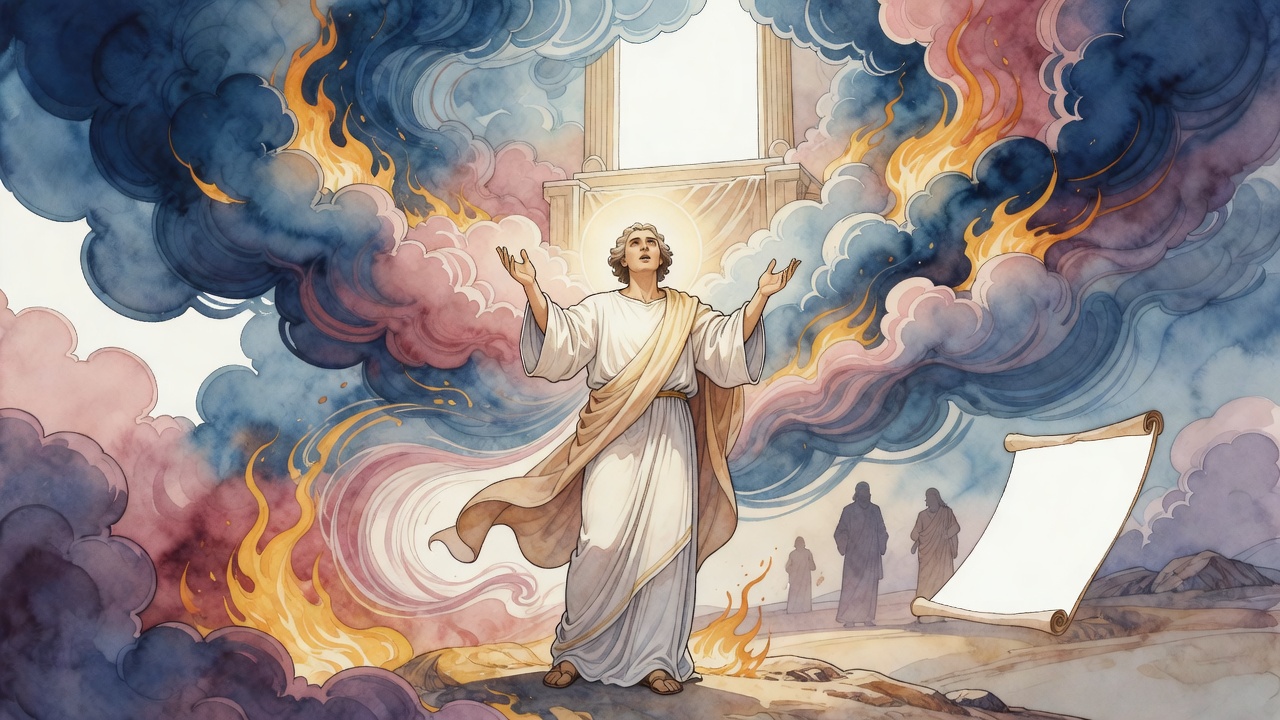
On the first day his hand went out for bread from pure habit and closed on the fold of his own robe. There was no bread. No ovens above the firmament, no coals, no smell of anything roasting anywhere in that country of light. He listened for the sound a knife makes at a throat, the sound that filled every court in the world below at dawn, and heard nothing at all. The creatures around the Throne stood and sang and never once stopped to be fed.

Forty days. Then forty more. Then forty after those.

A hundred and twenty days in a place with no table. He neither ate bread nor drank water (Exodus 34:28), his knees did not buckle, and somewhere in that long stretch his stomach stopped asking, because there was nothing over the clouds for it to ask for. He came down with a face the people could not look at.

The Second Whisper and the Altar Nobody Built on Sinai

The evil inclination came back sharper, the way it always does.

"Grant that he starved gracefully up there. What of it? If there were no eating and drinking in front of Him, He would never have told you to cut a bull's throat and pour wine into a fire. Nobody orders a dinner he cannot swallow."

Rabbi Shimon ben Lakish put both hands flat on the table when he answered that one.

"The continual burnt offering instituted at Mount Sinai" (Numbers 28:6), he said. "So who offered sacrifices on Mount Sinai?"

Nobody answered, because no altar was ever raised on that mountain and no animal was ever dragged up its slope. The only thing that went up Sinai and came down again was a man.

"Go and ask Moses whether there was food and drink before the Holy One," Ben Lakish said. "And when he tells you there was none, ask why the daily offering was laid on your shoulders at all. It was laid there to do you good."

Water Enough for the World in One Cupped Hand

Rabbi Hiyya bar Abba made the same case with his hands.

He cupped them and held them out the way a big man does at a stream, thirsty, dust in his beard. "How much does he drink that way?" he asked. "Ten handfuls? Six? Four? Nobody swallows less than two." He tipped the empty water of his palms into his mouth and let the room watch a strong man's thirst.

Then he opened the other hand. "Who has measured the waters in the hollow of His hand?" (Isaiah 40:12). Every sea. The rain still standing in the clouds and the water sleeping under the earth. All of it lies in the hollow of one hand and does not fill it.

"A hand like that has never once been thirsty," he said. "So why the bull at dawn, why the wine on the fire? Not to feed Him. To do you good."

The Lamp Kindled Out of the Darkness on the Deep

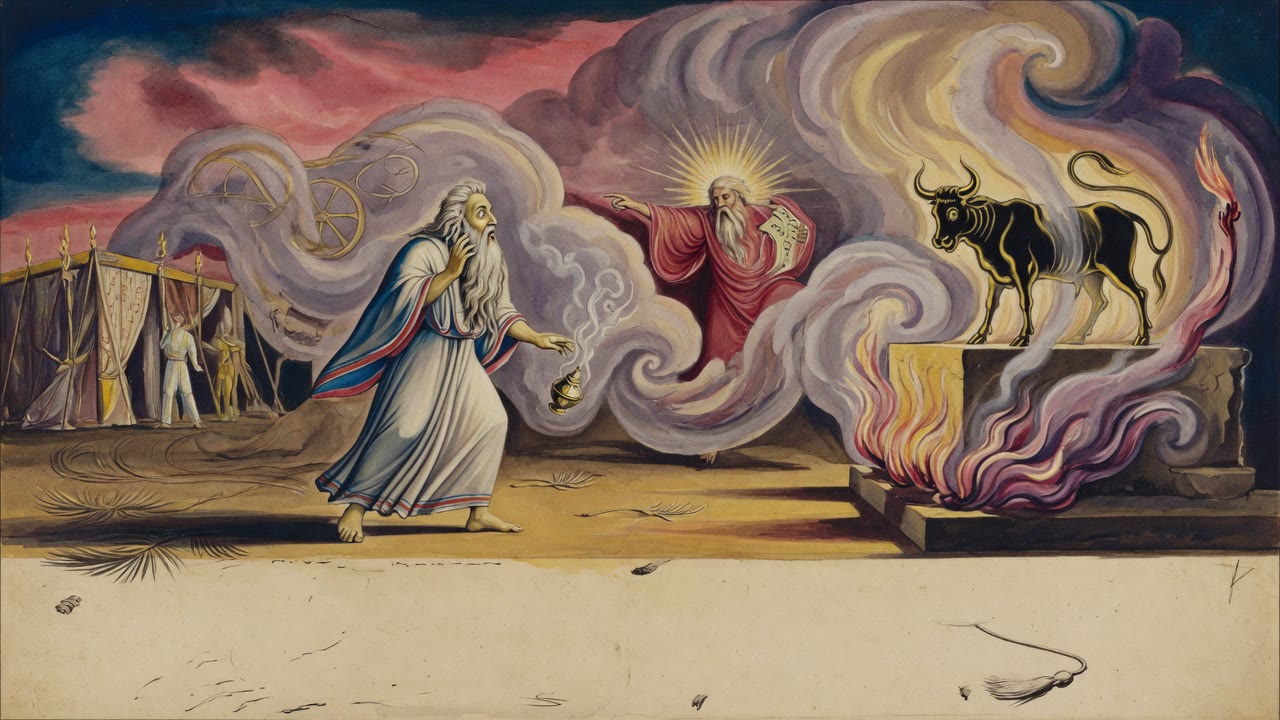
At dusk Aaron stepped up in front of the lampstand with a burning wick in his fingers, because borrowing is the only way a man has ever made fire. Flame from flame. Lamp from lamp. One cup of the menorah (the lampstand) leaning its light into the next until all seven stood up and the walls went gold.

Nobody has ever kindled a lamp out of darkness.

There was a night with nothing to borrow from. Darkness lay on the face of the deep (Genesis 1:2), with no coal anywhere inside it, no spark, no second lamp to lean toward. God said, "Let there be light," and light came up out of the dark itself, struck from a lamp that had never been lit.

The voice that had done that came to Aaron while the wicks were still smoking. "Do I have need of your light?" it asked. "Set the lamp up continually (Exodus 27:20). It rises to lift you, not Me."

The Smoke That Nothing Leaned Down to Take

The man laid both hands on the calf's head and pressed down until the animal quieted under the weight. The knife went across. The blood ran into the basin, the basin went to the corner of the altar, and the fat went up in a smell that carried past the far gate.

The smoke bent east with the wind, thinned, and was gone before it cleared the wall.

Nothing above the wall leaned down to meet it. Nothing up there had ever been hungry, and the man walked back down the ramp with his hands empty and lighter than they had been since morning. Beside him, for the first time since he came through the gate, the voice had nothing left to say.


← All myths
From the tradition

Sources

3 sources

The texts behind this telling. Some cards carry a translation of the source; others are our own retelling of it, and each card says which. Every card links out to the original.

Midrash Tanchuma, Emor 15Midrash Tanchuma

Retold in our words. Read the original at the link below.Townsend 1989 translation of Midrash Tanhuma, S. Buber Recension · CC-BY

(Lev. 22:27), “And from the eighth day on [it shall be acceptable for an offering by fire to the Lord].” So that your [evil] drive not lead you astray by saying that there is eating and drinking in front of Him. Who sacrificed to Him before Israel arose? David said (in Ps. 89:7), “For who in the skies is comparable (ya'arokh) to the Lord?” [This is to mean], who offered sacrifices to Him? R. Abbin the Levite said, “[This verse means,] who is like unto the Holy One, blessed be He, in sustaining orphans and feeding the hungry? After all, this word (ya'arokh) can only be a word concerning sustenance, since it is stated (in Lev. 24:8), ‘On [every] Sabbath day he shall [regularly] arrange (ya'arokh) it (i.e., the bread).’” Another interpretation (of Ps. 89:7), “For who in the skies is comparable (ya'arokh) to the Lord”: Who is like unto the Holy One, blessed be He, in bringing light to the eyes of those in the dark? After all, this word (ya'arokh) can only be a word denoting light, since it is stated (Lev. 24:4), “He shall set up (ya'arokh) the lamps upon the unalloyed lampstand.” Another interpretation (of Ps. 89:7), “For who in the skies is comparable (rt. 'rk) to the Lord”: Who is like unto the Holy One, blessed be He, in clothing the naked? After all, this word (rt. 'rk) can only be a word denoting a garment, since it is stated (in Jud. 17:10), “a suit (rt. 'rk) of clothes and [your] maintenance.” Another interpretation (of Ps. 89:7), “For who in the skies [is comparable (ya'arokh) to the Lord]”: Who is like unto the Holy One, blessed be He, in waging war for Israel? After all, the word, ya'arokh, can only be a word denoting war, since it is stated (in Gen. 14:8), “and they marshalled (ya'arokh in the plural) for battle with them.” Another interpretation (of Ps. 89:7), “For who in the skies is comparable to the Lord”: The Holy One, blessed be He, said, “If your [evil] drive comes and says to you, ‘Who sacrificed to (fed) the Holy One, blessed be He, before the world was created,’ say to him, ‘Consider that Moses ascended to the sky and spent a hundred and twenty days there. Let him tell you whether they were sacrificing to the Holy One, blessed be He. And in addition he was accustomed to eat; but when he ascended to Me, he saw that there is no eating and drinking in front of Me, and so he also did not eat, as stated (in Exod. 34:28), “And he was there with the Lord [forty days and forty nights; he neither ate bread nor drank water].”’” R. Simeon ben Laqish said, “If your [evil] drive comes to say to you, ‘If there were no eating and drinking before Him, He would not have told me to sacrifice and offer libations to Him’; [then ponder] what is written (in Numb. 28:6), ‘The continual burnt offering instituted at Mount Sinai’: Did they offer sacrifices on Mount Sinai? [No.] Rather observe that it was Moses who went up onto Mount Sinai. Let him tell you whether there were food and drink before Me. And so why did I trouble you and tell you to bring a daily sacrifice? In order to benefit you.” R. Hiyya bar Abba said, “When a mighty man who is walking on the road is thirsty and goes to drink water, how much does he drink with his hands? Ten handfuls? Six handfuls? Four handfuls? Less than two he does not drink. Now all the water that is in the world would be a filling for the hollow of the Holy One, blessed be He's, hand, as stated (in Is. 40:12), ‘Who has measured the waters in the hollow of His hand?’ [It is so written] in order to make known that for Him there is no eating or drinking. [Then] why did He tell me to offer a sacrifice? In order to benefit you.” Ergo (in Lev. 22:27), “When a bull or a sheep or a goat [is born… and from the eighth day on it shall be acceptable for an offering by fire to the Lord].” (Lev. 22:27), “And from the eighth day.” This text is related (to Eccl. 3:19), “As for the fate of humans and the fate of beasts, [they have the same fate; as the one dies, so does the other die. They all have the same lifebreath, but the superiority of the human over the beast is nil ('yn)].” It is written concerning the human (in Deut. 22:11), “You shall not wear interwoven stuff, wool and flax together.” It is also written concerning the beast (ibid., vs. 10), “You shall not plough with an ox and an ass together.” (Eccl. 3:19:) “[They] all have the same fate.” Just as the human contracts uncleanness, the beast also contracts uncleanness. It is written concerning the human (in Numb. 19:11), “One who touches the corpse of any human being shall be unclean.” Also concerning the beast (in Lev. 11:39), “whoever touches its carcass shall be unclean [...].” (Eccl. 3:19:) “As the one dies, so does the other die.” Concerning the human (in Lev. 20:16), “you shall kill the woman”; and concerning the beast (in vs. 15), “and you shall kill the beast.” (Eccl. 3:21:) “Who knows the lifebreath of a human that rises upward and the lifebreath of a beast that goes down into the earth?” Because the lifebreath of the human is given from above, concerning it, a rising up is written. And because the beast is given from below, concerning it, a going down is written. (Eccl. 3:19, cont.) “But the superiority of the human over the beast is 'yn (i.e., nil).” What is the meaning of 'yn? That [the human] speaks, but [the beast] does not ('yn) speak. And moreover, while there is knowledge in the human, in the beast there is no ('yn) knowledge. And moreover, while the human knows the difference between good and evil, the beast does not ('yn) know the difference between good and evil. And moreover, the human gets a reward for his works, but the beast does not ('yn) get a reward for its work. And moreover, when the human dies they care for him and he is buried, while the beast is not ('yn) buried. Ergo (in Eccl. 3:19), “but the superiority of the human over the beast is 'yn.” What is written concerning the human (in Lev. 12:2-3)? “When a woman emits her seed…. And on the eighth day [the flesh of his foreskin] shall be circumcised.” But about the beasts it is written (in Lev. 22:27), “When a bull or a sheep or a goat… and from the eighth day on it shall be acceptable [for an offering by fire to the Lord].”

Full source
Midrash Tanchuma Buber, Emor 20:5Midrash Tanchuma Buber, Emor

Translation of the source text.Midrash Tanchuma (Buber), Public Domain, on Sefaria · CC-BY-SA

Another interpretation of (Psalms 89:7) "For who in the skies can be compared to the Lord?" If your evil inclination comes to say to you, "Who was offering sacrifices to the Holy One, blessed be He, before the world was created?", [say to it:] Behold, Moses went up to the firmament and spent there a hundred and twenty days. Let it tell you whether they were offering sacrifices to the Holy One, blessed be He. And not only that, but he was accustomed to eating, yet once he went up to Me, [he saw that there is no eating or drinking on high]; he neither ate nor drank, [as it is said (Exodus 34:28): "And he was there with the Lord forty days and forty nights; he ate no bread and drank no water."]

Full source
Midrash Tanchuma Buber, Beha'alotcha 8:1Midrash Tanchuma Buber, Beha'alotcha

Translation of the source text.Midrash Tanchuma (Buber), Public Domain, on Sefaria · CC-BY-SA

Another interpretation of "in front of the menorah" (Numbers 8:2): Flesh and blood kindles a lamp from a burning lamp; can one possibly kindle a lamp out of darkness? Yet the Holy One, blessed be He, made a lamp give light out of the darkness, as it is said, "and darkness was upon the face of the deep" (Genesis 1:2). What is written after it? "And God said, Let there be light" (Genesis 1:3). And out of the darkness I brought forth light. Do I, then, have need of your light? And why did He command it? Only for the sake of your exaltation, "to set up a lamp continually" (Exodus 27:20).

Full source