5 min read

The Newborn That Waited for the Sabbath Queen

A calf may not climb the altar until Shabbat has passed over it. The king will not see a newcomer before the queen does, and the future is already planted.

Curated by Arthur · Told by Maggid ·
Table of Contents
  1. Seven Days Before the Knife
  2. Human Skin, Beast Skin
  3. The Future Already Done
  4. Four Witnesses Against Doubt
  5. Queen First, Then King
The Newborn That Waited for the Sabbath Queen Click for full size

Seven Days Before the Knife

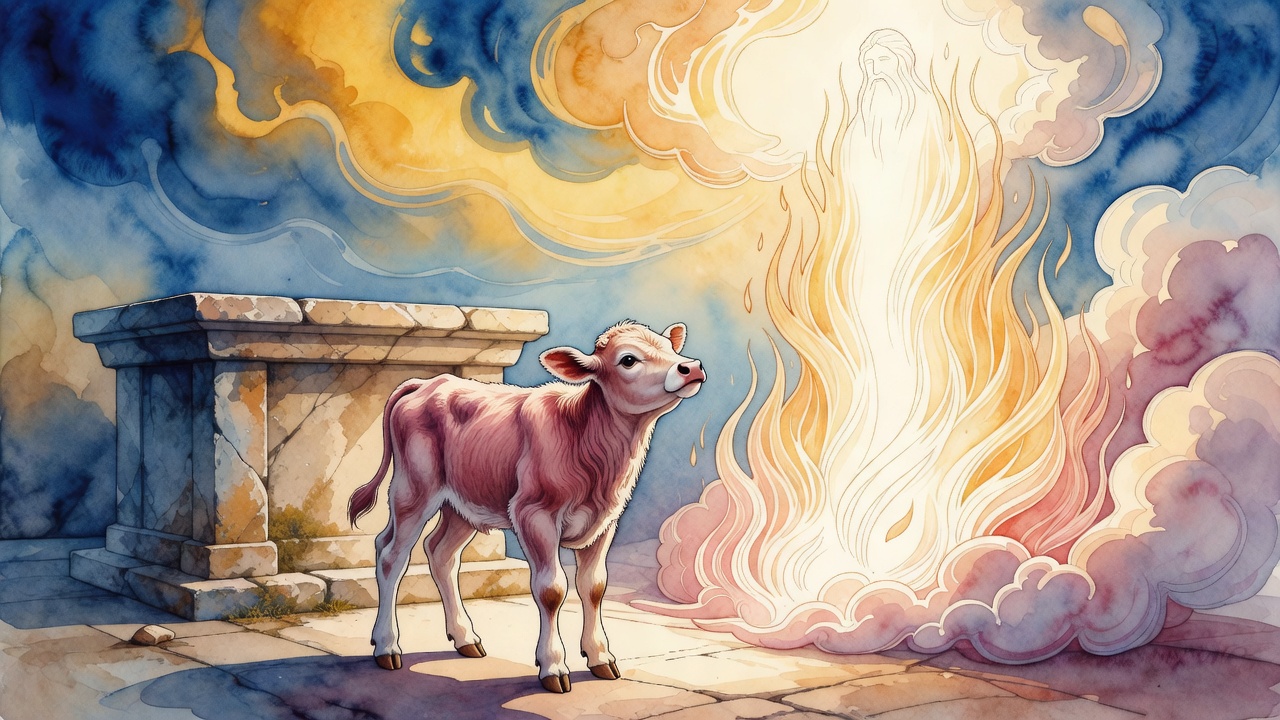
A newborn calf stood under its mother, warm and unmarked by any altar. The law would not take it yet. Seven full days must pass before a bull, sheep, or goat may be brought as an offering. Rabbi Joshua of Sikhnin, in the name of Rabbi Levi, told why with a parable that smells of palace dust.

A king entered one of his provinces and sent out a proclamation at once: let no newcomer who has arrived here look upon my face until he has first beheld the face of the queen, my matron. First her, then me. So the Holy One said to Israel: do not bring a sacrifice before Me until the Sabbath has first passed over it. There is no stretch of seven days that does not contain a Sabbath. The newborn must let the Sabbath Queen pass over it before it is fit to draw near to the King.

Human Skin, Beast Skin

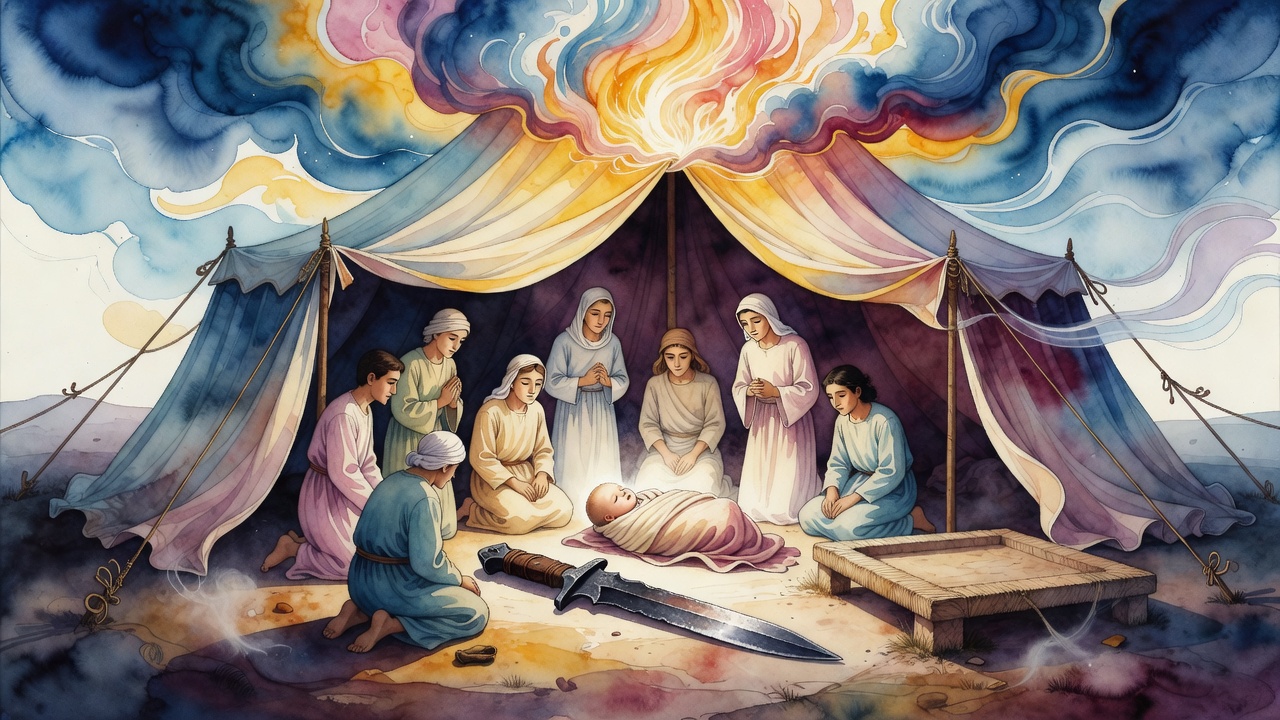
Rabbi Isaac drew the laws together as one. Of the human it is written, "and on the eighth day he shall be circumcised." Of the beast it is written, "from the eighth day onward it shall be accepted." Both alike must first be greeted by the Sabbath before they are welcomed before the King. A boy's covenant blood and a calf's altar blood share a rhythm. Time itself must host the Queen before either body is marked for heaven's service.

The camp that keeps this rhythm learns patience in the body. Not every holy act is improved by speed. Some holiness is only holiness after a day of rest has breathed across it.

The Future Already Done

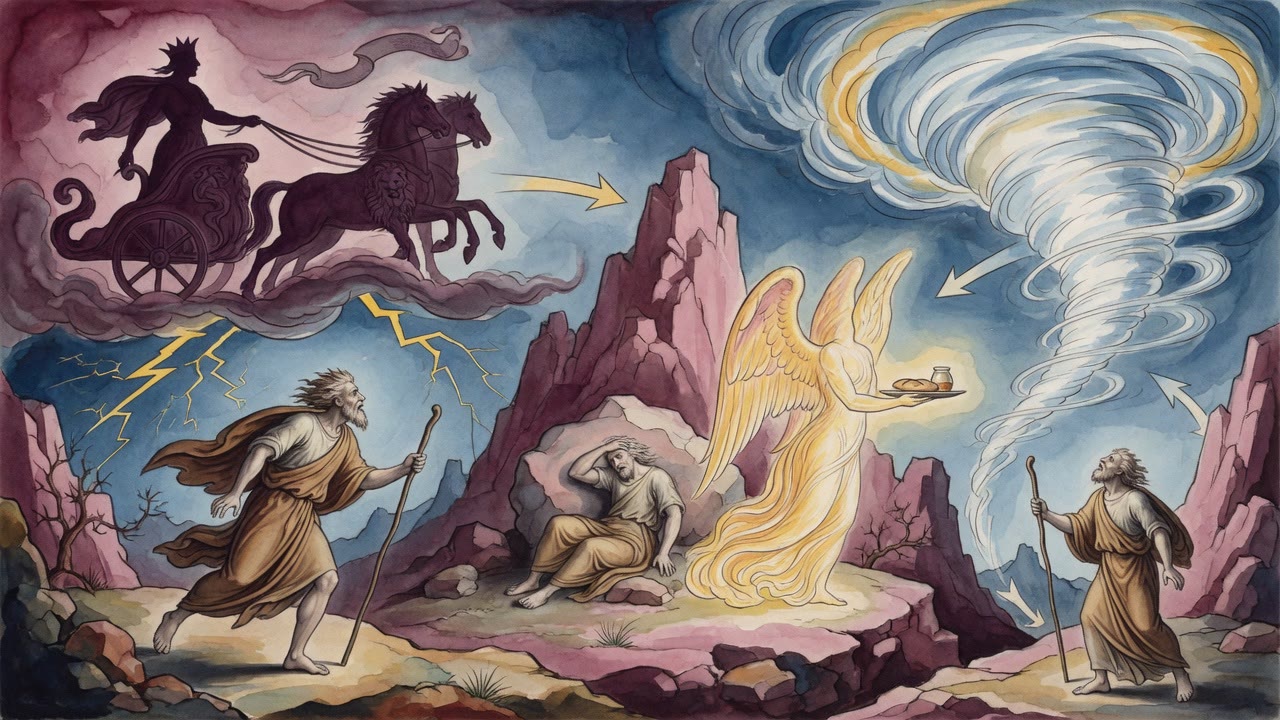
Why the wait at all? The sages heard in it the rhythm of Ecclesiastes: that which has been already is, and that which is to be already has been. Rabbi Yehudah taught: if someone insists that, had Adam never sinned, he would have lived forever, answer him with Elijah, who did not sin and so was taken alive, enduring still. If someone doubts that God revives the dead, point to Elijah, Elisha, and Ezekiel, through whom the dead already rose.

Rabbi Acha, in the name of Rabbi Shmuel bar Nachman, gathered the principle: everything the Holy One will do in the world to come, He has already begun through the righteous here. He will revive the dead; done, through Elijah, Elisha, Ezekiel. He will dry the sea; done, at the Reed Sea under Moses. He will open blind eyes; done, when He opened the servant's eyes for Elisha. He will remember the barren; done, when He remembered Sarah. He will bend kings to Israel; done, when Nebuchadnezzar bowed before Daniel. The future is a seed already planted.

Four Witnesses Against Doubt

When the chief of Ephraim brought his offering, the sages heard David's verse: "Gilead is Mine and Manasseh is Mine, and Ephraim is the stronghold of My head; Judah is My lawgiver." Resh Lakish taught that these four names are four witnesses. Should anyone whisper that the Holy One cannot raise the dead, point to Gilead, for from that land rose Elijah, through whose hand a dead child breathed again. Should anyone say the gates of return are barred, point to Manasseh, the wicked king who prayed from iron chains until God carried him home to Jerusalem and his throne.

Should anyone claim the barren womb lies beyond His reach, point to Ephraim, for from that hill country came Elkanah, whose wife Hannah was remembered. Should anyone insist that no one is plucked from the flames, point to Judah, for from that tribe stood Hananiah and his companions, who walked out of the furnace unburned. Resurrection, repentance, open wombs, rescue from fire: one short verse becomes a chain of proof. The princes do not merely bring silver bowls. They carry evidence that God withholds none of His power.

Queen First, Then King

Hold the calf and the witnesses in one telling. A small life waits for Shabbat the way a newcomer waits for the queen's face. The wait is not empty. It is alignment with a world where the great deeds of the end have already left footprints in the middle of history. Elijah already lifted a child. The sea already stood in walls. Daniel already bent a king's spine. The altar that refuses a six-day-old animal is training Israel to trust sequences heaven has already rehearsed.

When the eighth day comes, the calf may rise toward the fire, and the boy may receive the covenant cut, both having been brushed by the Queen's weekly arrival. Nothing rushed. Nothing missing the order that makes nearness safe. The King will be seen. The future will arrive. Both have already started, and both still ask for the patience of seven counted suns.

In the wilderness that patience was law. In the offerings of the princes it became testimony. In the soul it remains a discipline: let rest pass over the new thing before you call it ready for the highest fire.


← All myths
From the tradition

Sources

3 sources

The texts behind this telling. Some cards carry a translation of the source; others are our own retelling of it, and each card says which. Every card links out to the original.

Midrash Tanchuma Buber, Emor 17:1Midrash Tanchuma Buber, Emor

Translation of the source text.Midrash Tanchuma (Buber), Public Domain, on Sefaria · CC-BY-SA

(Leviticus 22:27:) "And it shall be seven days under its mother." Rabbi Joshua of Sikhnin said in the name of Rabbi Levi: A parable. It is like a king who entered a province, [and issued a proclamation] and said: All the guests who are here shall not see my face until they first see the face of the matron. So too the Holy One, blessed be He, said to Israel: My children, do not offer a sacrifice before Me until the Sabbath has passed over it; for there are no seven [days] without a Sabbath, and there is no circumcision without a Sabbath. Rabbi Isaac said: The law of a person and the law of an animal. [The law of] a person: "and on the eighth day he shall be circumcised" (Leviticus 12:3). [The law of] an animal: "from the eighth day onward it shall be accepted" (Leviticus 22:27).

Full source
Midrash Tanchuma Buber, Emor 12:1Midrash Tanchuma Buber, Emor

Translation of the source text.Midrash Tanchuma (Buber), Public Domain, on Sefaria · CC-BY-SA

[Another interpretation of (Leviticus 22:27): "A bull or a sheep or a goat." This is what Scripture says (Ecclesiastes 3:15): "That which has been already is, etc."] Rabbi Yehudah and Rabbi Nechemyah differed. Rabbi Yehudah says: If a person says to you that, had Adam the first man not sinned, he would have lived and endured forever, say to him: Behold Elijah (etc.) [who did not sin, and he lives and endures forever]. "And that which is to be already has been, etc." (Ecclesiastes there): If a person says to you that the Holy One, blessed be He, revives the dead, say to him: Behold, He has already done so through Elijah, and through Elisha, and through Ezekiel. [And Rabbi Nechemyah says: If a person says to you that the Holy One, blessed be He, will in the future make the sea into dry land, say to him: He has already done so in the days of Moses, as it is said: "But the children of Israel walked on dry land in the midst of the sea, and the waters were a wall to them on their right and on their left" (Exodus 14:29).] And Rabbi Acha said in the name of Rabbi Shmuel bar Nachman: Everything that the Holy One, blessed be He, will do in the time to come, He has already done a portion of it beforehand through the righteous in this world. The Holy One, blessed be He, said: I am destined to revive the dead, I have already done so through Elijah, and through Elisha, and through Ezekiel. The Holy One, blessed be He, said: I am destined to make the sea into dry land, I have already done so: "But the children of Israel walked on dry land" (ibid.). The Holy One, blessed be He, said: I am destined to open the eyes of the blind, it has already been done, as it is said: "And the Lord opened the eyes of the young man" (II Kings 6:17). The Holy One, blessed be He, said: I am destined to remember the barren, it has already been done, as it is said: "And the Lord remembered Sarah, etc." (Genesis 21:1). The Holy One, blessed be He, said: [I am destined to make kings bow down to you, as it is said:] "And kings shall be your foster-fathers, etc." (Isaiah 49:23), it has already been done through Daniel, [for Nebuchadnezzar bowed down to Daniel,] as it is said: "He paid homage to Daniel" (Daniel 2:46).

Full source
Midrash Tanchuma Buber, Nasso 30:1Midrash Tanchuma Buber, Nasso

Translation of the source text.Midrash Tanchuma (Buber), Public Domain, on Sefaria · CC-BY-SA

(Numbers 7:48:) ON THE SEVENTH DAY, THE PRINCE OF THE CHILDREN OF EPHRAIM. This is what Scripture says (in Psalms 60:9): GILEAD IS MINE AND MANASSEH IS MINE, AND EPHRAIM IS THE STRONGHOLD OF MY HEAD; JUDAH IS MY LAWGIVER.

Resh Lakish said: If the disputers should say to you that the Holy One, blessed be He, does not revive the dead, say to them: Behold, Elijah [bears witness] that He revived the dead [through his hand]. Thus: GILEAD IS MINE.

AND MANASSEH IS MINE. If the disputers should say to you that the Holy One, blessed be He, does not receive those who repent, say to them: Behold, Manasseh bears witness that I received him in repentance, as it is stated (in II Chronicles 33:13): AND HE PRAYED TO HIM, AND HE WAS ENTREATED BY HIM [AND HEARD HIS SUPPLICATION] AND RESTORED HIM TO JERUSALEM, TO HIS KINGDOM. Thus: MANASSEH IS MINE.

EPHRAIM IS THE STRONGHOLD OF MY HEAD. If the disputers should say to you that the Holy One, blessed be He, does not remember barren women, [say to them:] Behold, Elkanah [of Mount Ephraim] bears witness that I remembered Hannah his wife, as it is stated (in I Samuel 2:21): FOR THE LORD REMEMBERED HANNAH. Thus: EPHRAIM IS THE STRONGHOLD OF MY HEAD.

JUDAH IS MY LAWGIVER. If a person should say to you that the Holy One, blessed be He, does not rescue from the fire, behold, Hananiah and his companions bear witness that I rescued them from the fire, as it is stated (in Daniel 1:6): AND AMONG THEM, OF THE CHILDREN OF JUDAH, WERE [DANIEL, HANANIAH, MISHAEL, AND AZARIAH]. Thus: JUDAH IS MY LAWGIVER.

Full source