Parshat Vayeshev6 min read

Jacob's Sons Dragged a Live Wolf Home, and It Denied Killing Joseph

The brothers sold Joseph, bloodied his coat, and dragged home a live wolf as proof of the beast that ate him. Then God loosened its tongue.

Curated by Arthur · Told by Maggid ·
Table of Contents
  1. The Oath Sworn Over a Bloody Coat
  2. The Beast They Chose as a Witness
  3. Jacob's Hands on the Wolf's Throat
  4. The Tongue God Loosened
  5. The Stranger Set Free
Jacob's Sons Dragged a Live Wolf Home, and It Denied Killing Joseph Click for full size

The Oath Sworn Over a Bloody Coat

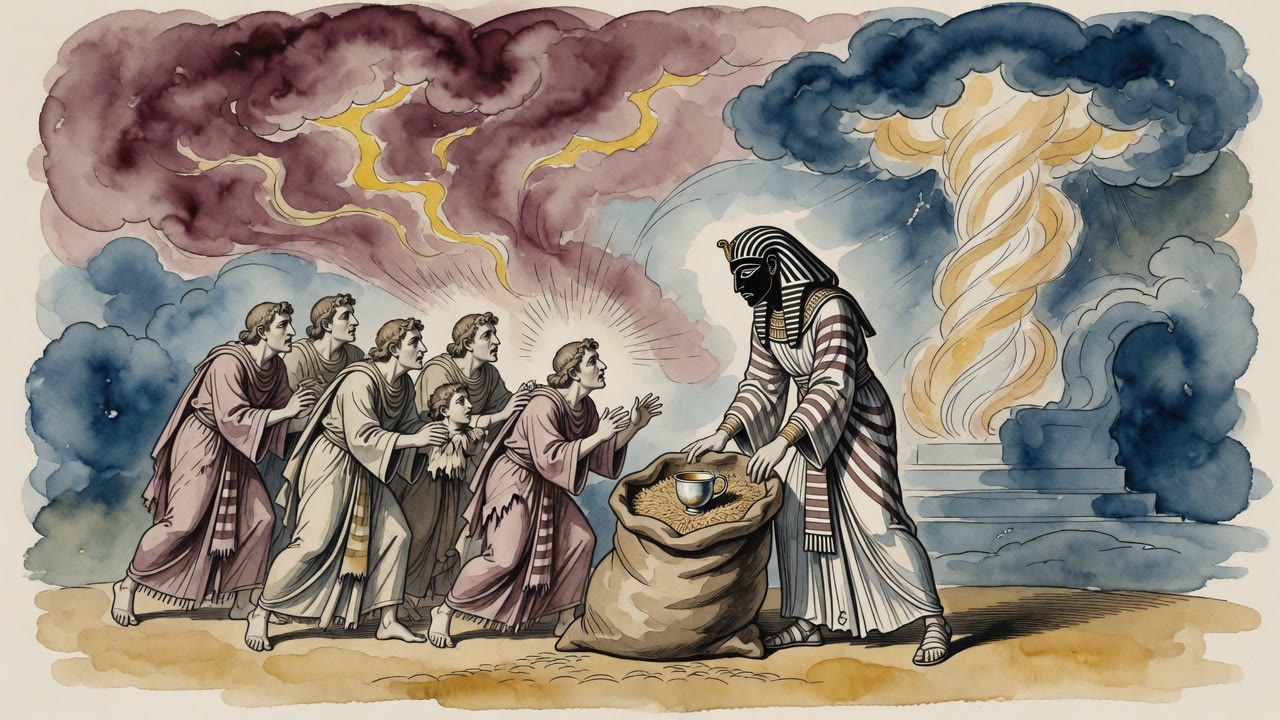
They had already thrown him into the pit and hauled him back up as merchandise. Now, in a field far from their father's tent, the sons of Jacob stood over the lie they still had to build. Joseph was gone, sold for twenty pieces of silver to men on the road to Egypt, and the dirt where he had begged them still held the shape of his knees.

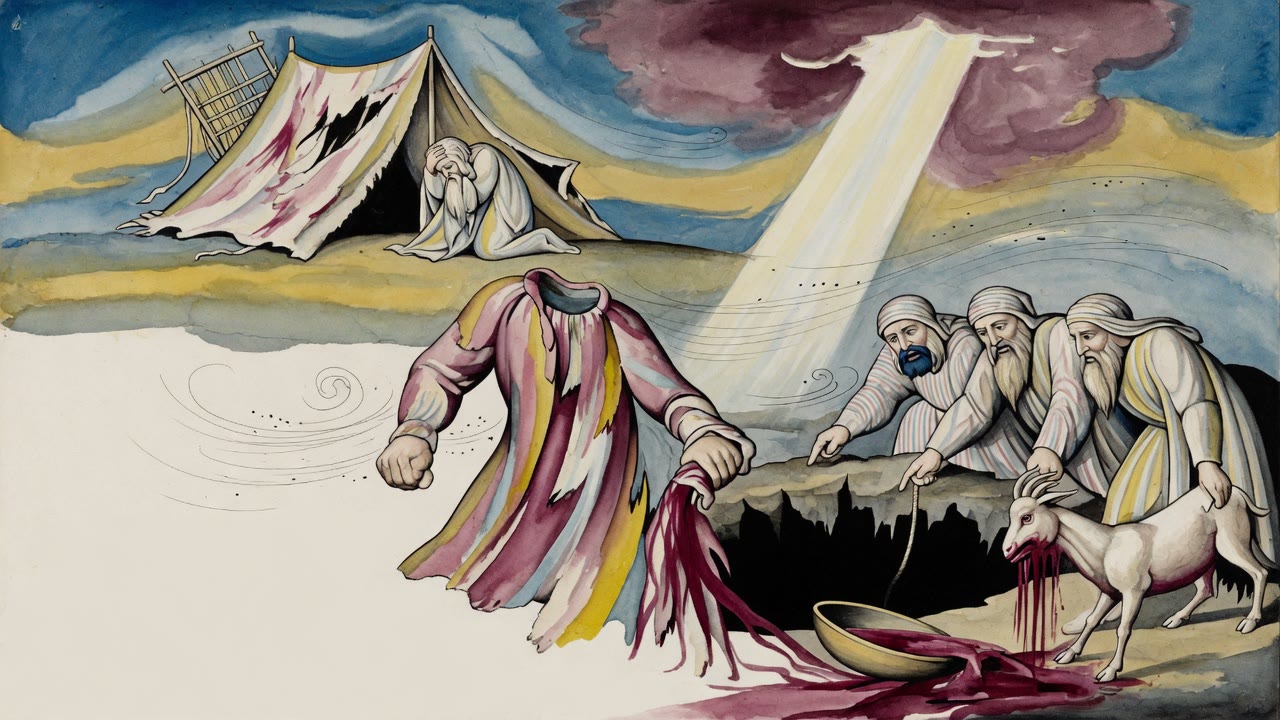
One of them said the word first. An oath. Not a promise so much as a blade laid across all their necks at once. Every brother swore, on pain of the sword, that no mouth among them would ever tell their father what the pit had held or what the silver had bought. Ten men tied their tongues together and made a single silence out of ten separate guilts.

Then came the harder question. A vow can hide a deed. It cannot fill the hole where a son used to be. Issachar had the answer ready. The coat. That long coat of colors their father had cut for his favorite, the cloth that had made every one of them feel like a shadow at his own table. Tear it, he said. Then kill a young goat and drag the cloth through its blood, because goat's blood, once it dries on wool, looks close enough to a man's.

The Beast They Chose as a Witness

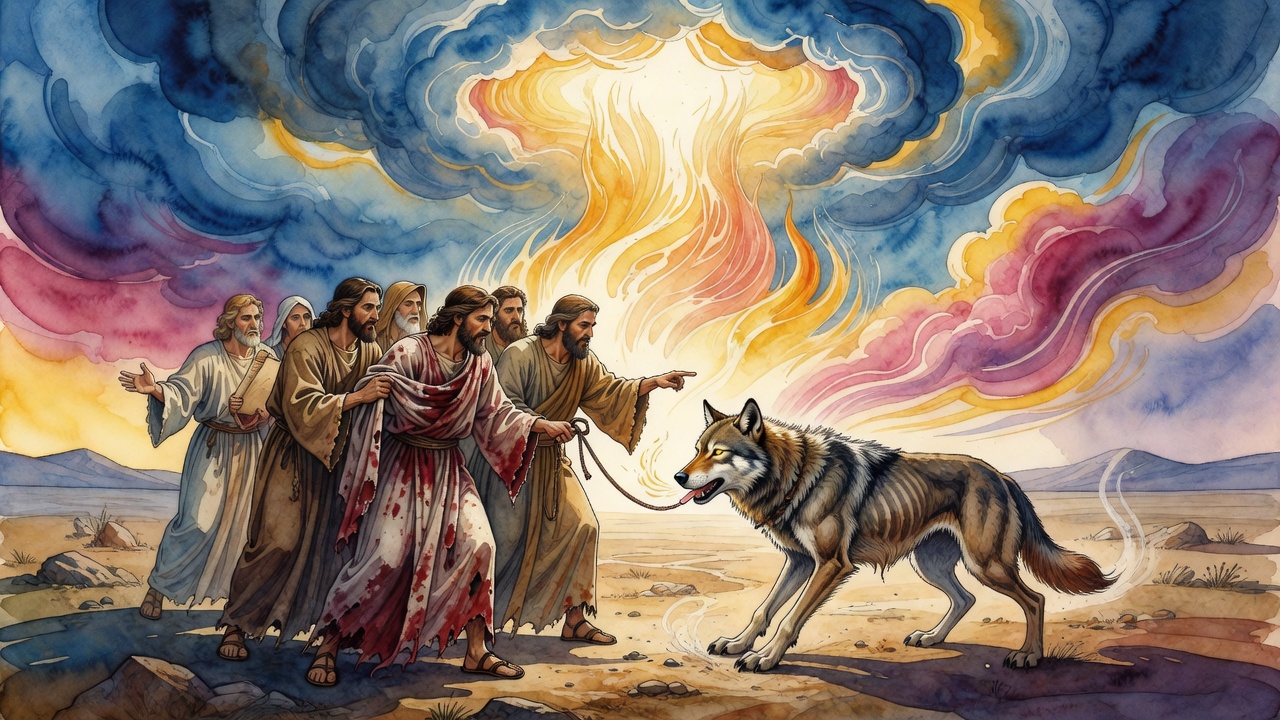
A stained coat says a boy is dead. It does not say what killed him. The brothers wanted a culprit their father could see with his own eyes, and the wilderness had one to lend. They ran a wolf to ground, roped its legs, bound its jaws, and dragged the living animal the long miles back toward home. It fought the ropes the whole way. It did not know it had been chosen to hang.

Jacob was where they had left him. He had stayed behind while his sons went out, and he had spent the hours weeping for a boy he did not yet know he was mourning by a false report. When his sons came through the tent flap he looked up for Joseph and did not find him. He found the coat, dark and stiff. And he found, muzzled and straining at the end of their ropes, a wolf.

"Here is the first wild beast we met," they told him, "and we have brought it to you. Of your son's body we found no trace." They laid the ruined coat in his hands as if that settled it, an animal offered in the place of a child.

Jacob's Hands on the Wolf's Throat

Something in Jacob broke and then hardened. He did not wail. He seized the wolf by the throat, the way a man grips the one thing left in reach when everything else has slipped away, and he pulled its head up to face him. His grief turned itself into a court, and the wolf was the only prisoner in it.

"Why did you devour my son Joseph," he said into the animal's eyes, "with no fear of the God of the earth, and no thought for the grief you would bring down on me? You tore him for nothing. He was guilty of no crime against you, and you have rolled the whole weight of his death onto my shoulders." His hands tightened. In another breath the beast would be dead, and the lie would be sealed by the very man it was told to.

The Tongue God Loosened

Then the wolf spoke.

God opened the mouth of the animal the sons had gagged, and out of that muzzled throat came words, plain and grieving, in a voice a shepherd could understand.

"As the Lord lives, who made me and made you, I never saw your son, and I never tore him. I have not tasted the flesh of any man. I am a stranger in this country. I came here from a distant land, and I came in mourning of my own, because my cub has been lost from me many days now, and I do not know whether he is alive or whether some hand has killed him. I have gone from beast to man and man to beast searching for what is mine, and your sons ran me down and bound me while I searched. Do not lay your dead on me. I am as bereaved as you are, and my mouth is as innocent as your son's."

The tent went quiet around that voice. Ten brothers stood inside their oath and heard the accused predator swear the one true thing spoken in that place all day. The only honest witness to Joseph's fate was the animal they had framed for it, and it had just cleared itself before the father they were deceiving.

The Stranger Set Free

Jacob's grip came loose. Whatever verdict he had been ready to pass, the prisoner had unmade it from inside the ropes. He let the wolf go. It shook off the loosened cords, and it left the tent the way a stranger leaves a house where it was accused of a killing it did not do, alive, uncondemned, still looking for its own lost young.

What was left in Jacob's hands was the coat, and the coat had never told him anything true. It said blood without saying whose. It said death without naming a killer. His sons had built him a witness of cloth and a witness of fur, and one of them had turned in his grip and testified against the whole design. Still he did not see the ten faces in front of him for what they were. He gathered the torn colors against his chest, and he said only that God avenges the man who is wronged, not knowing the wrong stood in the room, wearing the faces of his sons.


← All myths
From the tradition

Sources

3 sources

The texts behind this telling. Some cards carry a translation of the source; others are our own retelling of it, and each card says which. Every card links out to the original.

Legends of the Jews 1:53Legends of the Jews

Retold in our words. Read the original at the link below.The Legends of the Jews by Louis Ginzberg (1909) · Public Domain

The Torah tells us of Jacob's deep love for Joseph, a love that perhaps bordered on favoritism. So, picture Jacob, now alone, consumed by grief. The text says that while his sons went out to do his bidding, he stayed home, weeping, lamenting for Joseph. A father’s anguish, plain and raw.

Then, the sons return. But instead of Joseph, they bring… a wolf.

Yes, a wolf. They present it to Jacob, alive, saying, "Here's the first wild beast we encountered, and we have brought it to thee. But of thy son's corpse, we saw not a trace." Can you imagine the crushing blow? They offer him an animal in exchange for his son?

Jacob, overwhelmed by sorrow and suspicion, seizes the wolf. According to Ginzberg's retelling in Legends of the Jews, Jacob, in the midst of his weeping, actually addresses the wolf. He cries out, "Why didst thou devour my son Joseph, without any fear of the God of the earth, and without taking any thought of the grief thou wouldst bring down upon me?"

He continues, accusing the wolf of devouring his son without reason, of causing him endless pain. "Thou didst devour my son without reason," Jacob laments, "he was guilty of no manner of transgression, and thou didst roll the responsibility for his death upon me."

And then, a glimmer of faith, or perhaps a desperate plea: "But God avengeth him that is persecuted."

It's a powerful moment. A father confronting a wild animal, pouring out his heart, searching for answers in the face of unimaginable loss. The scene highlights not only Jacob's profound grief but also raises questions about justice, about divine retribution, and about the very nature of suffering.

Were Jacob's sons involved in Joseph's disappearance, as the story strongly hints? And what kind of comfort can be found in the idea of a God who avenges the persecuted?

The story, drawn from Legends of the Jews, a compilation of rich Jewish folklore and midrashic (rabbinic interpretive commentary) traditions, reminds us that even in the darkest of times, the human spirit. And the search for meaning, endures.

Full source
Legends of the Jews 1:45Legends of the Jews

Retold in our words. Read the original at the link below.The Legends of the Jews by Louis Ginzberg (1909) · Public Domain

They’d just sold him into slavery, a betrayal that surely echoed in the heavens. But now, they had a bigger problem: how to explain his absence to their father, Jacob.

In Legends of the Jews, a monumental work by Rabbi Louis Ginzberg drawing from countless sources, the brothers first swore a solemn oath. An oath of silence. They vowed, on pain of death by the sword, to never reveal the truth of what they'd done to Joseph to their father or anyone else.

Then came the agonizing question: What story could possibly mask their deed? Issachar, one of the brothers, offered a chillingly pragmatic solution. Tear Joseph's distinctive coat of many colors – that symbol of their father's favoritism. Then, dip it in the blood of a young goat, a giddi izim in Hebrew. Why a goat? Because, as the story goes, its blood bears a disturbing resemblance to human blood. The calculated nature of the deception. The brothers, wrestling with guilt and fear, choosing a path paved with lies. It's a stark reminder of how far people will go to protect themselves, even at the cost of immense pain to others.

Here's where the story takes an even more unexpected turn. As a consequence of this act of deception, the narrative suggests a fascinating link to the future. It was ordained, Ginzberg tells us, that a kid, a young goat, would be used as an atonement sacrifice when the Mishkan – the Tabernacle, the portable sanctuary – was dedicated.

A sacrifice, intended to cleanse and purify, born from a moment of profound dishonesty. A ritual, forever tied to a brother's betrayal. How even the most sacred acts can be shadowed by the imperfections of humanity.

The blood of the kid, a constant, silent echo of the blood spilled – metaphorically, at least – by Joseph's brothers.

Full source
Legends of the Jews, I. Joseph, The SaleLegends of the Jews

Retold in our words. Read the original at the link below.Project Gutenberg eBook #1494, The Legends of the Jews, Volume 2 · Public Domain

The story of Joseph, sold into slavery by his own brothers, is a prime example. It's a painful tale, but rich with layers of meaning. The brothers, remember, are plotting Joseph's demise. But instead of outright killing him, they chuck him into a pit. Conveniently (or not, depending on your perspective), a group of Midianite merchants happen by. According to Ginzberg's retelling in Legends of the Jews, these merchants notice birds circling the pit, assume there's water, and investigate. Instead, they find a very distressed Joseph.

"Who art thou?" they ask, pulling him out. "Who brought thee hither?"

The brothers, seeing Joseph rescued, try to reclaim him, claiming he’s just a disobedient slave. "Give him back!" they demand. But the Midianites aren't buying it. They retort, basically saying, "Slave? He's more beautiful than all of you combined! We found him; we're keeping him."

Things escalate. The brothers threaten violence. Simon, in particular, steps up, brandishing his sword and boasting of his past victories – remember how he single-handedly destroyed Shechem? The Midianites, understandably intimidated, back down a little.

And then comes the twist. They propose a deal: "Okay, okay, so you say he's rebellious? Why don't you just sell him to us? We'll pay whatever you want."

Now, this, according to the tradition, was divine intervention. As Ginzberg tells it, God orchestrated this moment, planting the idea in the Midianites' hearts to ensure Joseph wouldn't be murdered by his brothers. It's a fascinating glimpse into the idea of how God works in the world, subtly influencing events.

The brothers agree, and Joseph is sold for twenty pieces of silver.

The implications of this act reverberate throughout Jewish tradition. The Talmud says, "Over a meal did ye sell your brother, and thus shall Ahasuerus sell your descendants to Haman over a meal." According to the Talmud, because of the brother's greed, Joseph's descendants will be sold by Ahasuerus to Haman over a meal, and because you have sold Joseph into slavery you must say every year "slaves were we in Egypt."

Well, the story goes that the ordeal in the pit – the snakes, the scorpions, the sheer terror – had taken its toll. Joseph had lost his color, his appearance marred by suffering. This, the tradition suggests, justified the lower price.

There's even more to this transaction. The Midrash (rabbinic interpretive commentary) recounts that Joseph was naked when they pulled him from the pit, stripped of his clothes by his brothers. So, God sends the angel Gabriel to enlarge the amulet Joseph wore, transforming it into a garment. When the brothers see Joseph clothed, they demand the garment back, but the Midianites refuse, offering shoes in compensation.

This detail is rich with symbolism. The garment, the very one Joseph wears through all his trials in Egypt – his enslavement, imprisonment, and eventual rise to power – becomes a symbol of his resilience and divine protection.

And what about those twenty pieces of silver? Midrash Rabbah tells us that God commanded that every first-born son shall be redeemed by the priest with an equal amount, and, also, every Israelite must pay annually to the sanctuary as much as fell to each of the brethren as his share of the price. In this way, the act of selling Joseph became a constant reminder and a call to atonement.

The brothers, fueled by spite, use the money to buy shoes, symbolizing their desire to trample Joseph's dreams of dominion. This act, in turn, becomes the basis for the law of halizah, where a woman can remove the shoe of her brother-in-law as a sign of refusing to marry him to continue her deceased husband's line (Deuteronomy 25:5-10).

Finally, the Midianites, fearing they've unwittingly kidnapped a free man, sell Joseph to a group of Ishmaelites for the same price they paid.

So, what do we take away from this complex, multi-layered story? It's more than just a tale of sibling rivalry and betrayal. It's a story about divine providence, about how even the most horrific acts can be woven into a larger plan. It’s a reminder that our actions have consequences, and that even in moments of despair, hope and redemption are possible. And, perhaps most profoundly, it's a meditation on the enduring power of dreams.

Full source