Parshat Tzav6 min read

Twelve Princes Brought Identical Silver Plates to the Tabernacle

Twelve tribal princes walked toward the Tabernacle, each carrying a silver plate, a silver bowl, a gold spoon. None weighed a feather more than another.

Curated by Arthur · Told by Maggid ·
Table of Contents
  1. The First Prince Set Down His Plate
  2. No One Carried a Heavier Gift Than His Brother
  3. The Weights Remembered Abraham
  4. God Counted Each Gift Twelve Times Over

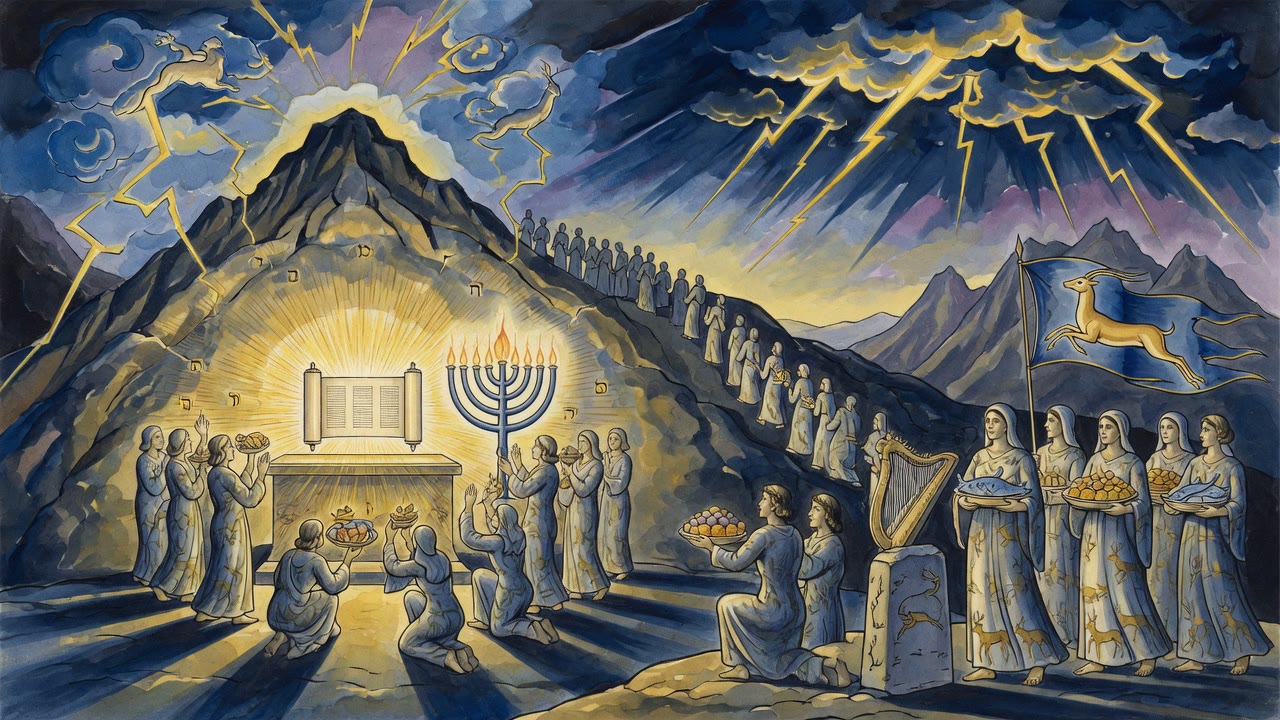
The dust had not yet settled around the new sanctuary when the first prince stepped forward, his arms full. In his hands rested a silver plate, broad and heavy, and a silver bowl beside it, and on top a small gold spoon that caught the morning light. He set them down at the entrance of the Mishkan (the portable sanctuary Israel carried through the wilderness) and stepped back without a word. Then the second prince came forward. He carried a silver plate, a silver bowl, a gold spoon. The third carried the same. And the fourth.
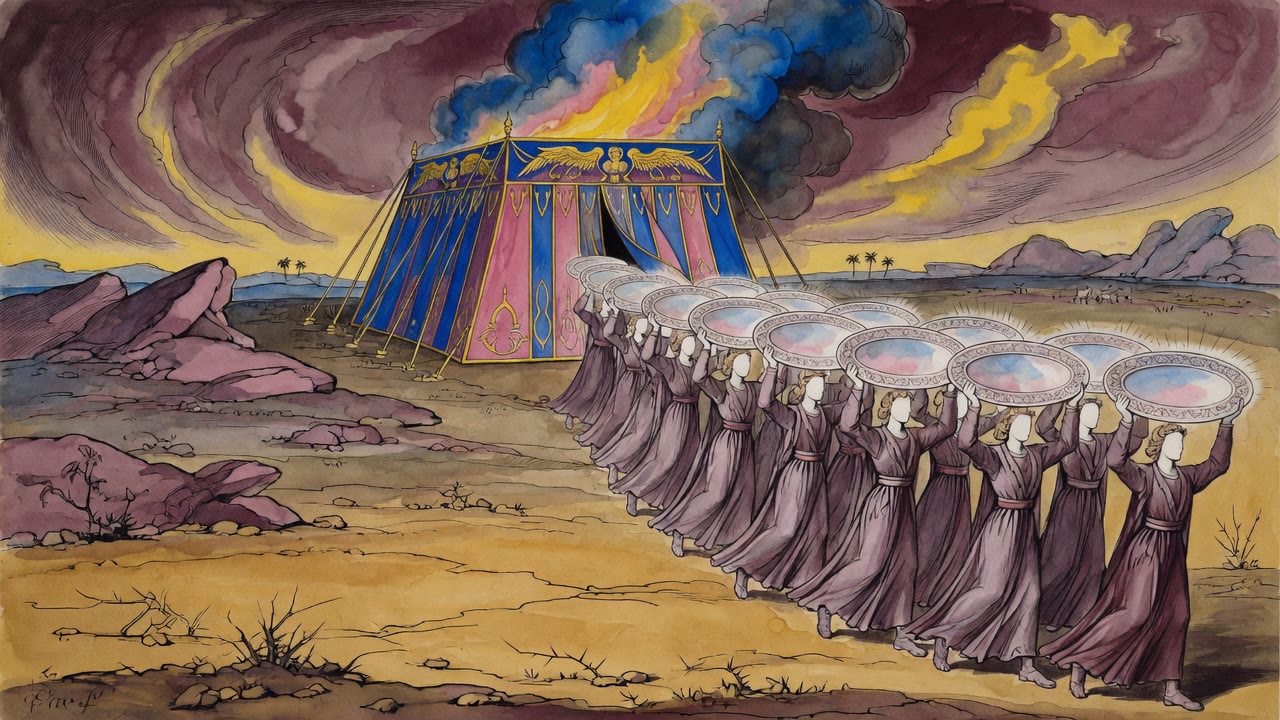
Anyone watching that line of men would have expected the opposite. These were the nesi'im (the tribal princes, נְשִׂיאִים), the chiefs of the twelve houses of Israel, each with a banner, each with thousands of armed men behind him, each with a name and a history and something to prove. A day like this was made for display. A man could carry gold worth a kingdom and let everyone see the weight of it in his arms.

The First Prince Set Down His Plate

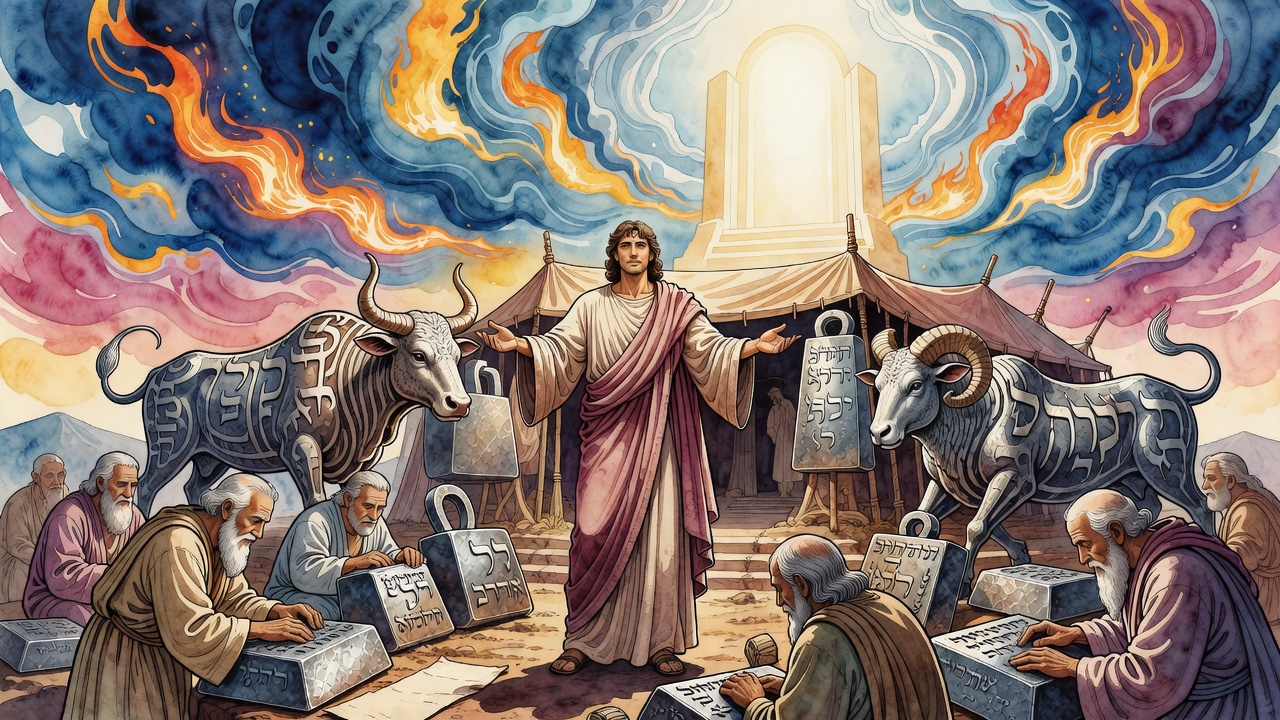
But the plate the first prince laid down weighed one hundred thirty shekels of silver, and the bowl seventy, and the spoon ten of gold filled with incense, with fine flour mixed with oil heaped in the silver (Numbers 7:13). When the second prince came, his plate weighed one hundred thirty shekels too. His bowl, seventy. His spoon, ten. The numbers did not move. Not by a grain.

The twelve had spoken among themselves before any of this. They had agreed in private, each man swallowing the urge to bring more, to bring finer, to be remembered as the one whose gift outshone the rest. None of them wanted to walk in carrying a heavier plate than his brother. So they fixed the measure together and held to it, and the line of identical silver moved forward like a single act repeated twelve times over.

No One Carried a Heavier Gift Than His Brother

Consider what that restraint cost. A prince of Judah, walking ahead of a prince of Dan, with the eyes of the whole camp on the both of them, and the freedom to bring whatever his tribe could afford. He brings exactly what the man beside him brought. He bites down on the part of himself that wants to be first, that wants to be largest, and he carries the same silver plate as everyone else. Twelve men did this. Twelve men chose to disappear into the line rather than rise above it.

And the objects themselves were not random weights chosen to fill a list. The silver plate, broad as the heavens, stood for the twelve constellations wheeling overhead, one for each tribe and its place in the order of things. The silver bowl stood for the twelve months, the turning of the year, the rhythm of seed and harvest. The gold spoon, small and full of fragrant smoke, stood for the twelve faculties knit inside a living man, the inward powers that move a body to act. Every prince laid a piece of the cosmos at the door of the sanctuary, and not one of them said so out loud.

The Weights Remembered Abraham

The seventy shekels of the bowl carried a memory inside the number. Seventy was the age of Abraham when the covenant of the pieces was cut between him and God, the night of fire and smoke that bound his children to the land (Genesis 15:18). The fine flour mixed with oil, soft and rich in the silver, spoke of the love of kindness that filled Abraham and Sarah's tent, the hospitality they poured out on strangers in the heat of the day (Genesis 18:1). And the gold spoon, ten shekels in weight, held the count of ten: the ten trials Abraham passed, ten times the evil inclination, the yetzer hara, pressed against him and ten times he held firm.

So each prince was carrying his forefathers in his arms. The plate, the bowl, the spoon were a folded letter to the dead, written in silver and gold, and the man who carried it stood in a line of men carrying the same letter, and none of them broke the formation to be seen.

God Counted Each Gift Twelve Times Over

This is what moved God. Not the silver, which any rich man could supply, and not the gold. The thing that changed the reckoning was the agreement among them, the unity so complete that no prince would step ahead of another, no man sought his own fame, each one content to be one of twelve and not the one above eleven.

So God answered the way they could not have asked. He counted the offering of each prince as though that single man had brought not only his own plate and bowl and spoon but the gifts of all his companions besides. The man of Reuben was credited with the silver of all twelve houses. The man of Gad as well. Each had brought one offering, and each was treated as though he had brought twelve, his single act multiplied by the eleven he had refused to outshine. The reward for not competing was to receive everyone's portion at once.

And the account of it was written out in full, twelve times, plate and bowl and spoon and flour and oil and incense, the same words repeated without a single weight changed. The repetition that a reader might call tedious was the honor itself. God would not collapse twelve men into one line that said "and the rest brought likewise." Each prince who had refused to be named above the others was named in full, every object of his gift set down on the page exactly, so that the equality they chose in the dust outside the sanctuary became permanent in the telling.


← All myths
From the tradition

Sources

4 sources

The texts this telling draws on, in full. Open a card to read inline, or expand it for a wider, quieter read.

Legends of the Jews 3:107Legends of the Jews

Legends of the Jews turns to Shabbat Before the Altar.

The Midrash (rabbinic interpretive commentary) tells us something astonishing. The gifts weren't just similar; they were identical. The same number of objects, the same size, the same width. Each tribe presented the exact same offering. Think about the effort that must have taken! No one wanted to outshine the others. No one sought personal fame. Instead, a spirit of perfect harmony reigned. Can you imagine such selfless coordination?

It wasn't just about the gifts themselves, though. It was about the intention, the kavanah, behind them. There was such a unity of spirit among the princes, such mutual regard and friendship, that God, in His infinite wisdom, saw something truly special.

The reward? According to the texts, God valued the service of each prince as if he had brought not only his own gifts, but also the gifts of all his companions. Each individual act was amplified, made infinitely more meaningful, because it was part of a collective, unified whole.

But the story doesn't end there. As a further evidence of their incredible unity, God granted them a truly exceptional distinction: they were permitted to present their offerings even on the Sabbath day. The Shabbat, a day of rest and reflection, a day when labor is forbidden. This exception highlights just how extraordinary their devotion was. It speaks volumes about the power of unity to transcend even the most sacred laws.

What can we learn from this story? It’s a lesson in selflessness, in cooperation, and in the power of unity. It’s a reminder that sometimes, the greatest achievements come not from individual brilliance, but from collective harmony. And who knows? Maybe, just maybe, when we act with such unity, we too can create something truly extraordinary.

Full source
Legends of the Jews 3:103Legends of the Jews

Legends of the Jews turns to Naphtali's Offerings Honor the Patriarchs and Torah.

Then comes a silver bowl, used for sprinkling blood. Its weight? Seventy shekels. Who lived to seventy when a major covenant was made? Abraham! Ginzberg's retelling echoes this, pointing out that Abraham was seventy years old when God made the covenant between the pieces – the Brit Bein HaBetarim. This wasn't random; it was intentional, a way to honor Abraham's commitment.

It gets deeper. The charger and bowl were filled with fine flour mingled with oil. What's that all about? It represents, says Legends of the Jews, the love for good and pious deeds that Abraham and Sarah embodied. Their home was a beacon of hospitality and kindness. The offerings are mirroring their very essence.

There's also a golden spoon, weighing ten shekels. This, too, alludes to Abraham. Why? Because he conquered the evil inclination, the yetzer hara, and resisted ten temptations! It’s like a little golden badge of honor for spiritual fortitude.

The three burnt offerings and the sin offering? They corresponded, in this symbolic reading, to the offerings made by Abraham at the covenant between the pieces. Everything is connected; every detail seems to point back to these foundational figures.

Even the animals offered had meaning. The two oxen for the peace offering represent Isaac and Rebekah. And the three kinds of small cattle? Jacob, Leah, and Rachel. But here's where it gets really interesting: the sum total of these three species was fifteen, corresponding to these three and the twelve fathers of the tribes!

So, what does all this tell us? It shows that the Torah isn't just a collection of laws and stories. it weaves layers of meaning, connecting us to our past and reminding us of the values that shaped our people. The seemingly mundane act of bringing an offering becomes a profound act of remembrance and reverence. It's a reminder that even the smallest details can hold immense significance, if we only know how to look.

Full source
Legends of the Jews 3:105Legends of the Jews

Take the gifts of the twelve princes, representing the twelve tribes of Israel, as described in the Torah (Numbers 7). A reader can skim over those lists of offerings – chargers of silver, bowls, spoons of gold. But according to the Legends of the Jews, compiled by Rabbi Louis Ginzberg, there's a rich symbolism woven into every detail. These aren't just random objects; they're a cosmic map!

Ginzberg tells us that the twelve chargers of silver symbolize the twelve constellations of the zodiac. – each tribe connected to a celestial house, a piece of the vast cosmic order. And the twelve silver bowls? They represent the twelve months of the year, marking the passage of time and the rhythms of the seasons. It's breathtaking, isn't it?

The symbolism doesn't stop there. The twelve golden spoons, filled with incense, are particularly fascinating. They correspond to the twelve "guides of men" – not external leaders, but internal organs and faculties. These aren't just body parts; they're aspects of our inner selves!

What are these guides? Well, there’s the heart, the source of understanding and insight. Then the kidneys, strangely enough, which offer both good and evil counsel. The mouth, which chews our food, and the tongue, which – paradoxically – can also render speech impossible. The palate, which tastes, the windpipe which allows us to breathe and speak. The esophagus, the lungs, the liver, even the crop and the stomach are all represented.

Imagine that: the gold spoons, offered as a sacred gift, representing the very organs that allow us to live, to breathe, to understand, to experience joy and sorrow. It's a powerful reminder of the sacredness of our physical bodies and the interconnectedness of all things.

And the numerical values? Even they carry significance! "All the silver of the vessels that weighed two thousand and four hundred shekels," Ginzberg points out, "corresponded to the years that had passed from the creation of the world to the advent of Moses in the fortieth year of his life." And "all the gold of the spoons, the weight of which was an hundred and twenty shekels, corresponds to the years of Moses' life, for he died at the age of a hundred and twenty."

These connections… are they just coincidence? Or are they deliberate clues, placed there to guide us toward a deeper understanding of the universe and our place within it?

The Legends of the Jews invites us to look beyond the literal meaning of the text and consider the symbolic richness hidden beneath the surface. It reminds us that everything – from the constellations in the sky to the organs within our bodies – is interconnected, and that even the smallest detail can hold profound meaning. So, the next time you read a seemingly mundane passage in the Torah, remember the gifts of the twelve princes. Remember the constellations, the months, the inner guides. And ask yourself: what other hidden meanings might be waiting to be discovered?

Full source
Midrash Tanchuma Buber, Nasso 23:1Midrash Tanchuma Buber, Nasso

Another interpretation of (Numbers 7:1): "And it came to pass on the day that Moses had finished setting up the Tabernacle." This is what Scripture says (Psalms 51:20–21): "Do good in Your favor unto Zion; [build the walls of Jerusalem. Then You shall delight in sacrifices of righteousness, in burnt offering and whole offering...]" Because in this world they offered but little, as it is said (Numbers 7:12): "And the one who offered his offering on the first day [was Nahshon son of Amminadab]." What did he offer as his offering? One silver dish, one ladle, one bull, one ram, one lamb, one he-goat, and for the peace offering two oxen, this was the whole of the offering.

To what is the matter comparable? To a king who set out on the road, and they would bring a meal before him according to the road and according to the inn. The king said to them: "Is this how you honor me? Is this how you treat me? Am I not a king, and do I not rule over the world?" They said to him: "Our lord the king, on the road we give according to the road, and according to the inn we have brought to you. But enter the city, and when you enter your palace, you will see with what we honor you."

So too, when the Tabernacle was set up, the princes offered Him a gift: one ladle, one bull, one ram, one lamb, one he-goat. The Holy One said to them: "Is this My honor?" They said to Him: "Master of the worlds, we are set down in the wilderness, and the offerings before You are according to the wilderness. But when You enter Your palace, You will see how many bulls we will offer before You," as it is said (Psalms 51:20–21): "Do good in Your favor [unto Zion]... Then shall they offer up bulls upon Your altar", and not one bull.

And so you find with Solomon when he built the Temple: he sought to offer for the dedication of the Temple. See what is written there (1 Kings 8:63): "And Solomon offered the sacrifice of peace offerings, which he offered unto the LORD, twenty-two thousand oxen and a hundred and twenty thousand sheep." And so too in the days of Ezra, what is written there (Ezra 6:17): "And they offered at the dedication of this house of God one hundred bulls, two hundred rams, four hundred lambs..." This is the meaning of (Psalms 51:20): "Do good in Your favor unto Zion..."

Full source