Parshat Toldot6 min read

Eden Entered the Tent When Jacob Stole the Blessing

Goat hide is the foulest thing a nose can meet. Isaac pressed his face into it and said his son smelled like a field the Lord had blessed.

Curated by Arthur · Told by Maggid ·
Table of Contents
  1. The Boy in Goat Skins
  2. The Smell of a Field
  3. Gehenna Came In Behind Esau
  4. The Blessing Given Again in Daylight
  5. The Traitors Who Still Smelled Good
Eden Entered the Tent When Jacob Stole the Blessing Click for full size

The Boy in Goat Skins

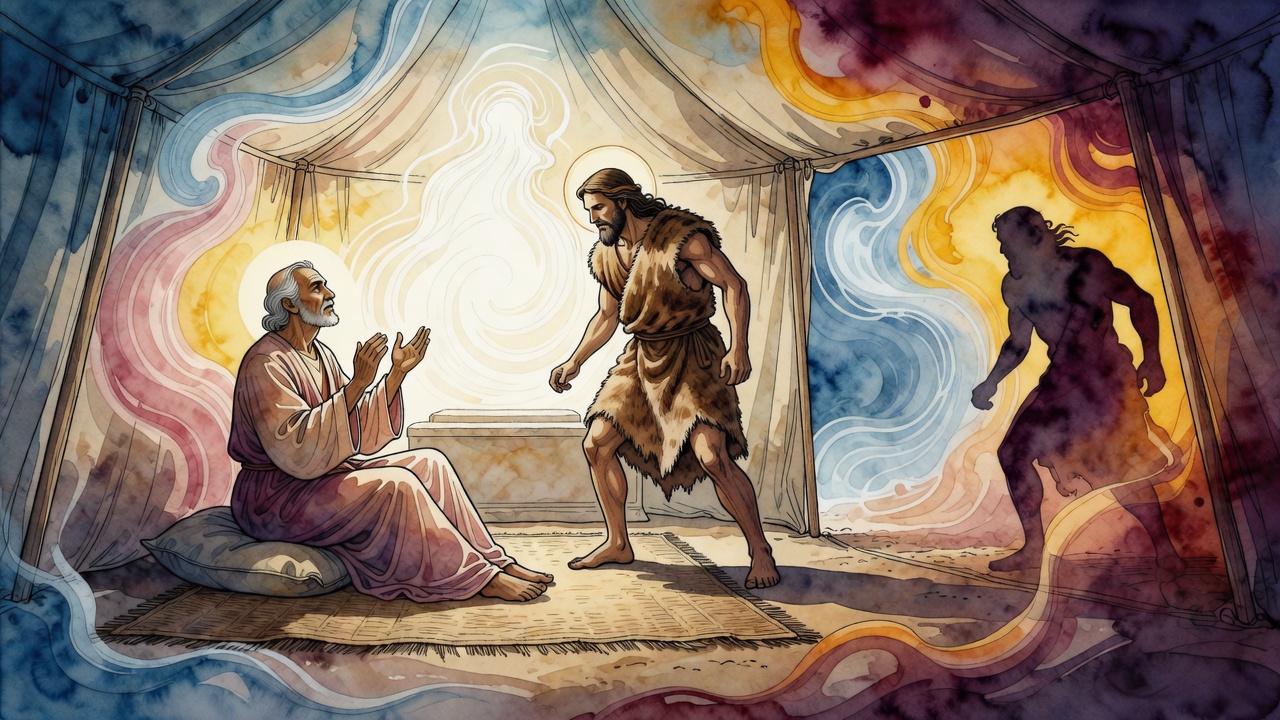
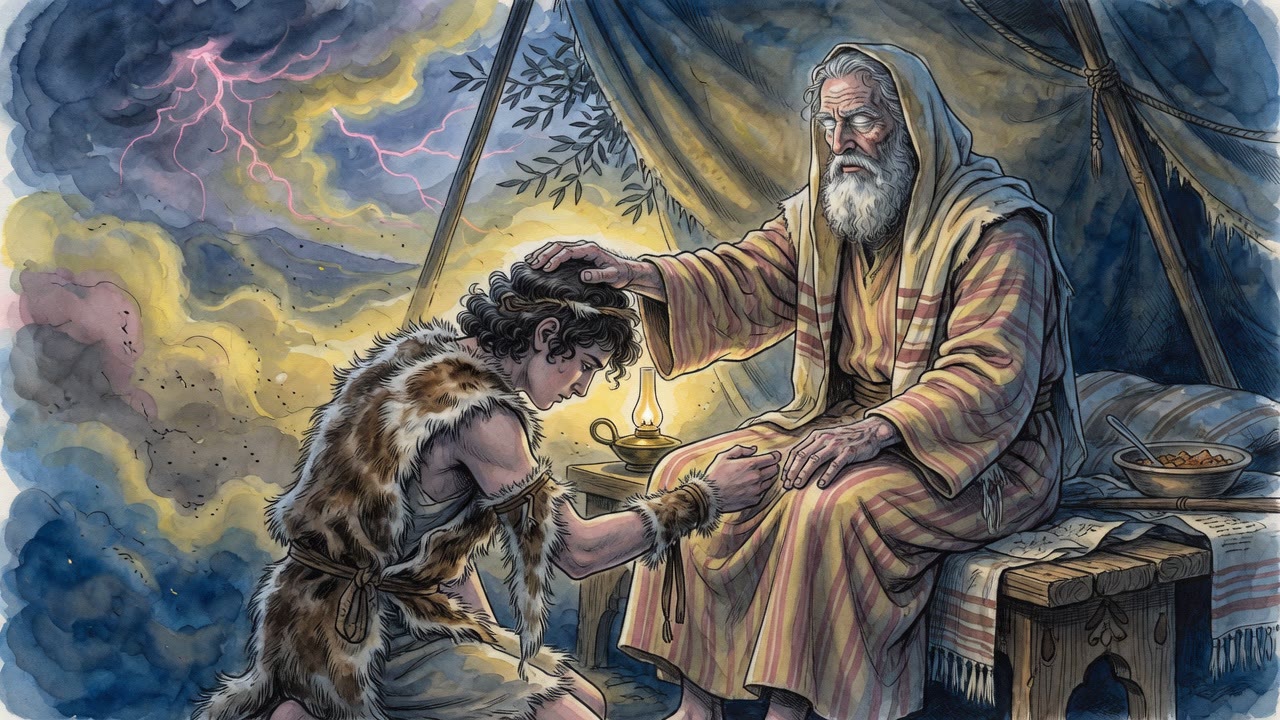
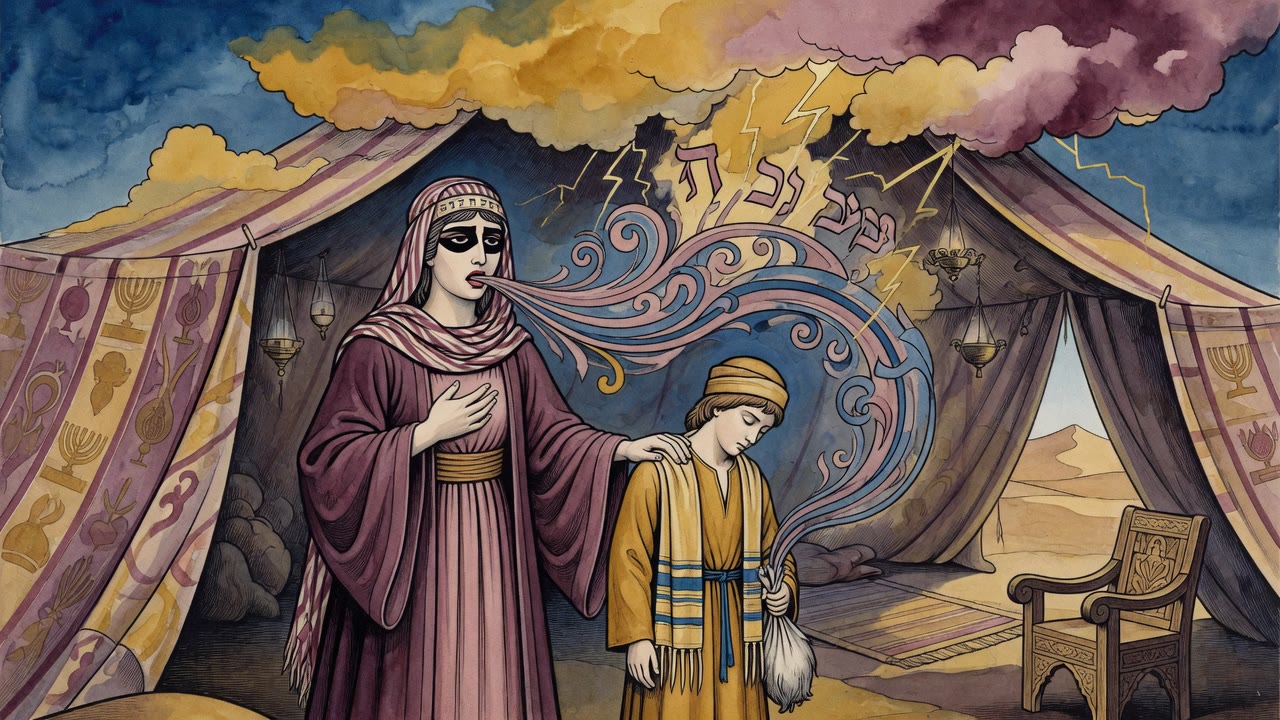
Jacob came through the tent flap with his brother's clothes on his back and strips of kid hide tied over his arms and the back of his neck.

"My father."

"Here I am. Which of my sons are you?"

"I am Esau your firstborn. I have done what you told me." Then, because he was a polite young man even while he stole his brother's blessing off a blind man, he added, "Get up, please. Sit. Eat what I hunted."

He said please to a blind old man he was in the middle of robbing. That courtesy did not go nowhere. Long afterward, when the ark went out ahead of the camp and the tribes broke camp behind it, the words that went up with it were: arise, LORD, and let Your enemies scatter. A son had asked his father to rise, and the request came back on the whole world.

The Smell of a Field

Isaac could not see him and could not place the voice, so he worked with what he had. Come close. Let me feel you. The hands were wrong for the voice, hairy where they should have been smooth, and he could not resolve it, and he blessed him anyway, and the wicked men who would one day come out of this son stayed as hidden from him as the boy in front of him.

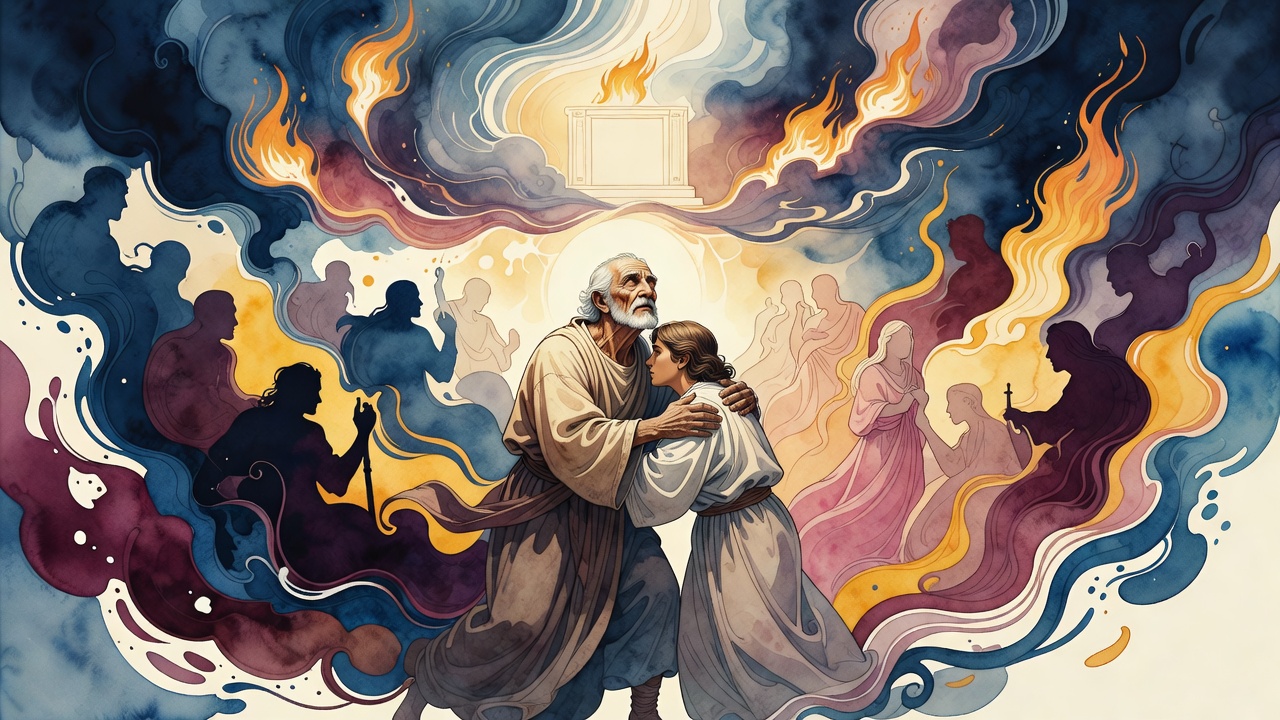
Then he said, come near and kiss me. And when Jacob bent down he told him a thing that was not part of the blessing at all: you will lie beside me when I am buried, and nobody else will.

The kiss put Isaac's face into the goat hide.

There is nothing in a household that smells worse than a fresh kid skin. It is the one thing a blind man would have known instantly, and it was pressed against his mouth. What he said was, the smell of my son is the smell of a field the LORD has blessed.

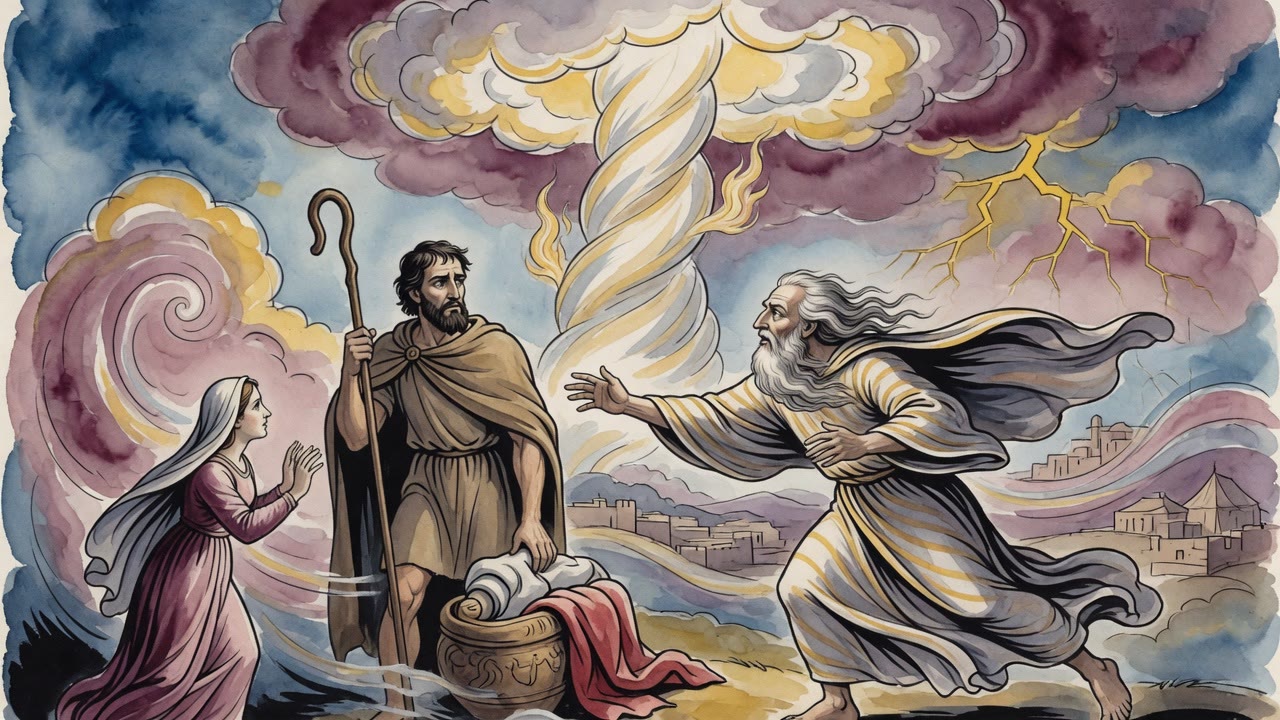
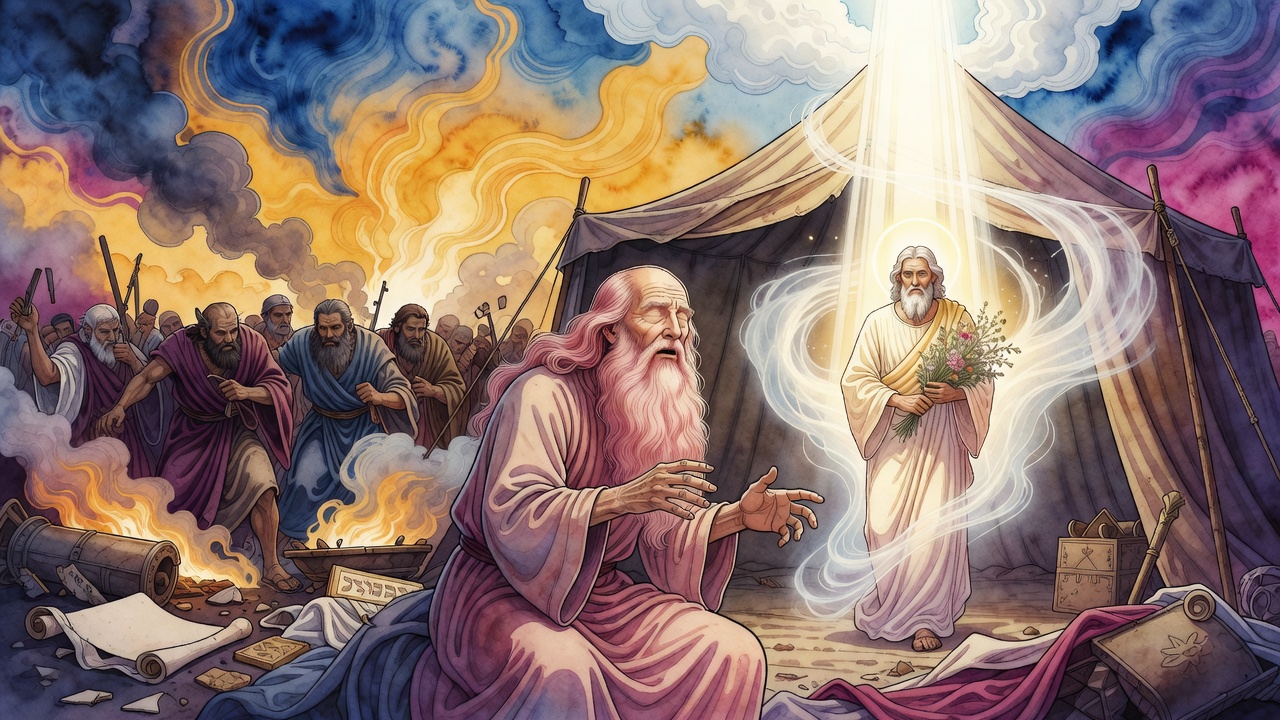
Because Gan Eden (the Garden of Eden) had entered the tent behind Jacob. The Garden itself had come in through the flap at his back and stood there in the room the whole time the blessing was being said, and that was what the old man had his face in.

Gehenna Came In Behind Esau

Esau got back from the field, cooked, and brought his plate in, and what he said was not please.

"Let my father get up."

It was the tone a man uses on a household idol he is standing upright in its niche, setting it on its base so it faces the room the right way. And Gehenna (the realm of judgment after death) came into the tent behind him the way the Garden had come in behind his brother, and the disgrace arrived with the spite, in the same breath, at the same doorway.

He was not punished for the hunting or the plate or even for the murderous years that came after. He was punished for one sentence. God answered him in the identical words He had used to reward Jacob's please, turned around: may God arise, and His enemies scatter. Some men are swept off without a hearing. That is the one who spoke to his father like that.

The Blessing Given Again in Daylight

Jacob went years with those blessings unsettled in his hands. He had them and he did not know if he had them. They had been taken in the dark off a man who thought he was somebody else, and a thing acquired that way never quite sits still.

Then Isaac sent for him. No disguise, no stew, no skins. He blessed him deliberately, on his own initiative, knowing exactly who was standing in front of him, and he gave him an instruction with it: do not take a wife from the daughters of Canaan, and stay away from the daughters of Aner and Eshkol and Mamre, who were his grandfather's own allies.

A contract holds when the men who signed it confirm it, and that was Isaac putting his hand to what he had already given.

There was a king's son who used to go out at night and dig in a particular spot for a pound of gold that was buried there. The king watched him do it for a while. Then he came out and said, why like this, in the dark? Come and take it in the daylight.

Jacob listened to his father and his mother and went to Padan Aram. Samson, later, looked at a woman and told his father to get her for him because she was fitting in his own eyes. One of them heard counsel. One of them saw what he wanted.

The Traitors Who Still Smelled Good

Two men who sold out their own people came back, at the very end, smelling like that field.

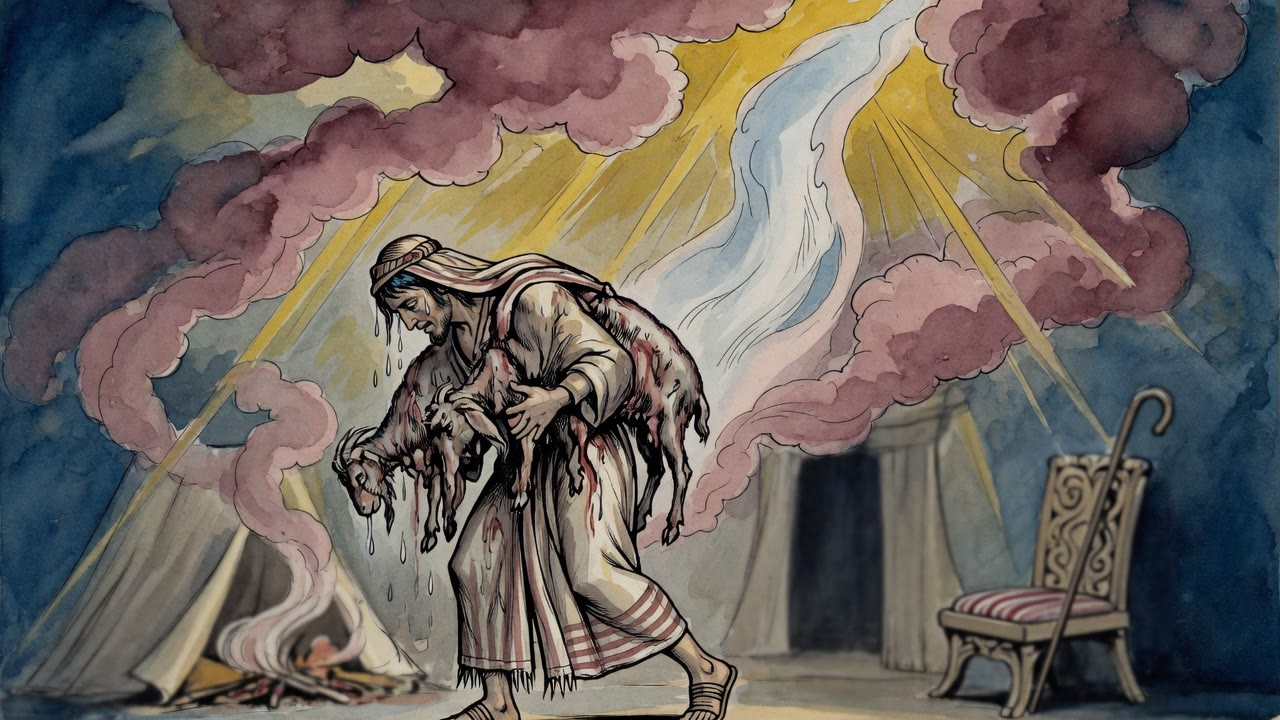
When the enemy wanted the Temple Mount desecrated they decided a Jew should go in first so it would start with his own people. They picked Yosef Meshita and told him whatever he carried out he could keep. He went in and came out with the golden lampstand. They said a common man has no business owning that, go back in, take something else, it is yours. He would not. They offered him three years of tax revenue. He would not. "Is it not enough that I angered my God once," he said, "that I should anger Him twice?" They put him on a carpenter's sawhorse and cut him in half, and the whole time he was shouting one sentence: woe to me that I angered my Creator.

Yakum of Tzerorot rode past his uncle on a Sabbath on a good horse while the beam they were executing Sabbath-keepers on was being dragged along in front of him, and he called out something clever about whose master had given whom the better mount. His uncle answered him and the answer went into him like snake venom. He went home and executed himself by all four court deaths at once, beam and rope and fire and sword arranged so that each one would find him. His uncle dozed off later and saw the man's bier go past him through the air, and understood that Yakum had got into the Garden a little ahead of him.


← All myths
From the tradition

Sources

3 sources

The texts behind this telling. Some cards carry a translation of the source; others are our own retelling of it, and each card says which. Every card links out to the original.

Bereshit Rabbah 65:18Bereshit Rabbah

Retold in our words. Read the original at the link below.The Sefaria Midrash Rabbah, 2022 · CC-BY

The scene is set: Jacob, disguised as his brother Esau, deceives his aging and blind father Isaac to receive the blessing meant for the firstborn. The Torah tells us, "He came to his father, and said: My father, and he said: Here I am; who are you, my son?" (Genesis 27:18). Jacob then lies, "I am Esau your firstborn; I did as you spoke to me. Arise please, sit and eat from my game, so that your soul will bless me" (Genesis 27:19).

The first reading, it's a story of deception, of sibling rivalry. But the rabbis of the Midrash (rabbinic interpretive commentary), in Bereshit Rabbah 65, see layers upon layers of meaning. Rabbi Levi, for example, offers a clever interpretation of Jacob's words, "I am Esau your firstborn." He suggests Jacob was subtly hinting at his destiny, saying, "I am destined to receive the Ten Commandments, but Esau is your firstborn." A fascinating way to weave in the future significance of Jacob, later renamed Israel, and the nation that would receive the Torah at Sinai.

The real punch comes from the seemingly innocuous phrase, "Arise please, sit." Jacob politely asks his father to sit up and enjoy the meal. Seems harmless. Think again.

The Midrash sees in this a seed of future consequence. The Holy One, blessed be He, says to Jacob, "You said: 'Arise please, sit.' As you live, I will repay you," as it is stated: "Arise Lord, and may Your enemies be dispersed" (Numbers 10:35). What's going on here?

The rabbis are pointing to a profound principle: our words have power. Our actions, even the seemingly small ones, create ripples that can echo throughout eternity. Just as Jacob asked his father to arise, so too will God, in a sense, “arise” to scatter His enemies. It's a mirroring, a divine response to human action.

And what about Esau? The Midrash doesn't let him off the hook either. "Some are swept away without justice" (Proverbs 13:23) – this, says the Midrash, is Esau, who was punished for his speech and not for his action. The Holy One, blessed be He, said to Esau, 'You said: “let my father arise” (Genesis 27:31) – like an idolic talisman which you stand up?' As you live, with that same expression, I will exact retribution against you': “May God arise and His enemies scatter” (Psalms 68:2). Esau's command to his father is seen as rude, even idolatrous in its disrespect. And so, the very words he used will be turned against him.

The Midrash is making a powerful statement about the interconnectedness of all things. About the power of language, and the subtle ways in which our actions, our words, can shape not only our own destinies, but the very course of history.

You never know what hidden connections, what profound lessons, might be waiting just beneath the surface.

Full source
Bereshit Rabbah 65:22Bereshit Rabbah

Retold in our words. Read the original at the link below.The Sefaria Midrash Rabbah, 2022 · CC-BY

In the story of Jacob and Esau, as told in (Genesis 27:23), that sense of smell takes on a whole new, almost mystical, significance.

The verse tells us, "He did not recognize him, because his hands were hairy like the hands of his brother Esau, and he blessed him." But Bereshit Rabbah, a collection of rabbinic homilies on the Book of Genesis, delves deeper. It asks a powerful question: what really happened in that tent when Jacob deceived his father, Isaac?

"He did not recognize him" – Bereshit Rabbah suggests this means that Isaac didn't recognize the wicked people who would descend from Jacob. That even in blessing his son, Isaac foresaw the struggles and moral ambiguities of future generations.

Then comes the kiss. "His father Isaac said to him: Approach and kiss me, my son" (Genesis 27:26). Here, the Midrash (rabbinic interpretive commentary) sees a profound promise. Isaac tells Jacob, "You will be adjacent to me in burial, but no other will be adjacent to me in burial." A place of honor, a physical closeness even in death, reserved only for Jacob.

But the most evocative part? "He approached and kissed him, and he smelled the scent of his garments, and blessed him, and said: See, the scent of my son is as the scent of a field that the Lord blessed" (Genesis 27:27). How can a goat skin possibly smell like a blessed field?

Rabbi Yoḥanan offers a stunning explanation. He says that when Jacob entered his father's tent, the Gan Eden, the Garden of Eden itself, entered with him! That's the scent Isaac perceived – the fragrance of paradise. But when Esau entered, Gehenna, a representation of hell, came with him. As it says in (Proverbs 11:2), "With the arrival of spite, disgrace arrives." What a powerful contrast.

But the story doesn't end there. Bereshit Rabbah offers another interpretation, linking the "scent of his garments" (begadav) to "his traitors" (bogedav) – a clever play on words. It suggests that even those who betray God can have a "good scent" if they repent. And to illustrate this idea, the text gives us two tragic stories: Yosef Meshita and Yakum of Tzerorot.

Yosef Meshita, faced with the desecration of the Temple Mount, initially agreed to participate in the sacrilege for personal gain. But then, overcome with remorse, he refused to continue, even when offered great riches. He chose instead to endure a horrific death, sawing him apart, proclaiming "Woe is me that I angered my Creator."

Then there's Yakum of Tzerorot, nephew of Rabbi Yosei ben Yoezer of Tzereida. Yakum, riding high in worldly status, mocked his uncle who was suffering terribly. But Rabbi Yosei's words, hinting at the ultimate rewards for those who suffer for God's sake, pierced Yakum's heart "like the venom of a serpent." He went on to inflict upon himself the four forms of capital punishment, a gruesome act of repentance.

After Yakum's death, Yosei ben Yoezer had a vision of Yakum's bier floating towards the Garden of Eden. He realized that even in his misguided path, Yakum's eventual repentance had earned him a place in paradise. He had preceded his uncle there by a small amount of time.

These are difficult stories, aren't they? They force us to confront the complexities of faith, repentance, and the enduring power of choice. They remind us that even in the darkest of times, the possibility of redemption, of finding that "good scent" through repentance, always remains. And what kind of world are we bringing into being with our choices?

Full source
Bereshit Rabbah 67:12Bereshit Rabbah

Retold in our words. Read the original at the link below.The Sefaria Midrash Rabbah, 2022 · CC-BY

"Isaac summoned Jacob and he blessed him. He commanded him and said to him: Do not take a wife from the daughters of Canaan" (Genesis 28:1). Simple enough. But Rabbi Abahu sees something deeper. He suggests that the blessings Jacob received earlier, when he cleverly impersonated his brother Esau, were somehow…unsettled. Lacking something. Incomplete.

Why? Because they were obtained under false pretenses. Jacob himself might have felt that uncertainty. So, where did those blessings finally become firm, unshakeable? Right here, Rabbi Abahu says. "Isaac summoned Jacob." This time, Isaac blesses Jacob knowingly, intentionally, without deception. As Bereshit Rabbah 67 tells us, this blessing was given on Isaac's "own initiative."

Rabbi Elazar adds another layer. Think about signing a document. It’s only truly valid with the signatures of those involved. Rabbi Elazar says this is like Isaac blessing Jacob. It's a way of saying that even if Jacob hadn't tricked Isaac earlier, he still would have received those blessings. This moment solidifies it. It’s an affirmation, a deliberate act.

Rabbi Berekhya offers a lovely parable: Imagine a king's son secretly digging, trying to unearth a pound of gold. The king sees this and says, "Why do it in secret? Come, take it openly!" That's the spirit of Isaac's blessing. It's about taking something that is rightfully yours, without the shadow of doubt or deceit.

And then, the story takes another turn. "He commanded him" (Genesis 28:1) – Isaac cautions Jacob against marrying the daughters of Aner, Eshkol, and Mamre. Now, these weren't just random people. They were allies of Abraham, as we see back in (Genesis 14:24). But for some reason, Isaac didn't want Jacob marrying into their families. Bereshit Rabbah says he cautioned him specifically against marrying them.

The next verse, (Genesis 28:7), tells us, "Jacob heeded his father and his mother, and he went to Padan Aram." He listened. And that simple act of listening becomes a powerful lesson in itself.

The text then brings in a verse from (Proverbs 21:2): "Every way of a man is fitting in his own eyes." The Rabbis use this to contrast two figures: Samson, who stubbornly followed his own desires ("Take her for me, as she is fitting in my eyes" – Judges 14:3), and Jacob. Samson saw what he wanted and pursued it. But Jacob? He "heeded his father and his mother." The Rabbis connect this to another proverb, (Proverbs 12:15): "And one who heeds counsel is wise."

So, what are we left with? It's more than just a story about blessings and marriages. It's a reflection on the nature of certainty, the importance of intention, and the wisdom of listening to those who came before us. It asks us: Are we like Samson, blindly following our own desires? Or are we like Jacob, open to guidance and wisdom? And perhaps most importantly, are the blessings we seek obtained through honesty and integrity, or through deception and trickery? These are questions worth pondering.

Full source