Parshat Ki Teitzei5 min read

Esau Bled Five Years from Abraham's Old Age

Esau's crimes cut five years from Abraham's life so the patriarch would not see his shame, and the color red clung from cradle stew to Edom's reckoning.

Curated by Arthur · Told by Maggid ·
Table of Contents
  1. Two Boys Until the Thorns Showed
  2. Five Years Cut from a Promise
  3. Dim Eyes and a Mother's Wound
  4. Red from Cradle to Reckoning
  5. Remember What Amalek Did
Esau Bled Five Years from Abraham's Old Age Click for full size

Two Boys Until the Thorns Showed

Esau and Jacob walked to the same elementary school while they were small, and no one could tell the myrtle from the thorn. Rabbi Levi said it plain. As long as they are small, no one distinguishes one plant from the other. After they grow, one gives off its pleasant smell, and the other brings forth its thorns. Esau became a skillful hunter, a man of the outdoors. Jacob was a mild man who stayed in camp. The split did not wait for polite adulthood. It arrived with the first blood Esau learned to love.

He went out and robbed and extorted, and people maledicted him in the streets. The grandson of Abraham became a rumor that hurt the living more than the dead.

Five Years Cut from a Promise

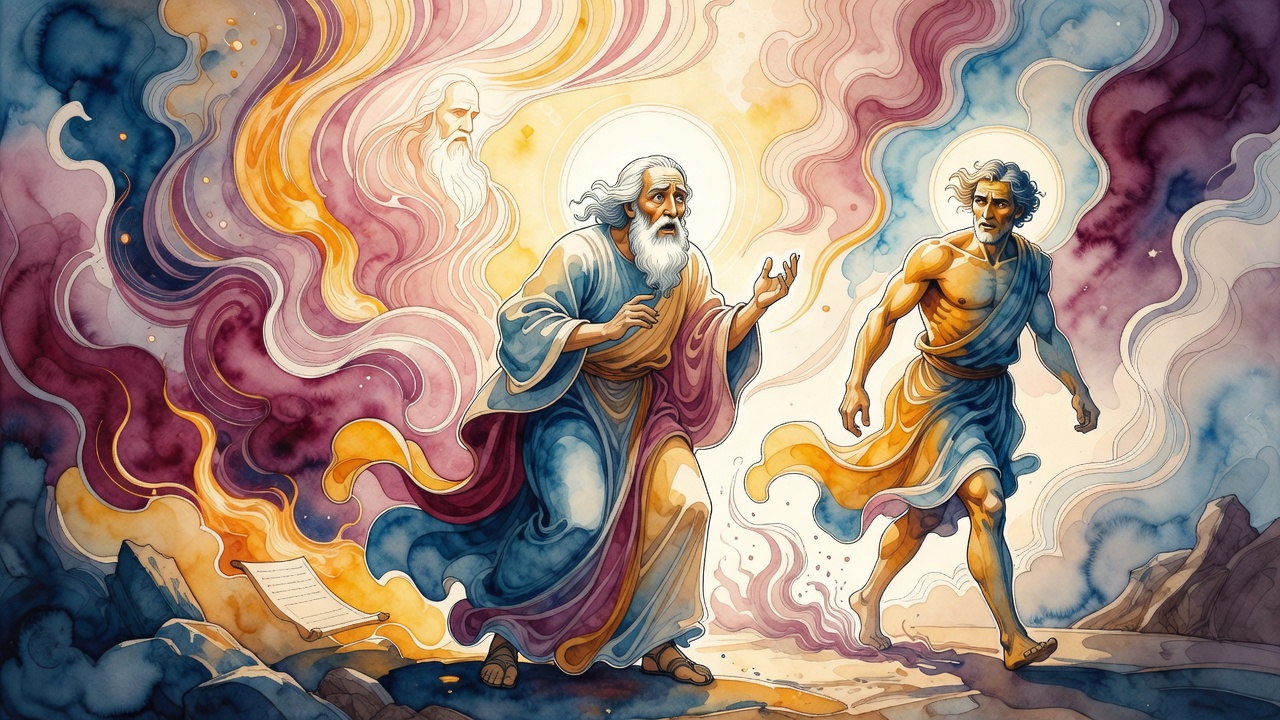
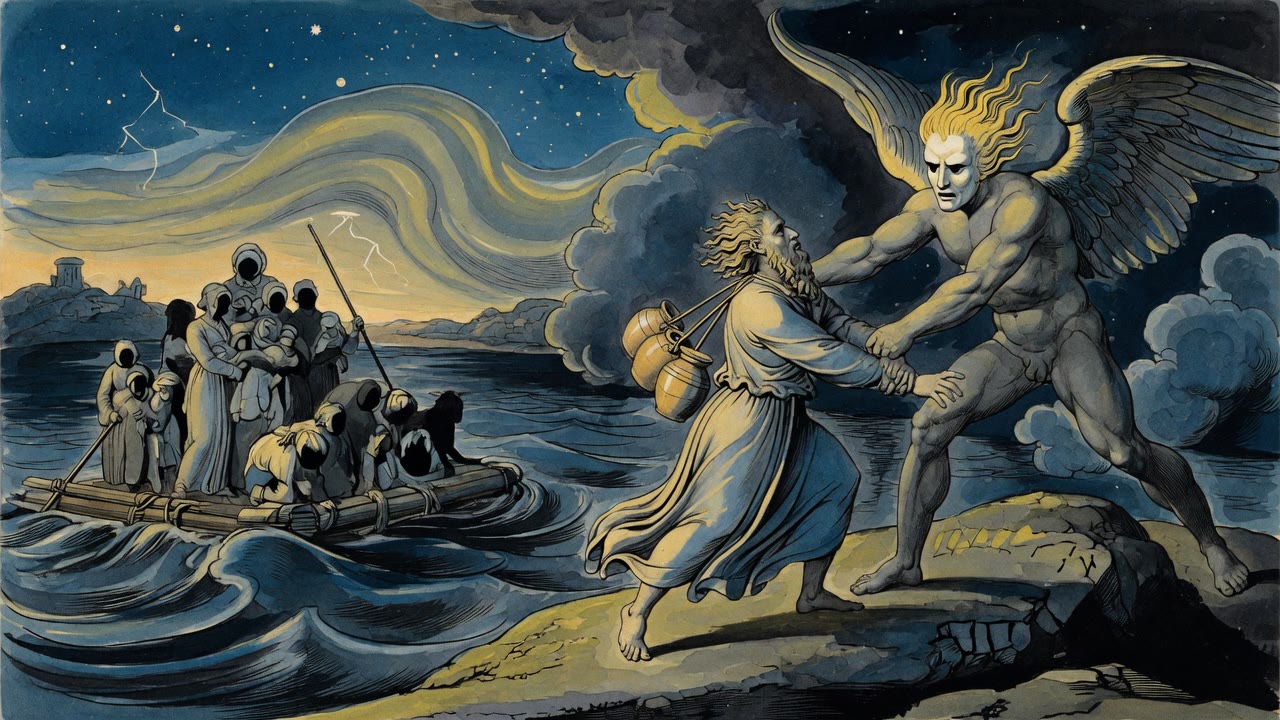
Isaac lived a hundred and eighty years. Abraham lived a hundred and seventy-five. Why the difference, when Isaac drew vitality from Abraham's line? So Abraham would not see Esau's shame. During the five years withheld from Abraham's life, Esau committed two serious transgressions. He violated a betrothed maiden. He took a life. Field, the midrash hears in the verse of Esau coming exhausted from the field, can only mean the place of a seized betrothed woman. Exhausted can only mean a murderer, whose victims leave the killer spent before those who kill.

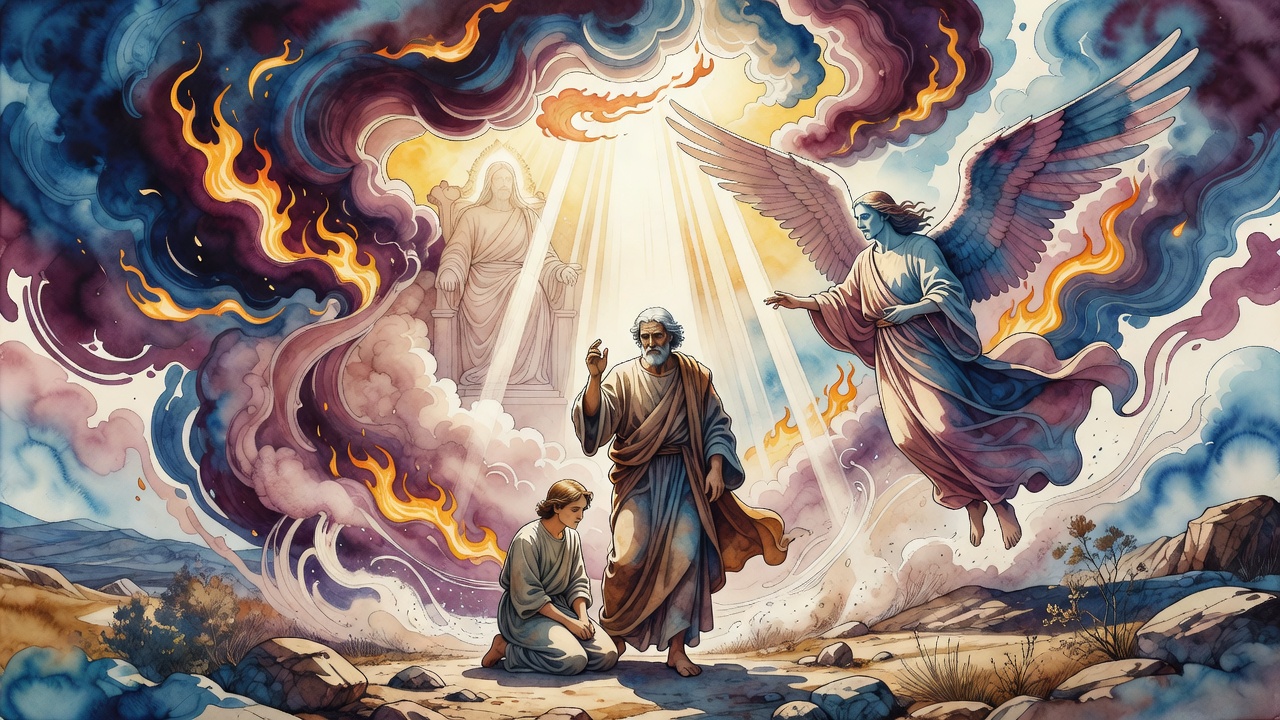
Rabbi Zakkay added theft to the ledger. The Holy One had promised Abraham he would go to his ancestors in peace and be buried at a good old age. But if Abraham heard what people said of his grandson, sexual crime and bloodshed, he would wonder whether the stipulations of the promise still held. He would voice a complaint. This is not a good old age. What should I do for him? Heaven gathered him from the world. Better for the righteous to be gathered in peace. Esau sinned against his grandfather by making peace impossible to watch.

Dim Eyes and a Mother's Wound

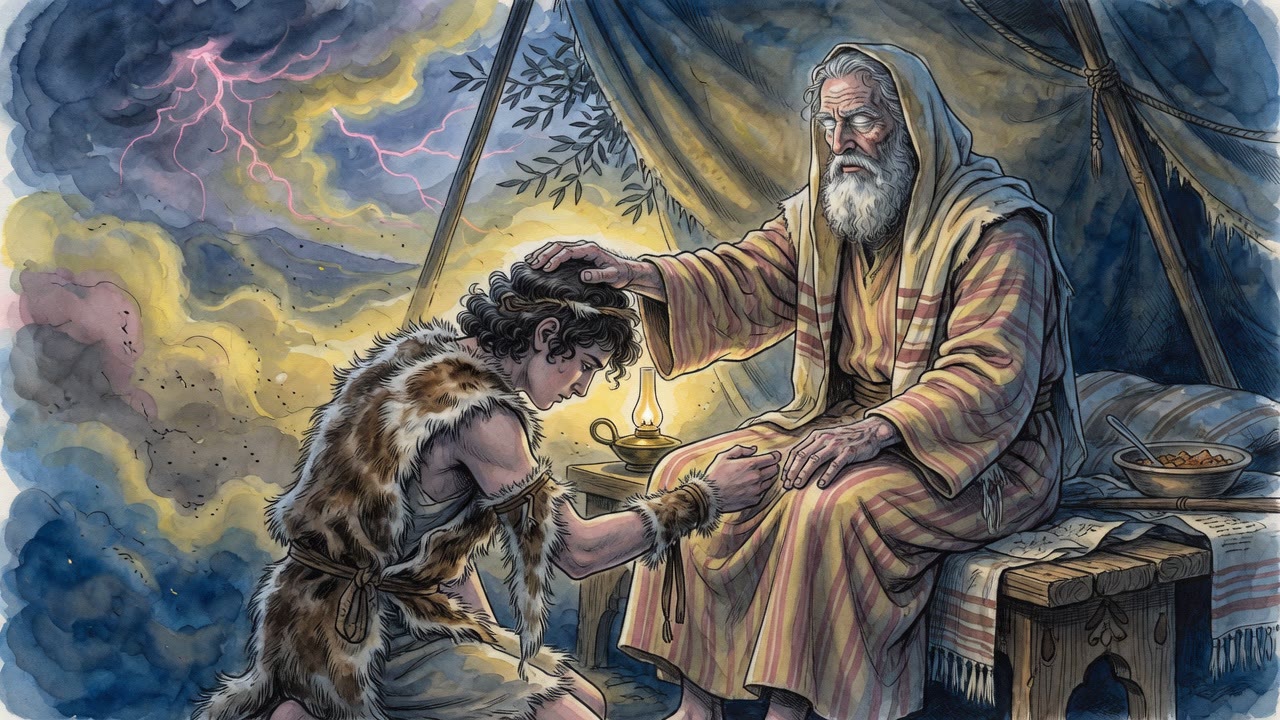
He sinned against his father as well. Whoever produces a wicked son causes his own eyes to grow dim during his lifetime. From Isaac you learn it. When Isaac was old, his eyes were too dim to see. A wicked disciple blinds too, as Ahijah was blinded after raising Jeroboam. Esau's violence reached backward into the bodies of those who made him.

Against his mother the midrash argues in several mouths. One says that leaving her womb he severed her uterus so she would bear no more. Another says that as he left, his fist was already stretched toward his brother. The wicked go astray from the womb. Another says he was the cause of her not producing twelve tribes. The infant already wore the future's aggression. Remember Amalek, Esau's grandson line, begins in that early heat.

Red from Cradle to Reckoning

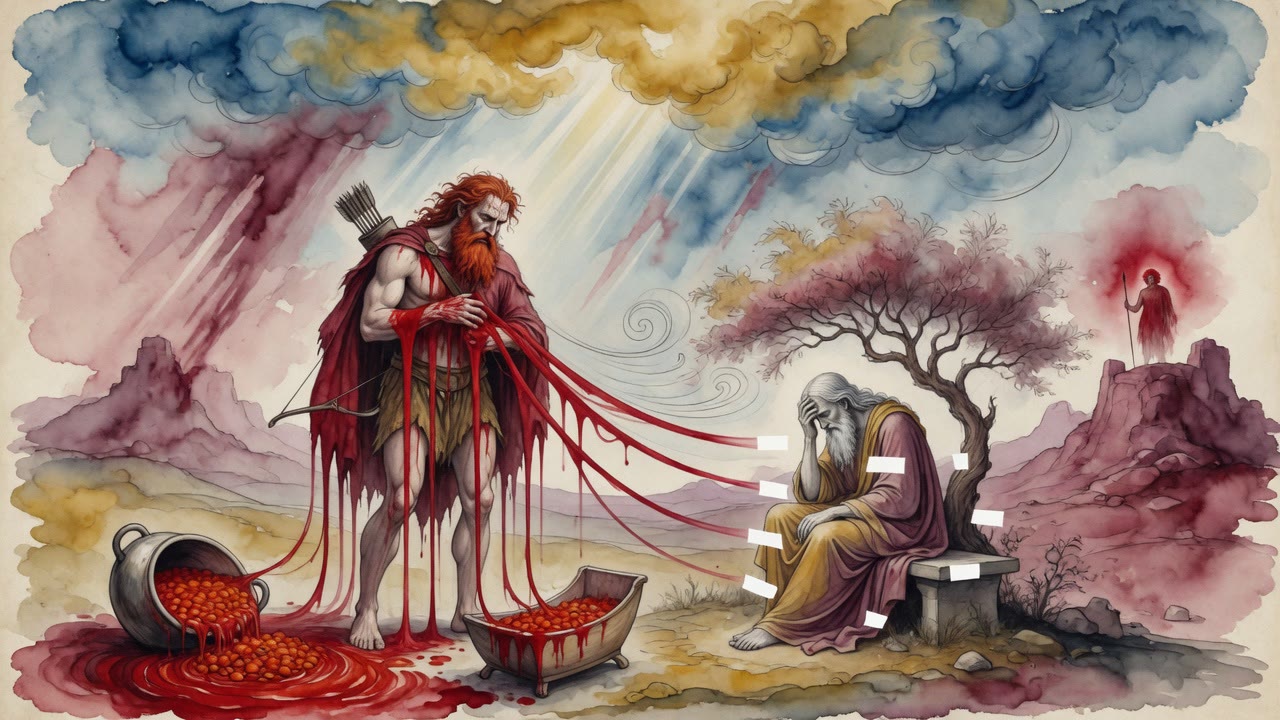
When Jacob later sent messengers to the land of Seir, the field of Edom, the sages heard a riddle in the names. Seir from se'ar, hair, for the mention of Esau makes a person's hair stand on end. Edom from adom, red, the color that clings to Esau from cradle to judgment. The first came forth ruddy. His food is red, the red stew for which he sold the birthright. His warriors are red, shields reddened, soldiers clothed in scarlet as Nahum saw. His land itself is red, the field of Edom.

But red answers red. The one who rises against Esau is also ruddy. This is David, ruddy when Samuel anointed him, who set garrisons in Edom and bent it low. And the One who exacts the final reckoning from Edom comes wrapped in red as well. Who is this coming from Edom, with crimsoned garments? The color that marks the wild brother also marks his shepherd-king and his Judge. Edom's red is not its glory. It is the seal of its undoing.

Remember What Amalek Did

Moses commands Israel to remember what Amalek did on the road, the attack on the rear, the weak, the weary. The midrash will not let that memory float free of Esau's earlier crimes against fathers and mother and the peace of Abraham's old age. Amalek is not a sudden monster from nowhere. Amalek is the long red thread pulled through a family that chose the field of blood over the camp of study.

Abraham dies five years early so his eyes will not have to watch. Isaac's eyes dim anyway. Jacob flees and returns limping. David stains Edom with garrisons. The final figure comes in crimson. Between those hours stands a hungry man who sold a birthright for stew and a hunter who came home exhausted from a field that was never only game. The drama is inheritance turned into violence, and a color that will not wash out of the story.


← All myths
From the tradition

Sources

2 sources

The texts behind this telling. Some cards carry a translation of the source; others are our own retelling of it, and each card says which. Every card links out to the original.

Midrash Tanchuma, Ki Teitzei 4Midrash Tanchuma

Retold in our words. Read the original at the link below.Townsend 1989 translation of Midrash Tanhuma, S. Buber Recension · CC-BY

(Deut. 25:17:) “Remember what Amalek (Esau's grandson) did to you.” This verse is related (to Ps.109:14), “May the iniquity of his fathers be remembered before the Lord […].” Were the fathers of Esau wicked? And were they not righteous? His grandfather was Abraham. His father was Isaac. But are you saying (in Ps. 109:14), “May the iniquity of his fathers be remembered”? [The verse is] simply [referring to] a sin that he sinned against his fathers. And how? You find that Isaac got his vitality from Abraham; yet he lived a hundred and eighty years, while Abraham only lived a hundred and seventy-five years. Why so? So he would not see Esau’s shame. Abraham had [Isaac] when he was a hundred years [old]. (Gen. 25:26-27:) “And Isaac was sixty years old when they were born. And the lads grew.” Both of them went to the elementary school, and both of them were equal until the age of fifteen. R. Levi said, “To what were they comparable? To a myrtle and a thorny plant. As long as they are small, no one [can] distinguish one from the other. After they have grown up, the one gives off its pleasant smell, but the other brings forth its thorns. Thus, so long as Esau and Jacob were small, no one distinguished between them. After they were grown up (in Gen. 25:26, cont.), ’Esau became a skillful hunter, a man of the outdoors; but Jacob was a mild man who stayed in camp.’” And Esau would go out and rob and extort, and people would maledict him. And during the five years [that were withheld from Abraham's life], Esau committed two serious transgressions: He violated a betrothed maiden, and he took a life. The one is what is written about (in Gen. 25:29), “then Esau came from the field, and he was exhausted.” Now field can only be a reference to a betrothed maiden [of whom it is stated (in Deut. 22:25), “If in the field the man finds [a maiden who is betrothed, and the man seizes her and lies with her…].” Moreover, exhausted can only be a reference to a murderer, of whom it is stated (in Jer. 4:31), “woe to me, now; for my life is exhausted before those who kill.” Rabbi Zakkay said, “He also stole, as stated (in Obad. 1:5), ‘If thieves have come to you.’” The Holy One, blessed be He, said, “I had already promised my beloved Abraham (in Gen. 15:15), ‘And you shall go unto your ancestors in peace; [you shall be buried at a good old age].’ But now he would see his grandson go to bad culture and hear what people say about his grandson; [that he was] transgressing sexual prohibitions and shedding blood. He would [then] wonder and say, ‘Are these the stipulations that the Holy One, blessed be He, being fulfilled with me?’ And he would voice a complaint, ‘And this is not “a good old age.”’ What should I do for him?” [So] He gathered him from the world. It is better for the righteous man to be gathered (to his ancestors) in peace, as stated in Ps. 63:4), “For Your steadfast love is better than life.” Behold, he [thus] sinned against his grandfather. He sinned against his father, as he caused his eyes to become dim during his lifetime. Hence they have said, “Whoever produces a wicked son or a wicked disciple causes his [own] eyes to grow dim during his lifetime.” From where [in Scripture] do you learn [this]? A wicked son, from Isaac, as stated (in (Gen. 27:1), “And it came to pass that when Isaac was old [and his eyes were too dim to see].” [In regard to] a wicked disciple, [we learn] from Ahijah, as it is written (in I Kings 14:4), “now Ahijah could not see, because his eyes were dim from old age.” Why? Because he produced a wicked disciple in Jeroboam. [(Ps. 109:14:) “And let not the sin of his mother be blotted out.”] But how had he sinned against his mother? R. Judah, R. Nehemiah, and [our] masters [differ]. R. Judah says, “When he left his mother's belly, he severed her uterus, with the result that she would not bear [any more children]. This is what is written (in (Amos 1:1)1), ‘because he (i.e. Edom, which is Esau) pursued his brother with the sword and repressed his pity (rachamiv),’ as it is written, ‘his uterus (rechemo).’” R. Berekhyah says, “You should not say [this] in reference to when he had left [his mother's uterus]. Rather, as he was leaving his mother's uterus, his zerta' [i.e. fist] was stretched out against him (i.e. against his brother Jacob).” What is the reasoning? (Ps. 58:4:) “The wicked go astray (zoru) from the womb.” R. Nehemiah says, “He was the cause of her not producing twelve tribes.” As Rav Huna has said, “Rebekah was worthy of producing twelve tribes, as stated (in Gen. 25:23), ‘And the Lord said to her, “Two nations are [in your womb].” Here are two. (Ibid. cont.) “and two peoples.�� Here are four. (Ibid. cont.) “And one people shall be stronger than the other.” Here are six. (Ibid. cont.) “And the elder shall serve the younger.”’ Here are eight. (Vs. 24:) ‘And behold there were twins in her womb.’ Here are ten. (Vs. 25:) ‘The first came out ruddy.’ That is eleven. (Vs. 26:) ‘And afterward his brother came out.’ Here are twelve.” And there are some who bring this [idea] from here (vs. 22); “and she said, ‘If so, why am I here (zh)?’” By gematria z (=7) + h (=5) [for a total of] twelve. But [our] masters have said, “He caused her bier to not go forth publicly [to her funeral]. You find that when Rebekah died, they were saying, ‘Who will go before her? Abraham is dead. Isaac's eyes are dim, and he is sitting at home. Jacob has gone to Paddan-Aram. Should Esau the wicked go before her? Then people would say [in Aramaic], “Cursed be her breasts for suckling this man.”’ What did they do? They brought out her bier at night, so that Esau not go out in front of her, and all say, ‘Cursed are the breasts suckled this evil man.’” R. Jose bar R. Hanina said, “Because they brought out her bier at night, the text only explained about her obliquely. Thus it is written (in Gen. 35:8), ‘Then Rebekah's nurse, Deborah, died [and she was buried under the oak below Bethel] and its name was called Weeping Oak (Allon-Bacuth)],’ as they wept two weepings (bekhiot).” While Jacob was seated in observance [of mourning] for her nurse, the news about his mother came to him, as stated (to Gen. 35:9), “Now God appeared unto Jacob again […,] and blessed him.” With what blessing did He bless him? He blessed him with the blessing of [consolation given to] mourners. The Holy One, blessed be He, said, “Did his father pay him (i.e. Esau) back with evil? Did his mother pay him back with evil? Did his brother pay him back with evil? Did his grandfather pay him back with evil? Did you pay him back with evil? I shall pay him back with evil, as his children destroyed My house. You and I shall rise against him, as stated (Obad. 1:1), “Rise, and we shall rise up against her for war.” Israel said to him, “Master of the world, we cannot [overcome] him.” [So] the Holy One, blessed be He, says to them, “You mention his name below, and I shall blot out his name above, as stated (Ps. 109:15) ‘Let them (the iniquity against his fathers and the sin against his mother) always be before (neged) the Lord.’ Whatever he has done, he has done against (neged) Me.” [Therefore] (ibid. cont.), “and may He have their memory cut off from the earth.” Ergo (in Deut. 25:17), “Remember what Amalek (Esau's grandson) did to you.”

Full source
Midrash Tanchuma Buber, Vayishlach 4:2Midrash Tanchuma Buber, Vayishlach

Translation of the source text.Midrash Tanchuma (Buber), Public Domain, on Sefaria · CC-BY-SA

"To the land of Seir, the field of Edom." [What is the meaning of "to the land of Seir"?] That he makes the hair (se'ar) of a person stand on end. "The field of Edom", he is red (adom), and his food is red, and his warriors are red, and his clothing is red, and his shields are red, and his land is red, and the one who stands against him is red, and the one who exacts punishment from him is red, in red clothing.

He is red, as it is said: "And the first came forth ruddy" (Genesis 25:25). And his food is red: "from this red, red stuff" (Genesis 25:30). And his warriors are red: "The shield of his mighty men is reddened" (Nahum 2:4). And his clothing is red: "the men of valor are clothed in scarlet" (Nahum 2:4). His shields are red: "The shield of his mighty men is reddened" (Nahum 2:4). And his land is red: "to the land of Seir, the field of Edom." And the one who stands against him is red, this is David: "And he sent and brought him, and he was ruddy" (1 Samuel 16:12). And what is written concerning him? "And he put garrisons in Edom" (2 Samuel 8:14). And the one who exacts punishment from him is red: "My beloved is dazzling and ruddy" (Song of Songs 5:10); "Who is this coming from Edom?" (Isaiah 63:1), in red clothing: "Why is your clothing red?" (Isaiah 63:2).

Full source