Parshat Korach6 min read

Korah Saw Samuel in His Bloodline and Reached for the Fire-Pan

Korah saw Samuel shining in his bloodline and read the vision as permission. He reached for the fire-pan, and the fire reached back.

Curated by Arthur · Told by Maggid ·
Table of Contents
  1. The Corridor of Generations
  2. One Altar, One High Priest
  3. Poison in the Incense
  4. Fire Above, Earth Below
  5. The Sons Who Stepped Back

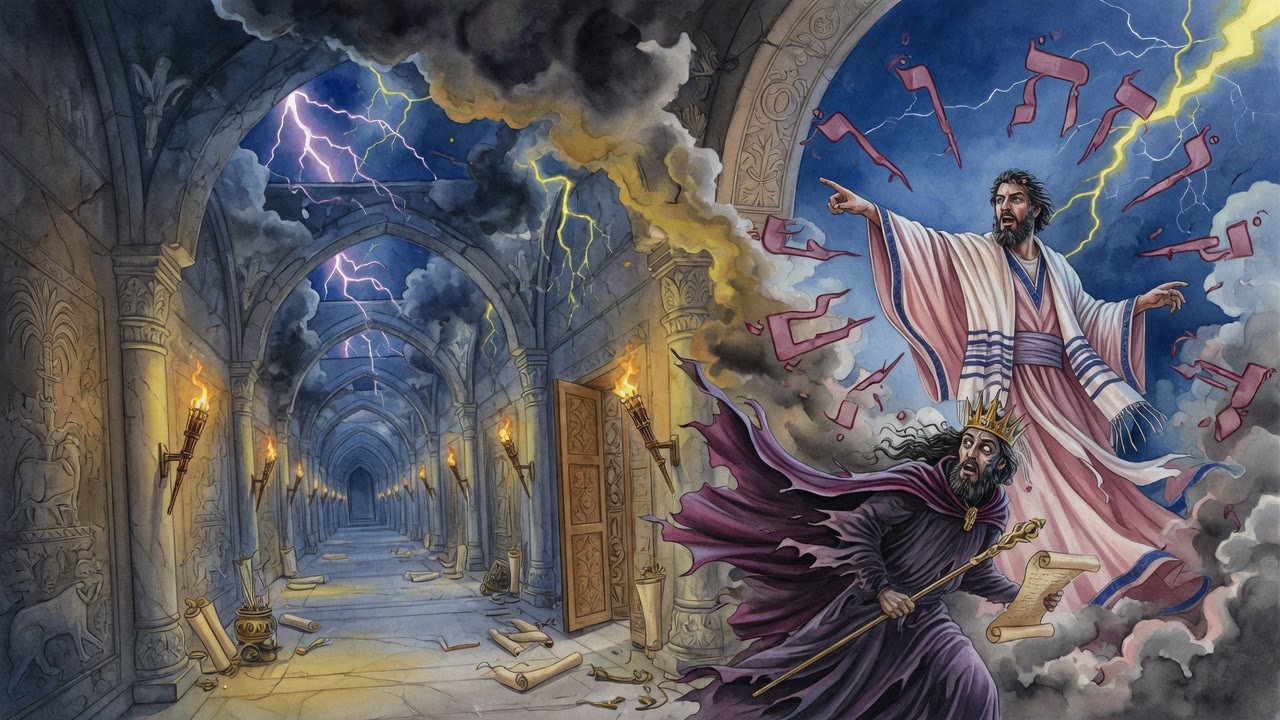
Korah stood at the door of his tent in the wilderness and looked down a corridor no one else in the camp could see. It ran forward through time, generation after generation of his own blood, and far down its length a boy lay sleeping in a sanctuary, waiting for a voice to call his name. The boy was Samuel, who would one day stand in the company of the greatest men Israel ever produced, as the psalm sings, "Moses and Aaron among His priests, and Samuel among those who call on His name" (Psalms 99:6).
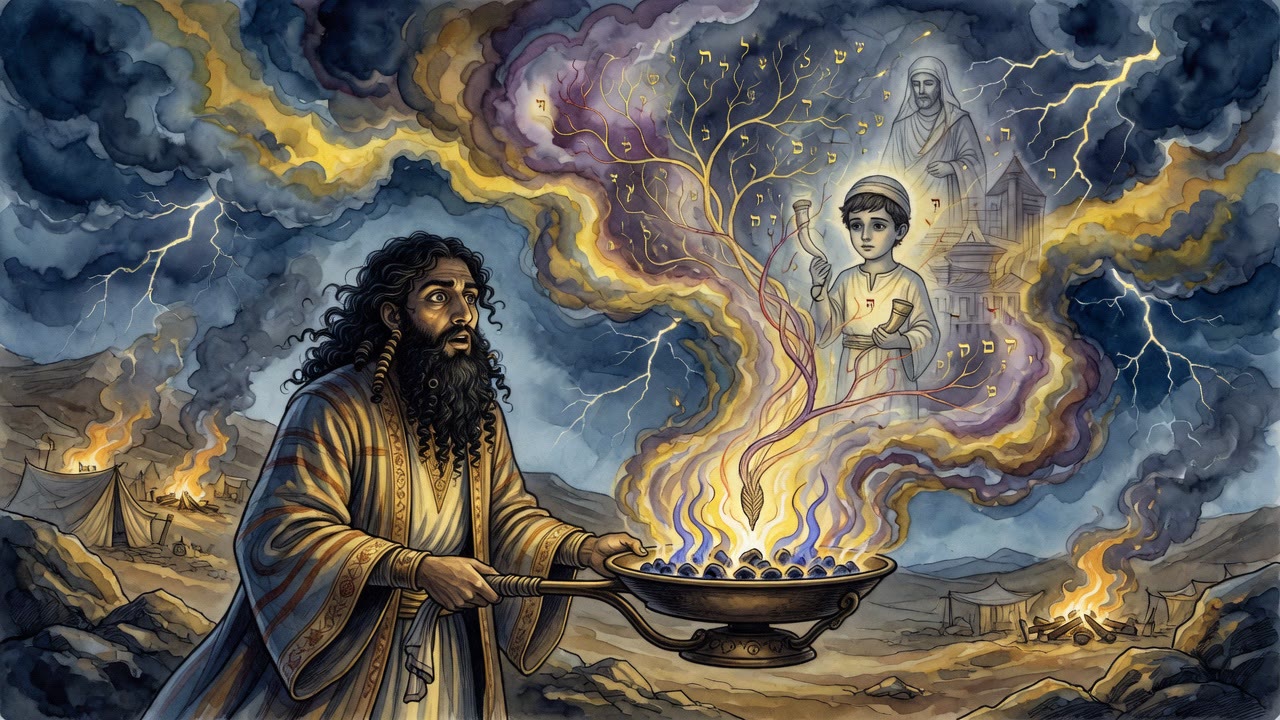
Korah kept looking. He saw twenty-four watches of his descendants standing in the Temple courts, the divine spirit resting on them, their voices climbing in song. He saw Heiman the singer, son of Joel, son of Samuel, of the family of Korah, his hands moving across the great harp of the Levitical choir (I Chronicles 25:5). Every face in the vision was real. And Korah, watching his own future blaze down that corridor, asked himself the question that destroyed him. If such greatness is coming out of my body, how can I keep silent? How can I not reach out and take what is so plainly mine?

The Corridor of Generations

The vision was true. The reading was false. What Korah could not see was the hinge the whole future turned on. The glory in his line would not grow out of his ambition. It would grow in spite of it, out of a choice his sons had not yet made. But a man who believes the future already belongs to him does not wait, therefore Korah gathered two hundred and fifty leaders of the congregation, men of name and standing, and marched them to the tent of Moses with a single grievance on their lips. All the congregation is holy. Why do you raise yourselves above it?

One Altar, One High Priest

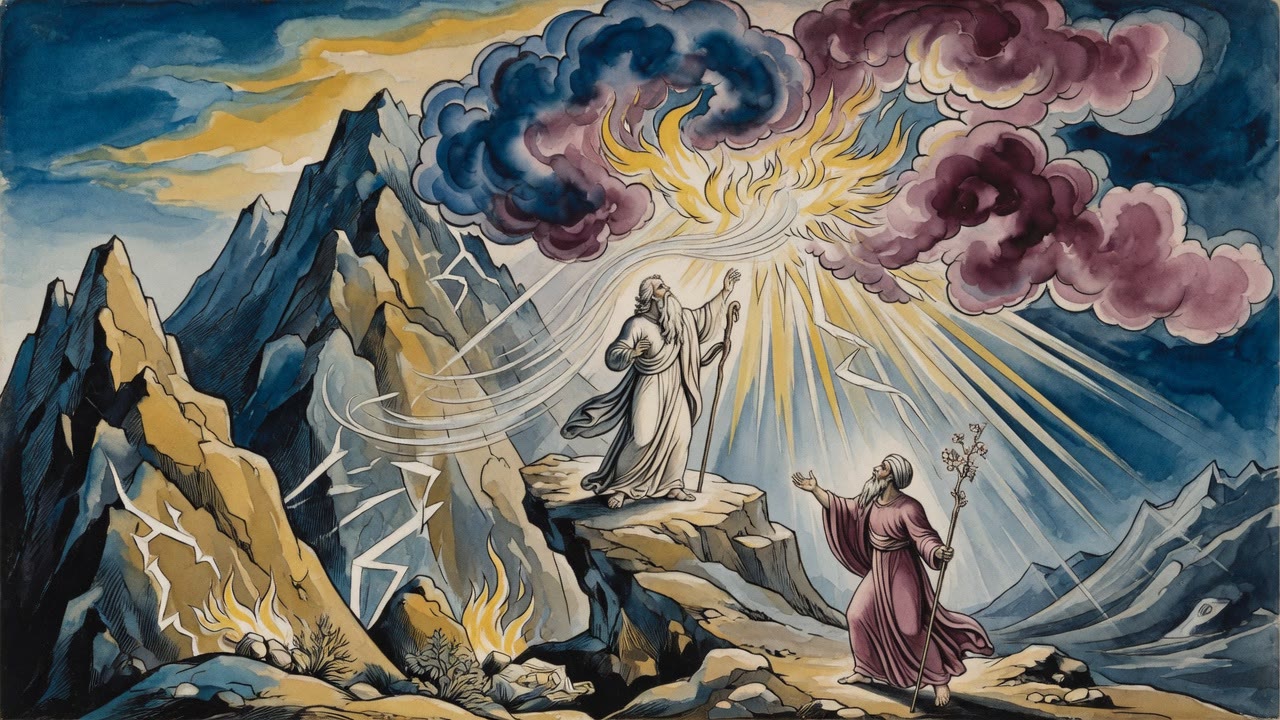
Moses heard them out. Then he gave them an answer that was also a door swinging open onto a furnace. "Take fire-pans, Korah and all his company, and put fire in them, and lay incense on them before the Lord tomorrow, and the man whom the Lord chooses, he is the holy one" (Numbers 16:7).

Moses had chosen the test with his eyes open. The nations around them kept many priests, many shrines, many competing rites, but Israel had one Lord, one Torah, one altar, and one High Priest. Two hundred and fifty men were reaching for a single office that could hold only one pair of hands. The ketoret (קְטֹרֶת), the sacred blend of spices sent up in smoke, was the most precious of all the offerings brought before God, and it was also the most lethal.

Poison in the Incense

Moses did not soften the danger. He warned them in plain words that a deadly poison rode inside this service. The whole camp carried the proof in living memory. Nadav and Avihu, the sons of Aaron himself, had brought strange fire before the Lord, and fire had come out and consumed them where they stood (Leviticus 10:1-2). Anointed priests, sons of the High Priest, burned for a single unauthorized offering.

They took the pans anyway, each man convinced that their numbers and shared holiness would press down the scale, that God would not choose one man over so many. In the morning they came, coals glowing, smoke rising from two hundred and fifty hands at once, and stood at the entrance of the Tent of Meeting.

Fire Above, Earth Below

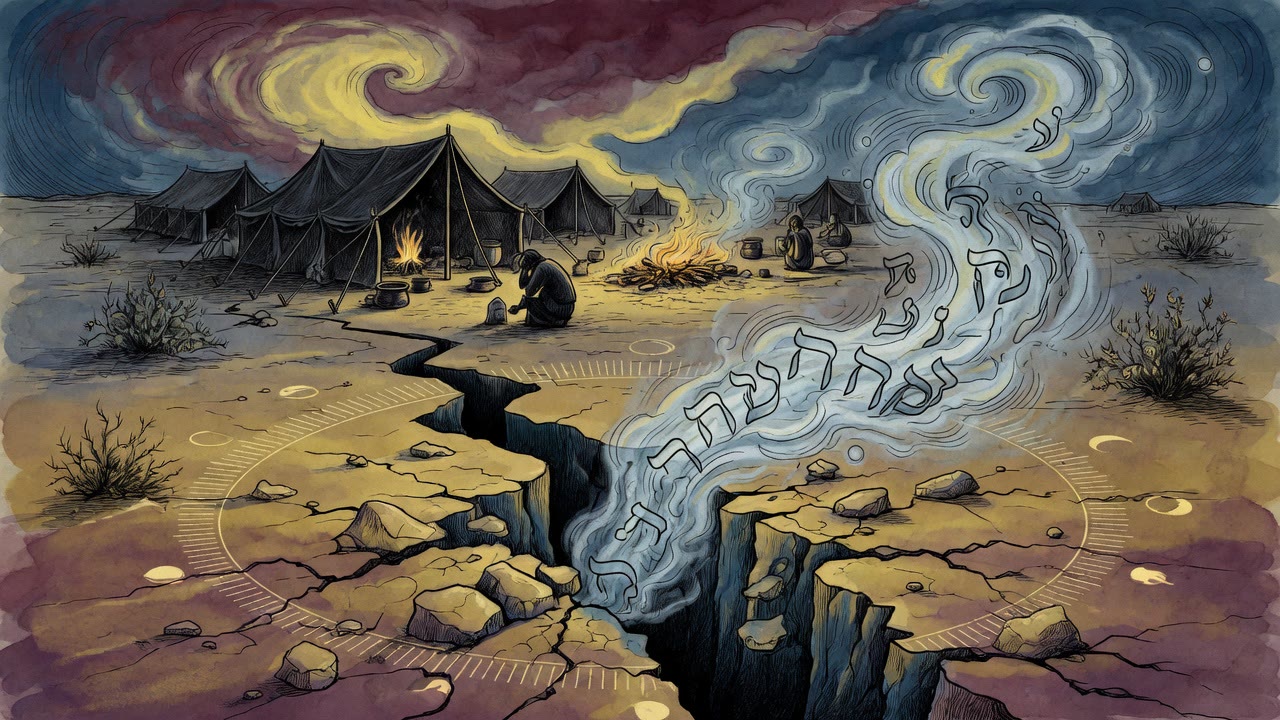
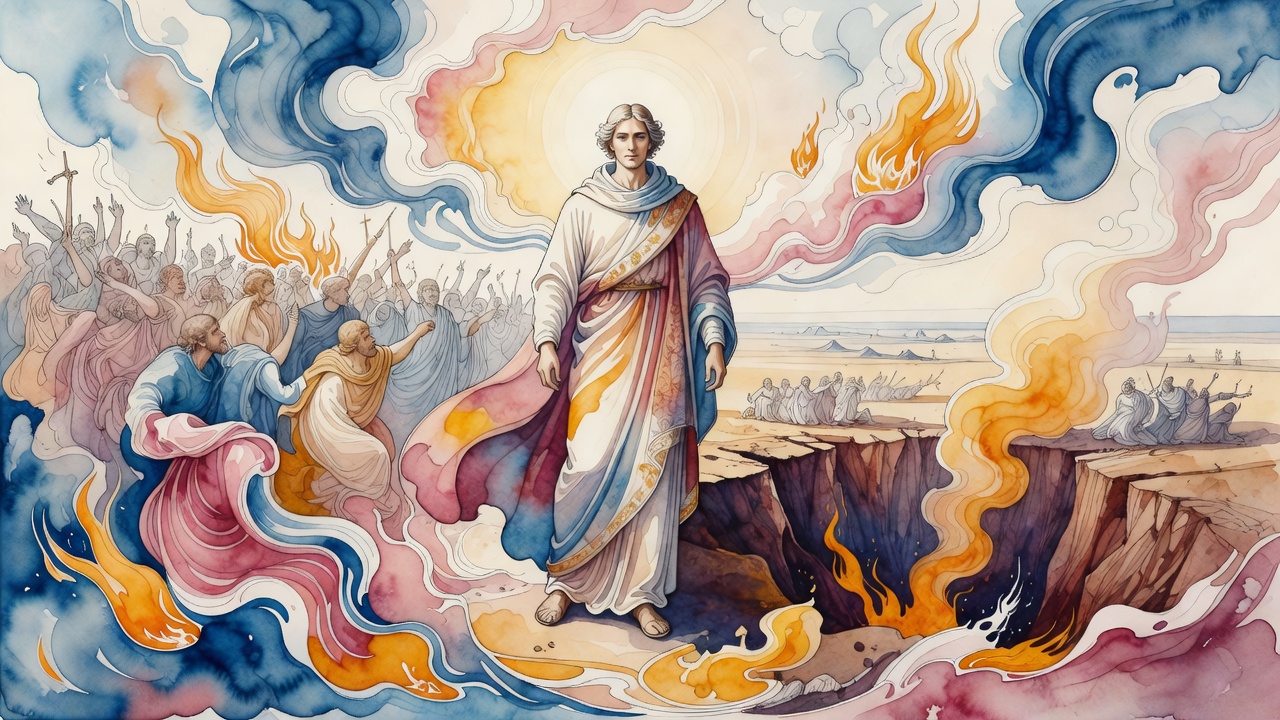
Fire came out from the Lord and consumed the two hundred and fifty men offering the incense (Numbers 16:35). The ground tore open beneath Korah's followers and swallowed them, their households, and everything that stood on their ground. Two companies of the condemned, one taken by flame above, one by the pit below.

Korah himself received both. The fire that ate the incense-bearers seized him first, and then, burning, rolled like a ball of flame across the broken ground and down into the chasm that had already taken the others. He died in the fire and he died in the earth, and each company of the condemned watched him share its fate. Had he only burned, the swallowed could have said he escaped their punishment. Had he only been swallowed, the burned could have said the same. No mouth, above the ground or under it, could claim that Korah got away. Afterward the fire-pans of the dead were gathered and hammered into copper plating for the altar, "a sign for the children of Israel" (Numbers 17:3), so that every offering forever after would rest on the flattened ambitions of the men who reached too far.

The Sons Who Stepped Back

One line in the ledger of the dead reads differently. "But the sons of Korah did not die" (Numbers 26:11). At the edge of the catastrophe, with their father's voice still ringing in their ears, his sons stepped back. Something in them refused the rebellion, and that turning, that teshuvah (return to God), became the hinge Korah never saw. Samuel came from them. The twenty-four watches stood because of them. Heiman's hands found the harp because his fathers' hands had let go of the fire-pan.

Korah had seen all of it correctly and read all of it backward. He looked at the glory in his bloodline and took it as a verdict already issued in his favor, a debt heaven owed him. It was the wage of a repentance not yet made, by sons who chose differently than their father while the ground groaned under his feet. The corridor of generations was real. He simply was not in it.


← All myths
From the tradition

Sources

2 sources

The texts this telling draws on, in full. Open a card to read inline, or expand it for a wider, quieter read.

Bamidbar Rabbah 18:8Bamidbar Rabbah

It’s a tale of ambition, delusion, and a very dangerous offering.

The scene is set: Moses, leading the Israelites. And then comes Koraḥ, a Levite, challenging Moses’s leadership, specifically around the priesthood. He and his followers, two hundred and fifty prominent men, confront Moses. "This you shall do," Moses tells them, "take for you fire pans, Koraḥ, and all his congregation." (Numbers 16:6). And then the challenge: "And place fire in them, and place incense upon them before the Lord tomorrow, and it will be the man whom the Lord will choose, he is the holy one; it is too much for you, sons of Levi" (Numbers 16:7).

Why incense? Bamidbar Rabbah asks, what did Moses see that led him to propose such a test?: in other nations, there are many priests, many rituals. But Israel has "one Lord, one Torah, one protocol, one altar, and one High Priest." So why are so many of you – two hundred and fifty men – seeking the High Priesthood? Moses is essentially saying, "This is a sacred, singular role, and you're treating it like a free-for-all."

Moses even points out the inherent danger. Incense, the ketoret, the most beloved of all services, is also fraught with peril. Think back to Nadav and Avihu, who offered "strange fire" and were consumed (Leviticus 10:1-2). As the text in Bamidbar Rabbah emphasizes, "a deadly poison was placed within it." That’s why Moses warns them: only the one chosen by God will survive. It’s a serious gamble.

"It is too much for you, sons of Levi," Moses declares. He is saying, "I'm warning you, this is a dangerous game." Weren’t they fools, the text asks, to accept this challenge after such a clear warning? They were, as it says: “The firepans of these sinners against their souls” (Numbers 17:3).

But what about Koraḥ himself? He was, after all, considered wise. What drove him to such a seemingly foolish act? Bamidbar Rabbah suggests that his "eye deceived him." He foresaw a great dynasty emerging from his lineage. He saw the prophet Samuel, who is equal to Moses and Aaron, as it is stated: “Moses and Aaron among his priests, and Samuel among those who called His name” (Psalms 99:6). He saw twenty-four watches of his descendants, all prophets, filled with the divine spirit. “All of these were sons of Heiman, [the king's seer in matters of God] From the sons of the Kehatites: Heiman the singer, son of Yoel, son of Samuel…son of Koraḥ” (I (Chronicles 25:5), I (Chronicles 6:18), 22).

Imagine seeing that future, that potential for greatness stemming from your own family! Koraḥ must have thought, "How can I stay silent? How can I not strive for more, knowing what my descendants are destined to achieve?"

But here's the crucial point: Koraḥ’s vision was incomplete. He didn’t see why this greatness would emerge from his line. He didn't see that it was because his sons would ultimately repent. Moses, however, did see this. That is why Koraḥ participated, based on his presumption regarding what he heard from the mouth of Moses, that all of them would be eliminated, and one would survive: "It will be the man whom the Lord will choose, he is the holy one."

The story of Koraḥ is a potent reminder that ambition, while not inherently bad, can blind us. It can lead us to misinterpret signs, to overestimate our own abilities, and to ignore warnings. And it’s a story of the power of repentance, of how even from a place of rebellion, redemption is possible. What do you think, is Koraḥ a villain, a misguided visionary, or something in between?

Full source
Legends of the Jews 5:21Legends of the Jews

The story of Korah is a chilling example. We find it in the Book of Numbers (Numbers 16), but the Rabbis and storytellers throughout the ages have embellished it, explored it, and made it a truly terrifying morality tale.

Korah, as you may recall, instigated a rebellion against Moses and Aaron. He challenged their leadership, their authority, their very connection to God. And as we know, things didn't end well for him or his followers.

The earth opened up and swallowed some of Korah's band. But what about Korah himself? The Torah tells us that the two hundred and fifty men who offered incense with Aaron were consumed by a divine fire (Numbers 16:35). But Korah? He faced something far more… comprehensive.

In Legends of the Jews, a work compiling Midrashic (rabbinic interpretive commentary) and Talmudic traditions, Korah was first consumed by the very same fire that engulfed the incense-offering rebels. But that wasn't the end. No, his punishment was far from over.

Imagine this: consumed by fire, he then transformed into a ball of flame. A terrifying, writhing sphere of pure, agonizing retribution. And in this state, he rolled, burning, toward the chasm in the earth that had already claimed so many of his followers, and vanished within it.

Why this double dose of divine wrath? Why both fire and the earth?

The Rabbis, in their infinite wisdom, saw a profound justice at play. The Midrash, particularly Midrash Rabbah, explores the nuances of this multi-layered punishment. If Korah had only been consumed by fire, those swallowed by the earth might have cried out, "Korah led us to our doom, yet he escaped it himself!" (Numbers 16:30-33)

And conversely, if Korah had only been swallowed by the earth, those consumed by fire might have lamented, "The one who caused our destruction went unpunished!"

This double punishment, then, ensured that no one could claim injustice. All those who suffered – whether by fire or by the earth – witnessed their leader sharing their fate. They all saw Korah experience their same terrifying demise.

It's a stark reminder that actions have consequences. That challenging divine authority, inciting rebellion, and undermining faith can lead to a truly terrible end. More than that, it's a reminder that justice, even when it seems harsh, strives for a complete and all-encompassing reckoning. It’s meant to be seen by all.

So, the next time you hear the name Korah, remember not just his rebellion, but the fiery, earth-shattering consequences that followed. And consider: what kind of legacy do we want to leave behind?

Full source