Parshat Korach6 min read

Korah's Widow, His Lie, and the Voice at Sinai

A widow with two daughters loses everything to priestly law, and Korah turns her tears into a weapon against Moses and Aaron in the wilderness.

Curated by Arthur · Told by Maggid ·
Table of Contents
  1. The voice in the assembly drops to a whisper
  2. The harvest is taken piece by piece
  3. Nothing is left but the shoulder and the cheeks
  4. Every law was true and the widow was never real
  5. The argument at Sinai turns against the men who carried it

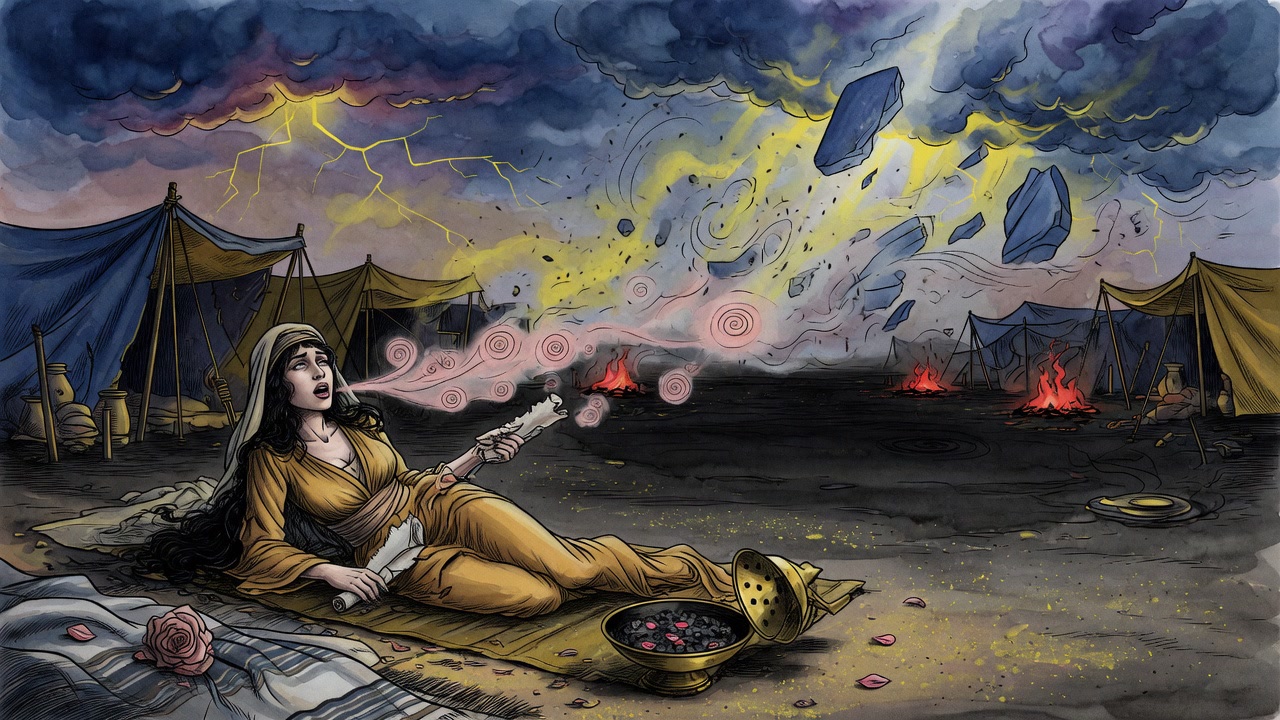
The crowd pressed in close enough that Korah could smell the dust on their robes, and he lowered his voice the way a man does when he wants every ear to lean toward him. He did not shout. He told a story. Around him the camp of Israel went still, mothers holding children, men setting down their tools, and the name of a widow none of them had ever met began to move through the assembly like smoke.
The voice in the assembly drops to a whisper

There was a widow, Korah said, and her two daughters, and a single field barely wide enough to feed them. He let that picture sit. He knew these people. They had buried husbands and fathers in Egypt and in the wilderness, and every one of them could see her, the thin shoulders, the daughters too young to work, the field that was all that stood between them and hunger.

She went out to plow, Korah said. And here he paused. She could not yoke her ox and her donkey together to break the soil (Deuteronomy 22:10). One law, and her plowing was crippled. She tried to sow, and she could not scatter two kinds of seed in the same ground (Leviticus 19:19). A second law, and her planting was halved. The men in the crowd nodded. They knew these laws. They had kept them.

The harvest is taken piece by piece

The grain came up anyway, Korah went on, against the odds, green and then gold. And on the day she went to gather it, the first of her fruit was not hers (Deuteronomy 18:4). It went to the priest. The corners of her little field she could not even reap, because the edges belong to the poor, and the gleanings that fell from her hand she could not stoop to retrieve (Leviticus 19:9-10). Korah named Aaron now for the first time, and the name landed in the crowd like a stone dropped in a well.

The widow gave up on grain. She sold the field, every furrow of it, and bought sheep, because surely a flock would feed two girls where a field had failed. The first lamb born to her, the firstborn of the flock, she carried it in her arms, and Aaron was waiting. The firstborn is the priest's. The first shearing of the wool, the warmth that would have clothed her daughters through the desert nights, Aaron took that too. A tithe of the whole flock, one in ten, walked away toward the sanctuary.

Nothing is left but the shoulder and the cheeks

So she made her decision, Korah said, and his listeners were leaning so far forward they were almost touching him. She would slaughter the sheep. If the law devoured her flock alive, she would at least eat the meat. She raised the knife. And the priest's portion is the shoulder, the two cheeks, and the stomach (Deuteronomy 18:3). Aaron's hands were already open.

In her grief, Korah said, the widow did the only holy thing left to her. She declared the carcass devoted, consecrated wholly to the sanctuary, lifting it out of her own use and giving it to God. And whatever is devoted in Israel belongs to the priest. Aaron took it. The meat, the wool, the lambs, the grain, the field, all of it gone, and the widow and her two daughters stood with empty hands in the dust.

Korah let the silence stretch. Then he delivered it, flat and cold as a verdict. "Such are Moses and Aaron," he said, "who pass off their own cruelty as the law of God." The crowd made a sound, low and angry, and Korah had them.

Every law was true and the widow was never real

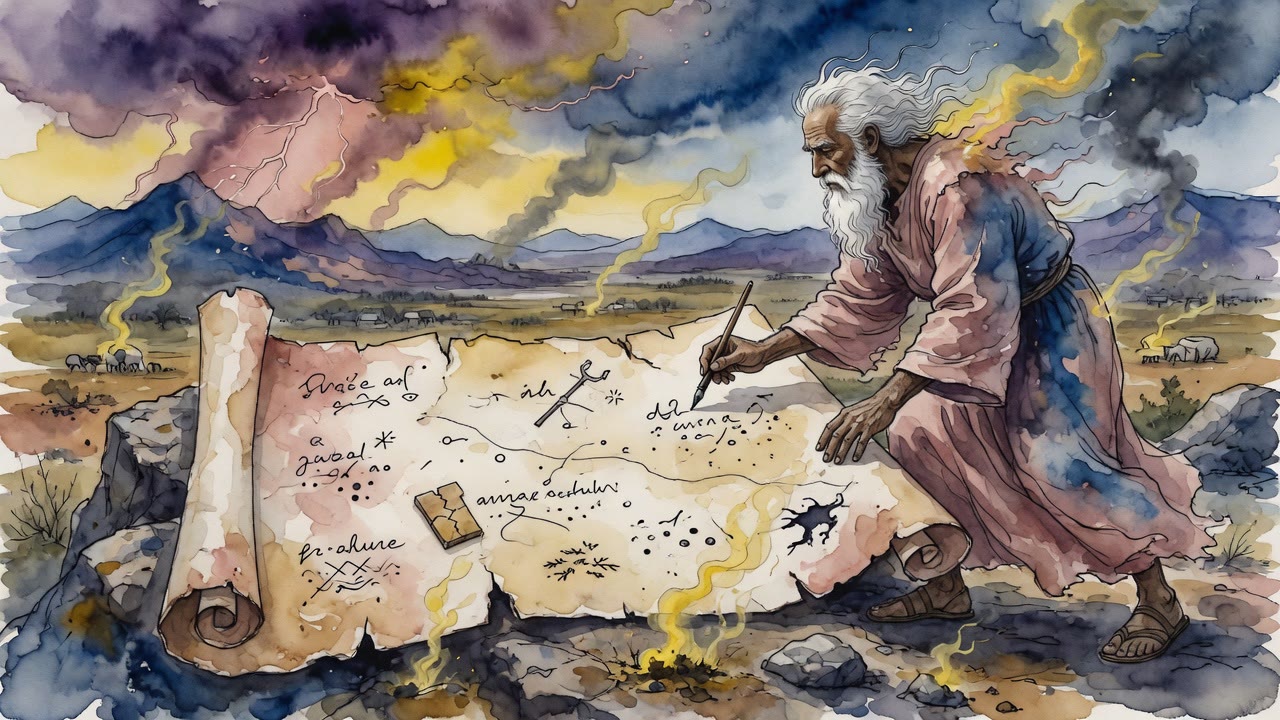
None of it had happened. There was no widow. There were no two daughters, no sold field, no slaughtered flock. Korah had built her out of nothing but true things. Every law he cited was a real law, written and kept, and he had strung them one after another around an invented woman until the laws themselves looked like a trap closing on the innocent. The tears were borrowed. The hunger was staged. The Israelite who wept for her was weeping at a shape Korah had made for him to weep at.

The argument at Sinai turns against the men who carried it

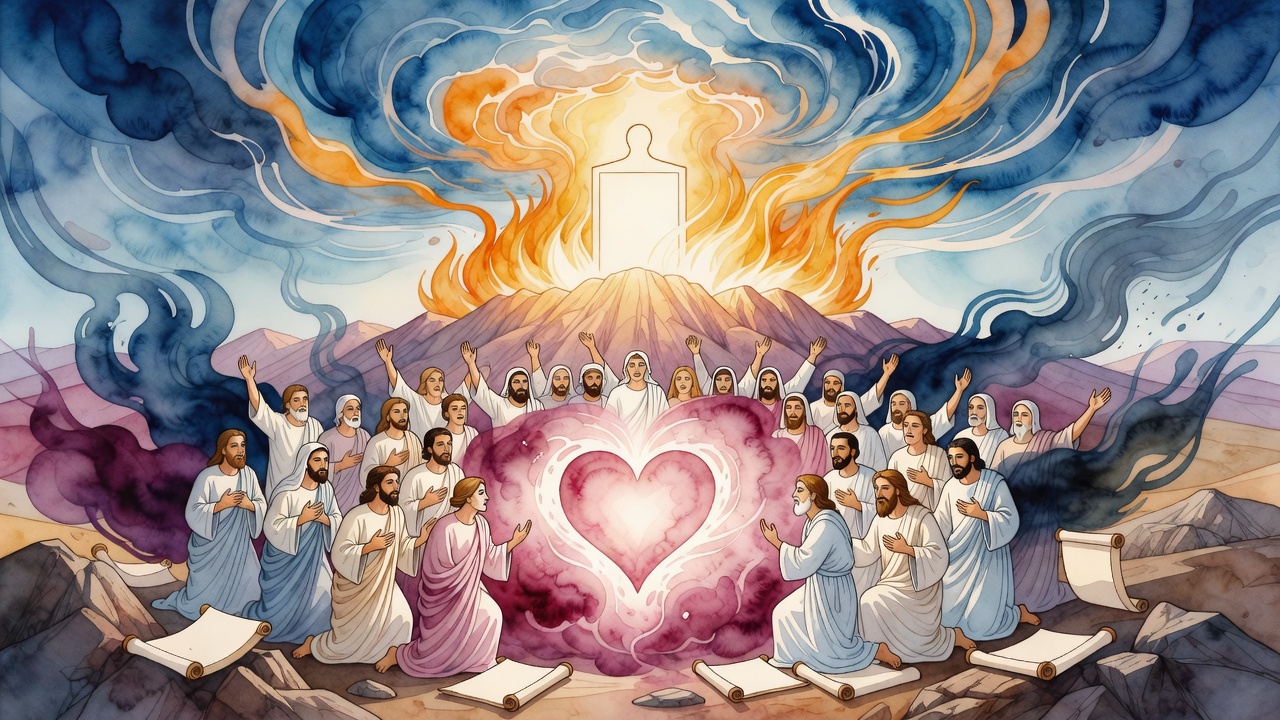
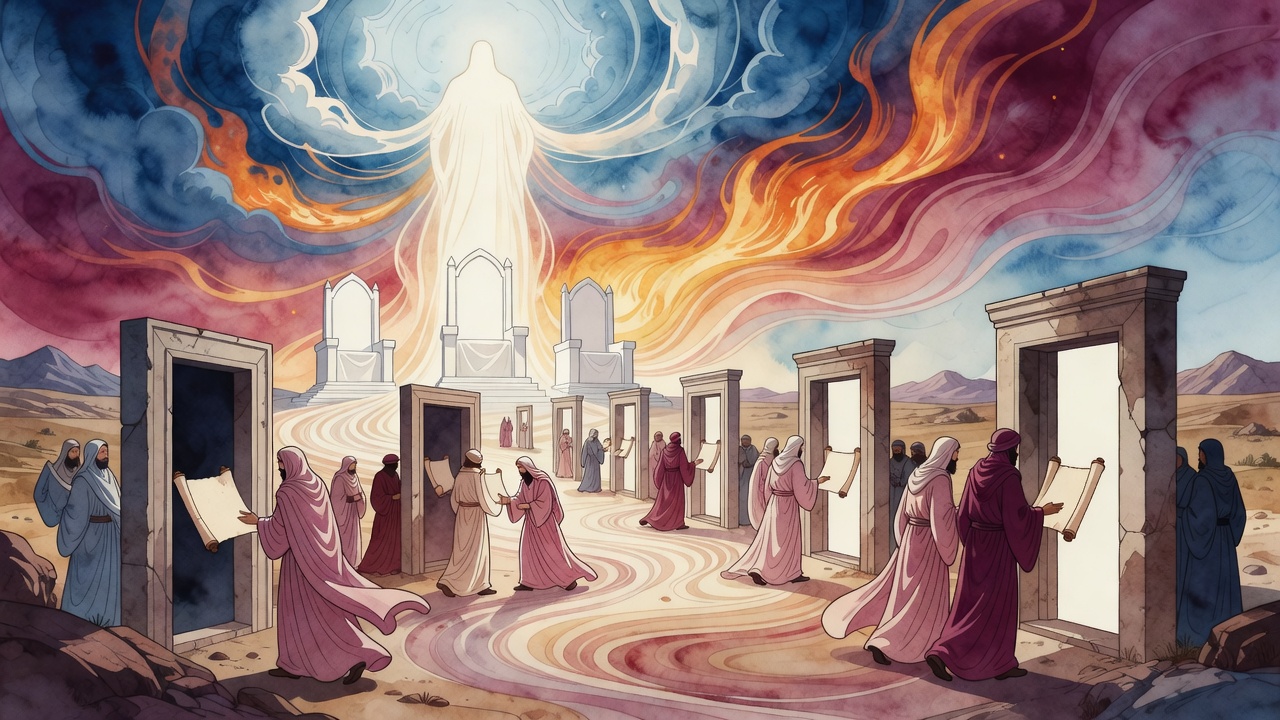
Korah had a second weapon, and this one needed no fiction at all. He stood before Moses and the gathered congregation and made his claim plain. "The whole community is holy, all of them, and the Lord is in their midst" (Numbers 16:3). Every soul standing in that camp had stood at the mountain. Every one of them had heard the voice say, "I am the Lord your God" (Exodus 20:2). They had all heard it. Not Moses alone, not Aaron alone. All of them.

So why, Korah demanded, do you raise yourselves above the assembly of the Lord? It was unanswerable on its own terms, because it was true. The voice had come to everyone. Korah hammered the heart of it until it rang. If we all heard God speak with our own ears, what makes these two men more holy than the rest of us?

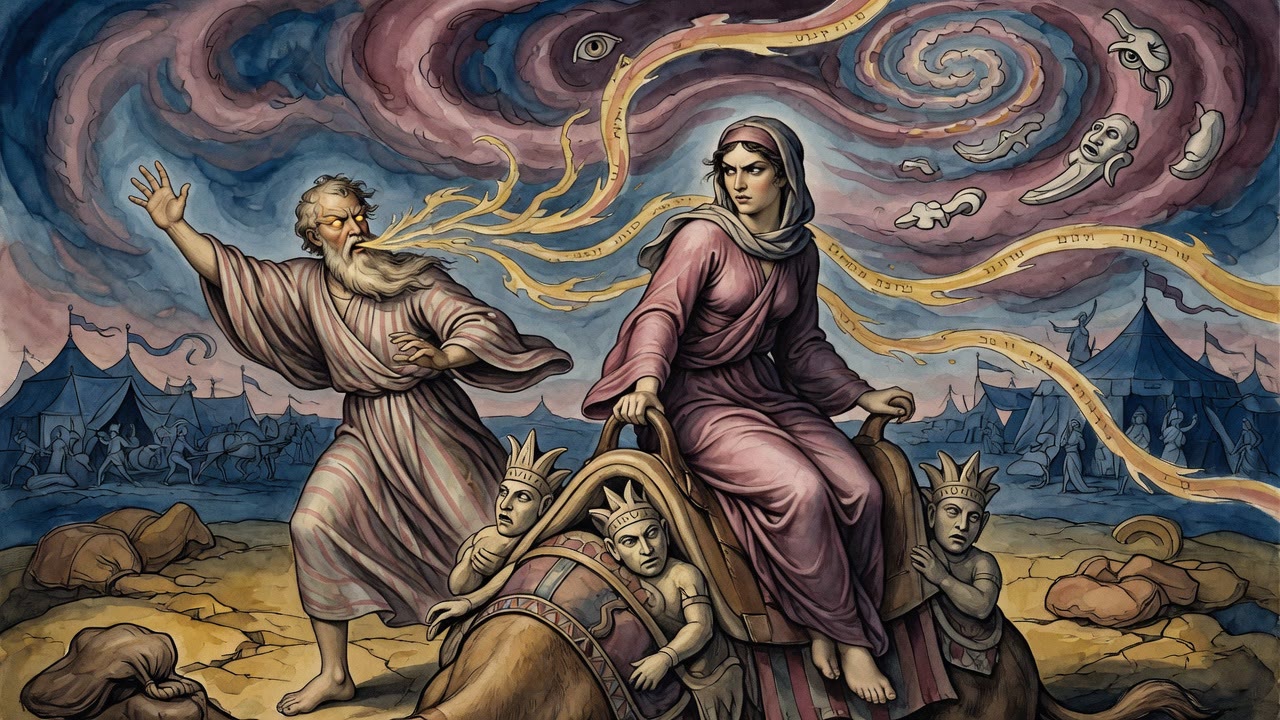
That was the whole of his rebellion. Not a sword, not an army. A widow nobody could find and a fact nobody could deny, fitted together so that the man who heard them felt the truth burning in his chest and never noticed that the hand arranging it belonged to a Levite who wanted Aaron's place. The most dangerous lie is the one with no lie in it, only true pieces, laid in the wrong order, by a man who knows exactly where to stand.


← All myths
From the tradition

Sources

2 sources

The texts this telling draws on, in full. Open a card to read inline, or expand it for a wider, quieter read.

Legends of the Jews 5:7Legends of the Jews

That feeling isn’t new. to a story about Korah, a figure who challenged Moses and Aaron, found in Legends of the Jews by Louis Ginzberg, which itself draws from various Midrashic (rabbinic interpretive commentary) sources.

Korah, according to the legends, wasn’t just griping; he was actively stirring up rebellion. His main tactic? Painting Moses and Aaron as greedy and oppressive. He focused on the terumot (tributes) imposed on the people for the priests. To illustrate his point, Korah concocted a heartbreaking story. It's propaganda, pure and simple, but with a devastating emotional core.

A widow, struggling to support her two daughters. All she has is a small field, barely enough to keep them alive. But every time she tries to work the land, Moses appears with another seemingly impossible demand.

First, she can't plow with an ox and an ass together (Deuteronomy 22:10). Then, she can’t sow different kinds of seeds in the same field (Leviticus 19:19). As the first fruits appear, Moses tells her she must give them to the priests, because they are "the first of all the fruit of the earth" (Deuteronomy 18:4). And when harvest time arrives, she's ordered not to reap the edges of her field, nor gather the gleanings, but to leave them for the poor (Leviticus 19:9-10).

You can almost feel her desperation. After all this, after following every instruction, she’s about to thresh the grain when Moses reappears. More demands: the terumah (heave offering), the first tithe, and the second tithe, all for the priests. At this point, the widow realizes she can’t possibly survive. She sells her field and buys sheep, hoping for a little peace.

But no.

When the first lamb is born, Aaron arrives, demanding it because the firstborn belongs to the priest (Numbers 18:15). The same thing happens with the wool. At shearing time, Aaron takes "the first of the fleece" (Deuteronomy 18:4). And then, unbelievably, he returns for one sheep out of every ten as a tithe (Leviticus 27:32).

This is the last straw. The widow, pushed to the brink, slaughters her sheep, thinking she can finally keep the meat. But Aaron appears again, citing the Torah to demand the shoulder, the two cheeks, and the maw (Deuteronomy 18:3).

The woman cries out, "The slaughtering of the sheep did not deliver me out of thy hands! Let the meat then be consecrated to the sanctuary." But Aaron replies, "Everything devoted in Israel is mine" (Numbers 18:14). He takes the meat, leaving the widow and her daughters weeping in despair.

Korah then delivers his punchline: "Such men are Moses and Aaron, who pass their cruel measures as Divine laws."

Ouch. Talk about a persuasive (if manipulative) story. It’s a powerful indictment of perceived injustice, tapping into the deep-seated human desire for fairness.

It makes you wonder: how do we ensure that religious authority doesn't become a tool for oppression? How do we balance the needs of the community with the rights of the individual? These are questions that resonate even today, long after Korah told his fictional tale of woe.

Full source
Bamidbar Rabbah 18:6Bamidbar Rabbah

In this week's portion, we encounter the rebellion of Koraḥ, a story that's not just about one disgruntled guy, but about the very foundations of leadership and faith. "Koraḥ assembled…against them," the Book of Numbers (16:19) tells us, setting the stage for a dramatic showdown.

What was Koraḥ's argument? He essentially accused Moses and Aaron of elitism. "The entire congregation, all of them are holy," Koraḥ declared, as we find in (Numbers 16:3). "And all of them heard at Sinai: 'I am the Lord your God' (Exodus 20:2), and why do you elevate yourselves over the assembly of the Lord?" It's a powerful point. Everyone at Sinai experienced God's revelation. Who were Moses and Aaron to act like they were somehow better or more important?

In Bamidbar Rabbah, Koraḥ was really laying it on thick. He hammered home that everyone present at Sinai heard the divine voice, making them all equally worthy. So, what gave Moses and Aaron the right to positions of authority?

Picture Moses hearing this. Bamidbar Rabbah says he was immediately shaken. Why? Because this wasn't just a random disagreement; it was the fourth time the Israelites had challenged his leadership. The text then offers a really poignant analogy, a mashal, about a king's son who repeatedly misbehaves. Imagine a king's son who keeps messing up. He wrongs his father, the king, and each time, a dear friend of the king steps in to plead for forgiveness. Once, twice, three times this friend is successful. But what happens the fourth time? The friend's hands are, as Bamidbar Rabbah puts it, "rendered powerless." They think, "How many times can I impose upon the king?"

This is how Moses felt.: The Golden Calf (Exodus 32:11) – Moses prayed. The people complaining (Numbers 11:1) – Moses prayed (Numbers 11:2). The incident with the spies (Numbers 14:13) – Moses pleaded with God, reminding him that the Egyptians would hear and think God wasn't powerful enough to bring them into the land.

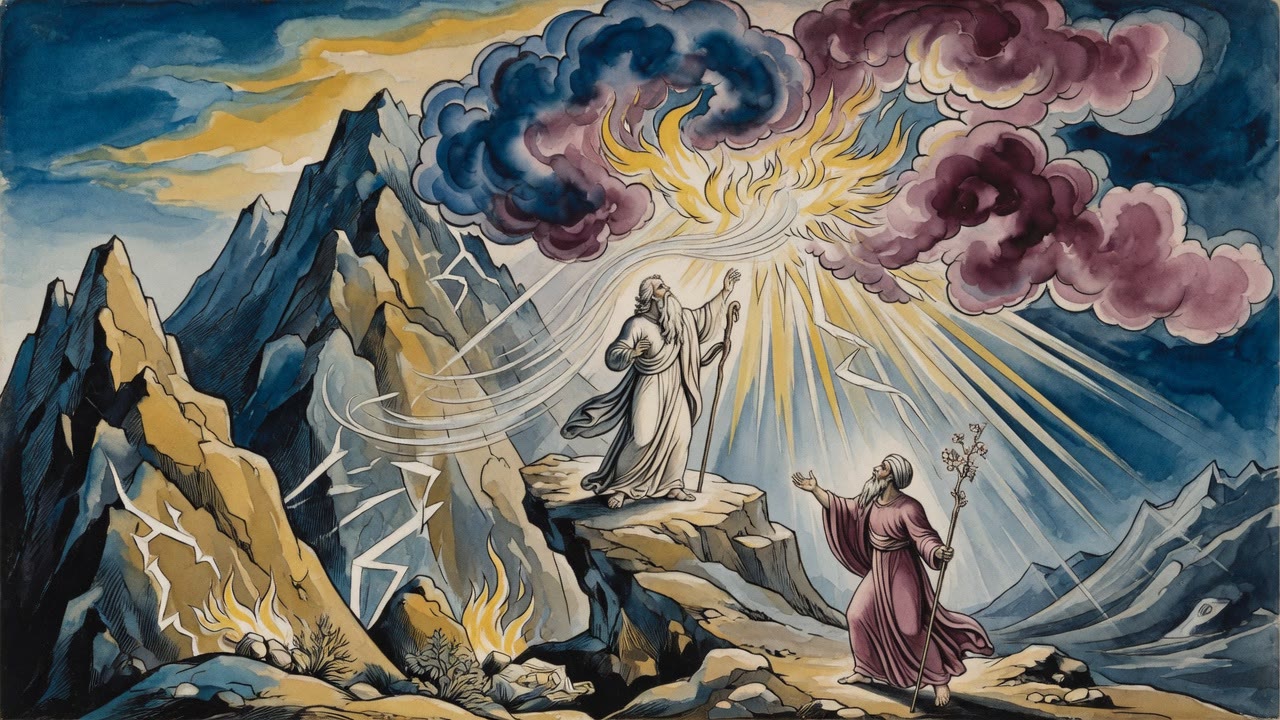
But with Koraḥ's rebellion, Moses felt he had reached his limit. "How much can I impose upon the Omnipresent?" he must have wondered. That's why, as (Numbers 16:4) tells us, "Moses heard and he fell on his face." He was utterly overwhelmed.

This moment, Moses falling on his face, is more than just a physical reaction. It's a moment of profound vulnerability, of feeling the crushing weight of responsibility and the sting of repeated rejection. It's a reminder that even the greatest leaders, the most devout individuals, can reach a point where they feel they have nothing left to give.

What do we learn from this? Perhaps it’s a reminder that leadership isn't just about authority, but about the delicate balance between guidance, humility, and the understanding that even the most patient among us has a breaking point. And maybe, just maybe, it's a call to be a little more understanding, a little more forgiving, and a little less quick to challenge those who are trying to lead us forward.

Full source