Parshat Bo4 min read

The Moon Waxed From Abraham Straight to Solomon

Solomon made the shields of gold. Rehoboam replaced them with bronze. The kings kept shrinking until Zedekiah, whose eyes were put out.

Curated by Arthur · Told by Maggid ·
Table of Contents
  1. This Month Is for You
  2. A New Birthday of Freedom
  3. Flesh That Is Not Bronze
  4. Two Brothers Share the Honor
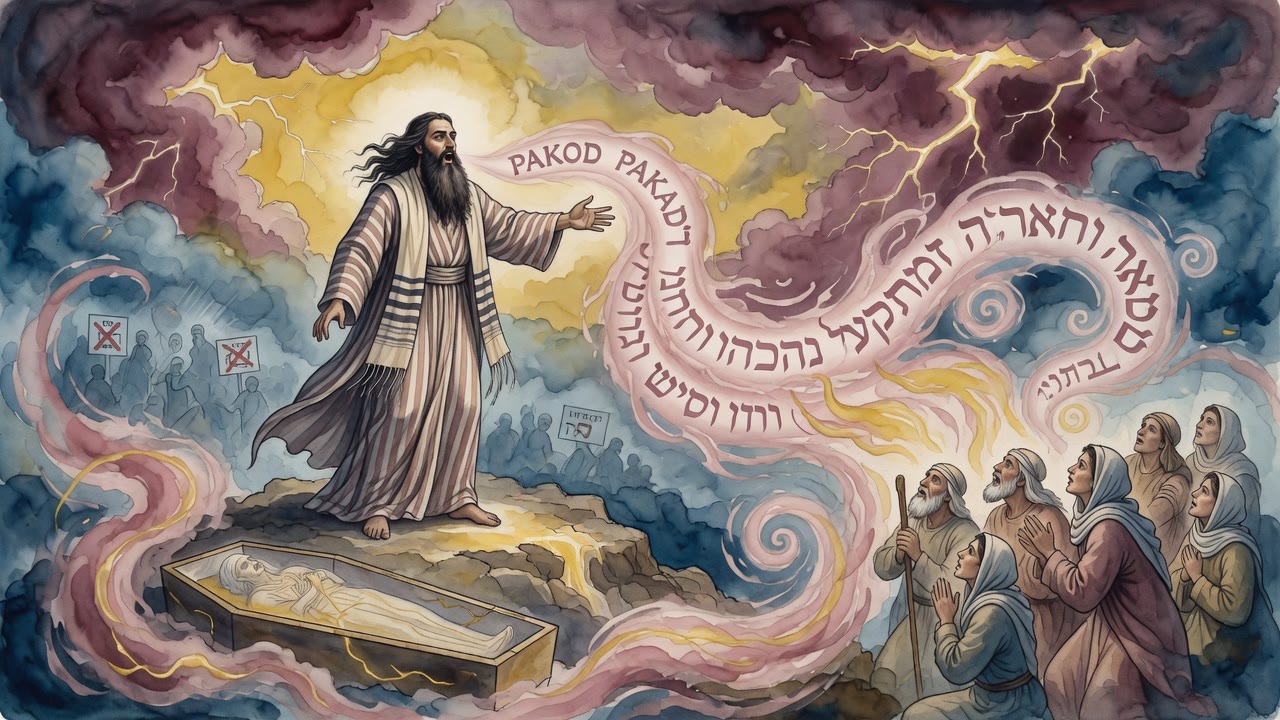
The Moon Waxed From Abraham Straight to Solomon Click for full size

This Month Is for You

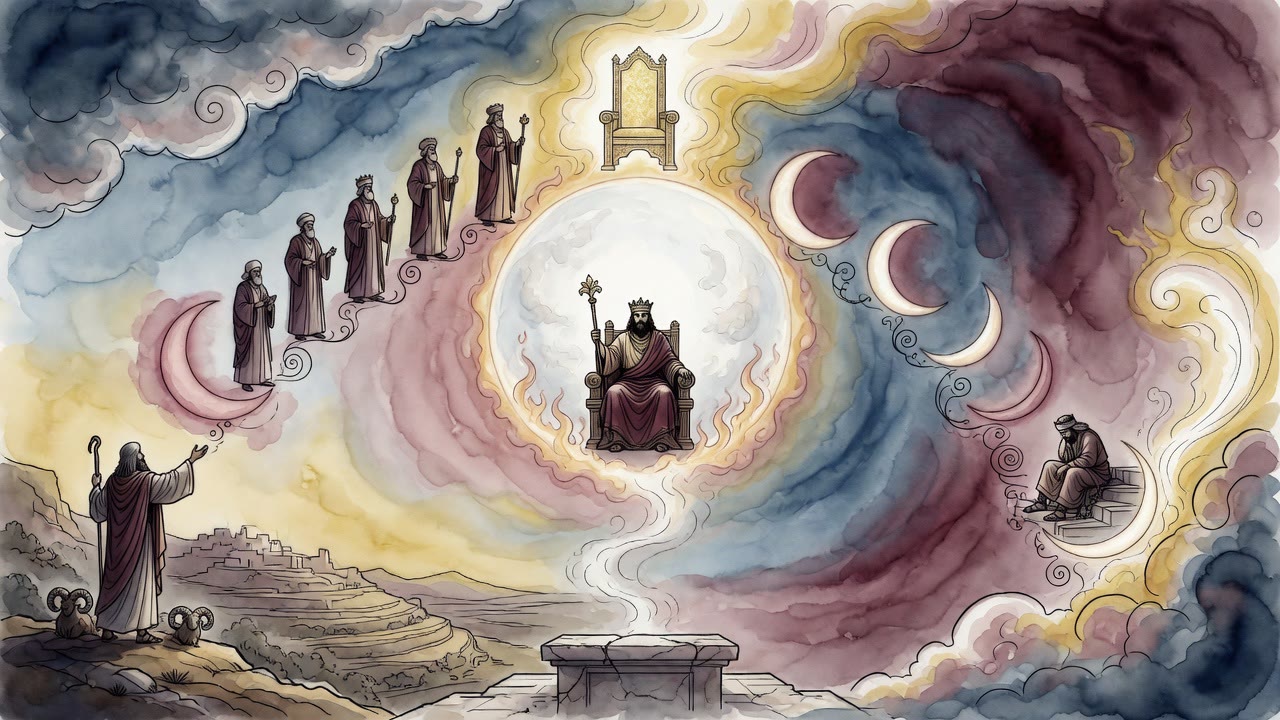
"This month is for you" is a charge about how Israel counts time. When the people are worthy, they reckon by the moon as it swells toward fullness. The generations climb from Abraham through David to Solomon, who sat upon the throne of the LORD as king. That is the moon at the full.

When Israel is not worthy, they count its waning. Solomon made shields of gold. Rehoboam made them of bronze in their place. Kings diminish until Zedekiah, whose eyes were put out. The moon had set.

The Assembly of Israel cried out. How long shall darkness sit on us while the nations hold the light? He answered that the day comes when the darkness will be theirs and the radiance yours.

A New Birthday of Freedom

Shemot Rabbah offers a king whose son is captured for years. When the son is redeemed, the day of redemption becomes a new birthday, not a continuation of the old count from birth.

That is what happened in Egypt. Time was measured by the weight of enslavement and the four hundred years named to Abraham. Once they were freed, "This month shall be for you the first of months." They stopped counting down and began counting up from deliverance.

Redemption is not only exit. It is a new clock. Nisan becomes first not because the sun changed, but because a people did.

Flesh That Is Not Bronze

Still in chains, Israel lifts a plea from Job. "What is my strength, that I should keep waiting? Is my strength the strength of stones? Is my flesh forged of bronze?" Flesh wears thin. How much longer can hope hold?

The Holy One does not scold them. "Every hope you carried through bondage, you hoped well. Not one of those hopes was wasted." Then the turn. "And in this month you are redeemed." Patience nearly snapped becomes the doorway to freedom.

"This month" is the answer to a question whispered in chains. The same people who will watch the moon of kingship wax to Solomon and wane to Zedekiah first learn that a month can be a rescue.

Two Brothers Share the Honor

Before the final plague, "And the LORD said unto Moses: Pharaoh will not hearken unto you." Rabbi Judah hears it reaching back to the first plague. Rabbi Nehemiah hears it pointing forward to the sea. Then a verse names two men. "And Moses and Aaron did all these wonders."

Heaven had wished to set the whole parashah to Moses's credit alone. The verse protested, bearing Aaron's name. So the Holy One answered: "I am giving it to the two of you together." "And the LORD spoke unto Moses and unto Aaron."

The moon that swells toward Solomon's throne, the new first month of freedom, the hope that was not wasted, and the shared commission of two brothers all turn on the same claim. Time, honor, and redemption belong to a people who wait, count, and walk out together.

Rehoboam hung bronze where gold had hung. He walked the armory, ordered the new shields into place, and left the room without looking back. A generation later the line still thinned. When the enemy put out Zedekiah's eyes, the moon the midrash had been watching finished its set.

The Assembly of Israel still cried out under that dark. How long? Heaven answered with a month that could still be first, and with two brothers who shared one commission so the wonders would not belong to a single mouth.


← All myths
From the tradition

Sources

4 sources

The texts behind this telling. Some cards carry a translation of the source; others are our own retelling of it, and each card says which. Every card links out to the original.

Midrash Tanchuma Buber, Bo 15:1Midrash Tanchuma Buber, Bo

Translation of the source text.Midrash Tanchuma (Buber), Public Domain, on Sefaria · CC-BY-SA

Another interpretation of "This month" (Exodus 12:2): If you are worthy, you count according to its waxing toward fullness: Abraham, Isaac, and Jacob, [Judah], Perez, Hezron, Ram, Amminadab, Nahshon, Salmon, Boaz, then Jesse, David, and Solomon, "and Solomon sat upon the throne of the LORD as king" (1 Chronicles 29:23). But if not, you count according to its defect: Rehoboam, (Abijah). And from Rehoboam they began to grow defective and decline. Solomon made shields of gold, and once Rehoboam arose he made them of bronze, as it is said, "And King Rehoboam made shields of bronze in their place" (1 Kings 14:27). They began to diminish: (Rehoboam,) Abijah, Asa, Jehoshaphat, (Judah) [Jehoram], Ahaziah, Joash, Amaziah, Uzziah, Jotham, Ahaz, Hezekiah, Manasseh, Amon, Josiah, Zedekiah, [and it is written] "and they put out the eyes of Zedekiah" (2 Kings 25:7). Thus the moon was in its defect. The moon set, and they began to walk in darkness. The Assembly of Israel said before the Holy One, blessed be He: Master of the universe, how long will the darkness of the world be upon us, and the light belong to the nations of the world? The Holy One, blessed be He, said: [By your lives, in the world to come I am bringing darkness upon the nations of the world] and the light to you. Isaiah said, "For behold, darkness shall cover the earth, and thick darkness the peoples; but the LORD shall shine upon them, and His glory shall be seen upon you" (Isaiah 60:2).

Full source
Shemot Rabbah 15:9Shemot Rabbah

Retold in our words. Read the original at the link below.The Sefaria Midrash Rabbah, 2022 · CC-BY

It was about a whole new way of counting time itself.

Think of it this way. Shemot Rabbah, a collection of rabbinic teachings on the Book of Exodus, offers a beautiful analogy to explain this idea. The king mourns, time stretches on, marked only by the son's absence. But then, the son is finally redeemed! Does the king continue counting the years from the boy's birth as before? No! The day of his redemption becomes a new birthday, a fresh starting point for celebration and reckoning.

That's precisely what happened with the Israelites in Egypt. Before the Exodus, their time was measured by the weight of their enslavement. We read in Genesis (15:13) that God told Abraham his descendants would be strangers in a foreign land for four hundred years and that they would be enslaved there. Every day brought them closer to an unknown, but certainly difficult, future.

Once they were freed, once the Holy One, blessed be He, performed miracles on their behalf, everything changed. "This month shall be for you the first of months," God declared (Exodus 12:2). As Shemot Rabbah 15 points out, their timeline shifted. Their redemption became their new beginning. They stopped counting down to some distant, uncertain liberation. Instead, they began counting up, building a future filled with promise and divine purpose.

That even after periods of darkness and hardship, we have the capacity to redefine our lives. To choose a new starting point. To celebrate the moment of our own personal redemptions and let them shape the way we experience time. What "new birthday" can you celebrate today?

Full source
Midrash Tanchuma Buber, Bo 8:1Midrash Tanchuma Buber, Bo

Translation of the source text.Midrash Tanchuma (Buber), Public Domain, on Sefaria · CC-BY-SA

Another interpretation of "This month" (Exodus 12:2). This is what Scripture says: "What is my strength, that I should wait?... Is my strength the strength of stones, or is my flesh bronze?" (Job 6:11-12). Israel said before the Holy One, blessed be He: Master of the Universe, is our strength the strength of stones, and is our flesh of bronze? "What is my strength, that I should wait?" The Holy One, blessed be He, said to them: As you live, all that you hoped for while you were enslaved, you hoped for well; and in this month you are being redeemed.

Full source
Midrash Tanchuma Buber, Bo 8:2Midrash Tanchuma Buber, Bo

Translation of the source text.Midrash Tanchuma (Buber), Public Domain, on Sefaria · CC-BY-SA

What is written above on this matter? "And the LORD said unto Moses: Pharaoh will not hearken unto you" (Exodus 11:9). Rabbi Judah and Rabbi Nehemiah disagree. Rabbi Judah says: This passage speaks from the beginning of the plagues, "Pharaoh will not hearken unto you." But Rabbi Nehemiah says: It is stated in its own place, at the sea more than in Egypt.

"And Moses and Aaron did all these wonders" (Exodus 11:10). The Holy One, blessed be He, sought to give this passage to Moses by himself. The Holy One, blessed be He, said to him: You have taught well; by your lives, to the two of you I am giving it, as it is said, "And the LORD spoke unto Moses and unto Aaron" (Exodus 12:1).

Full source