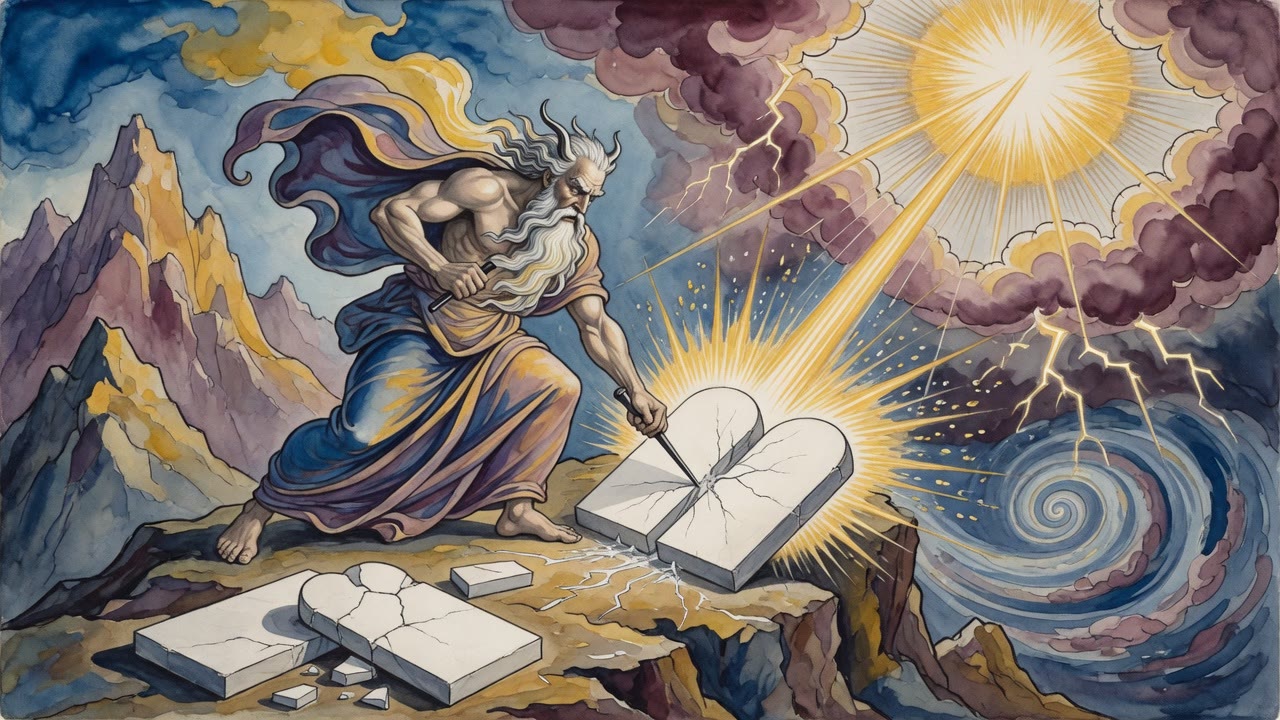
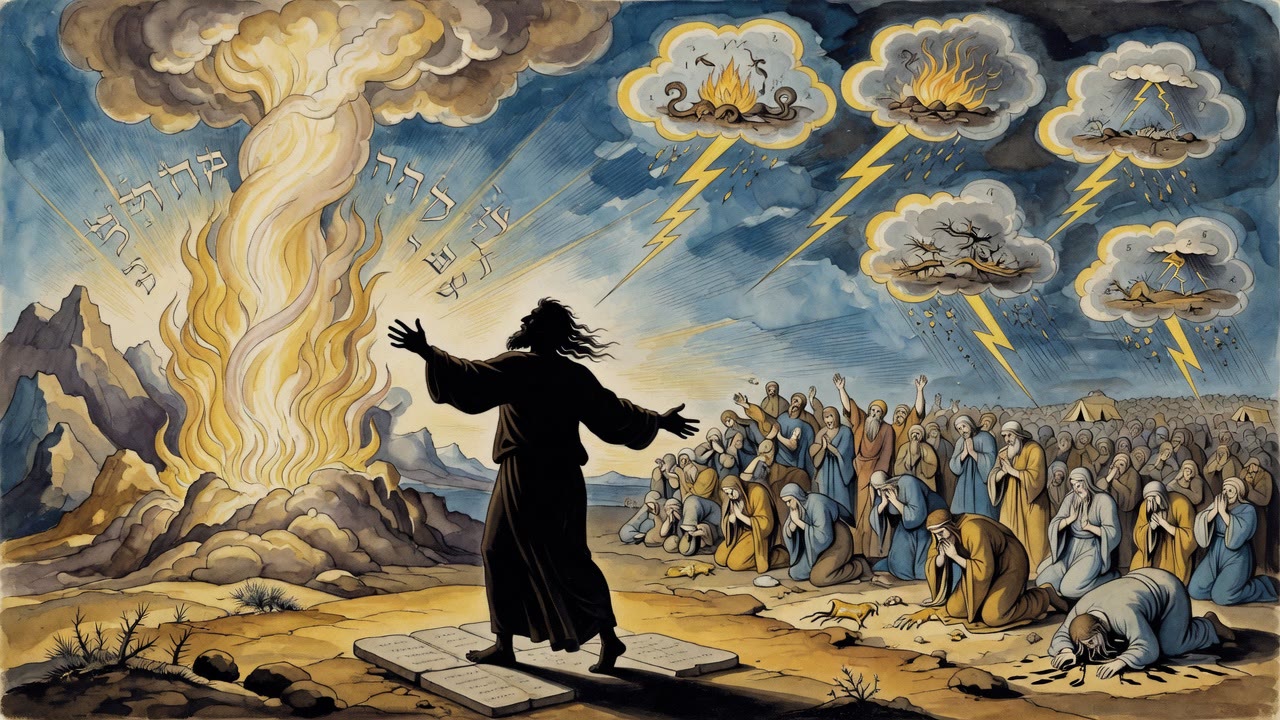
Moses Took the Angels' Praise and Israel Wears It Indoors
Six words of the Shema go up in full voice. The next line drops to a murmur, as if Israel were wearing stolen stones in a locked room.
Table of Contents
 Click for full size
Fire on the Mountain and a Voice Above It
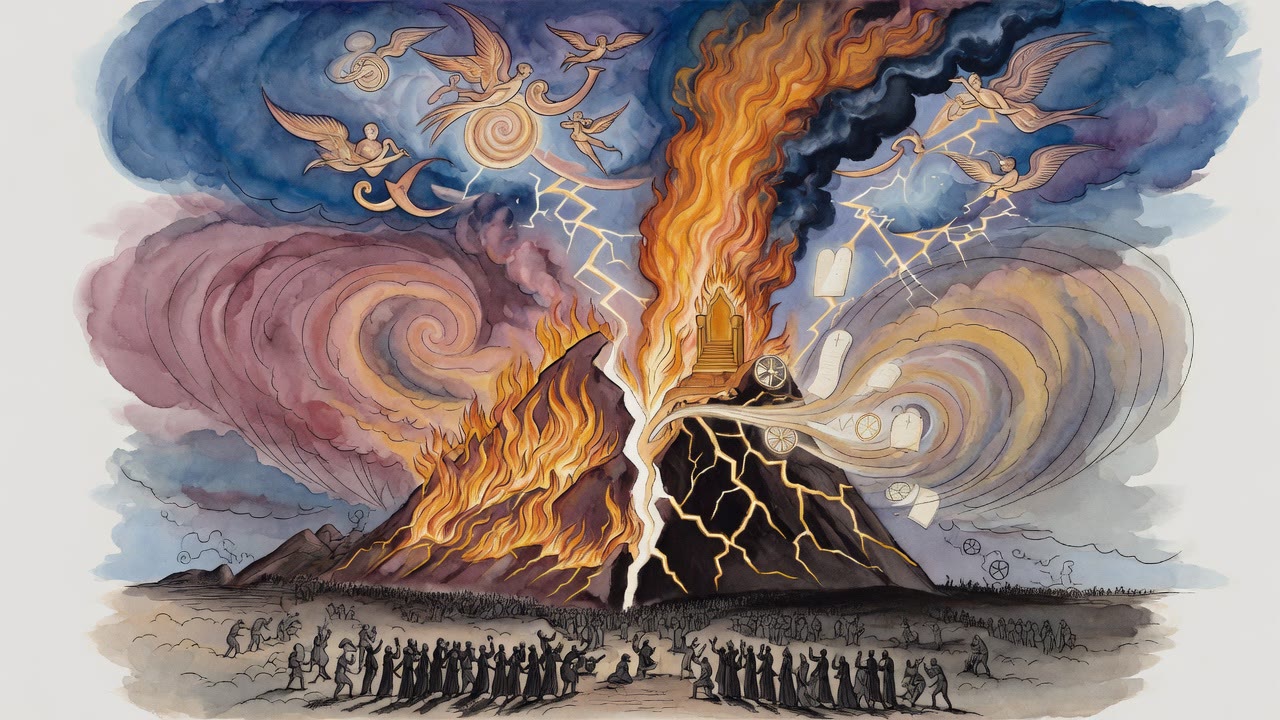
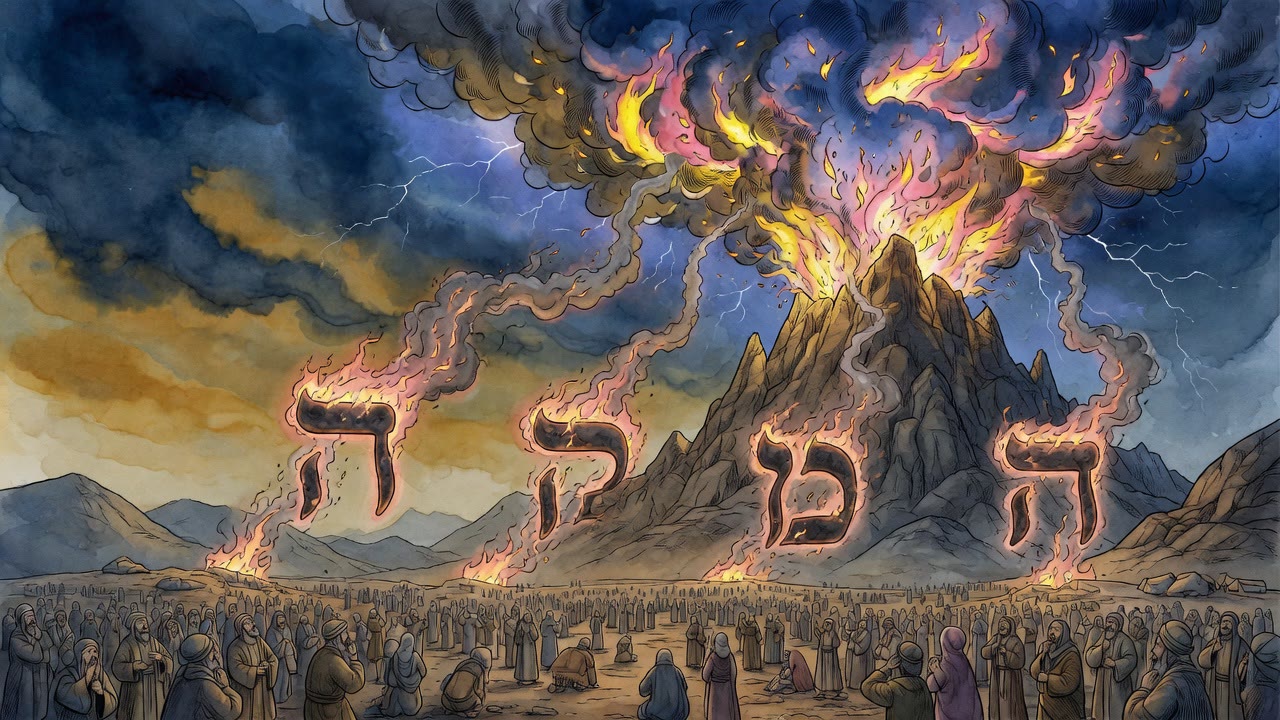
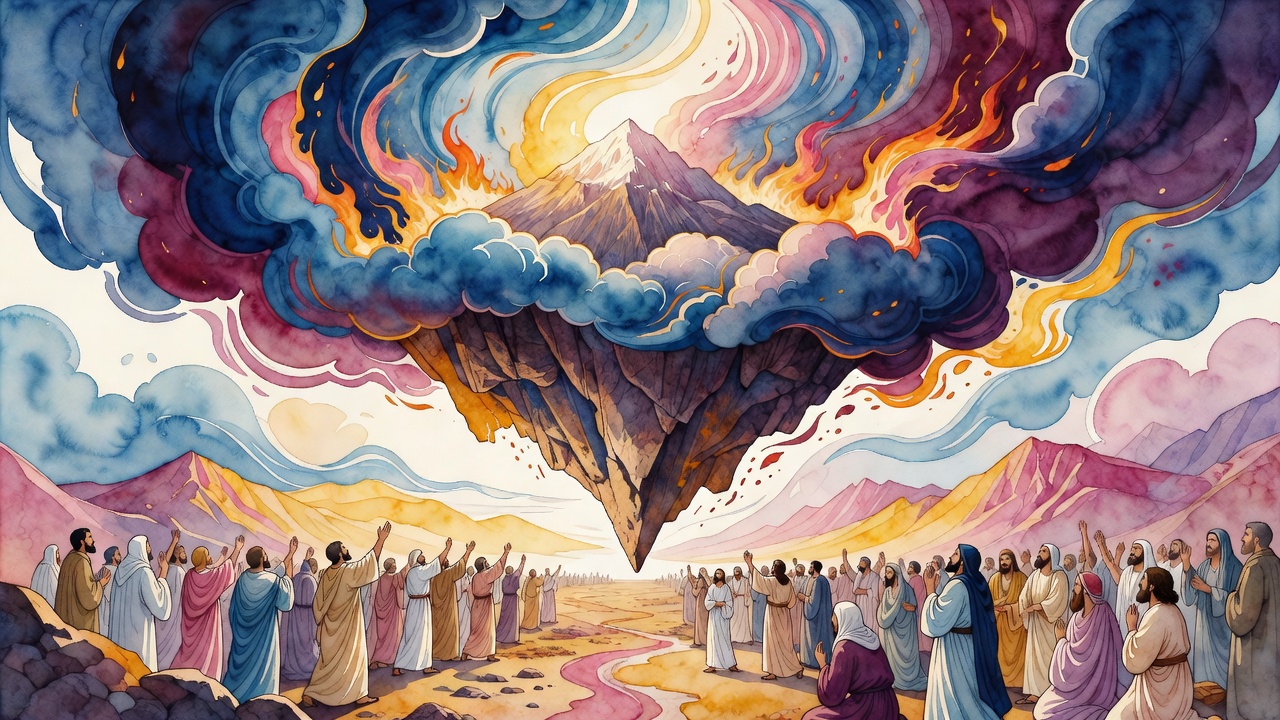
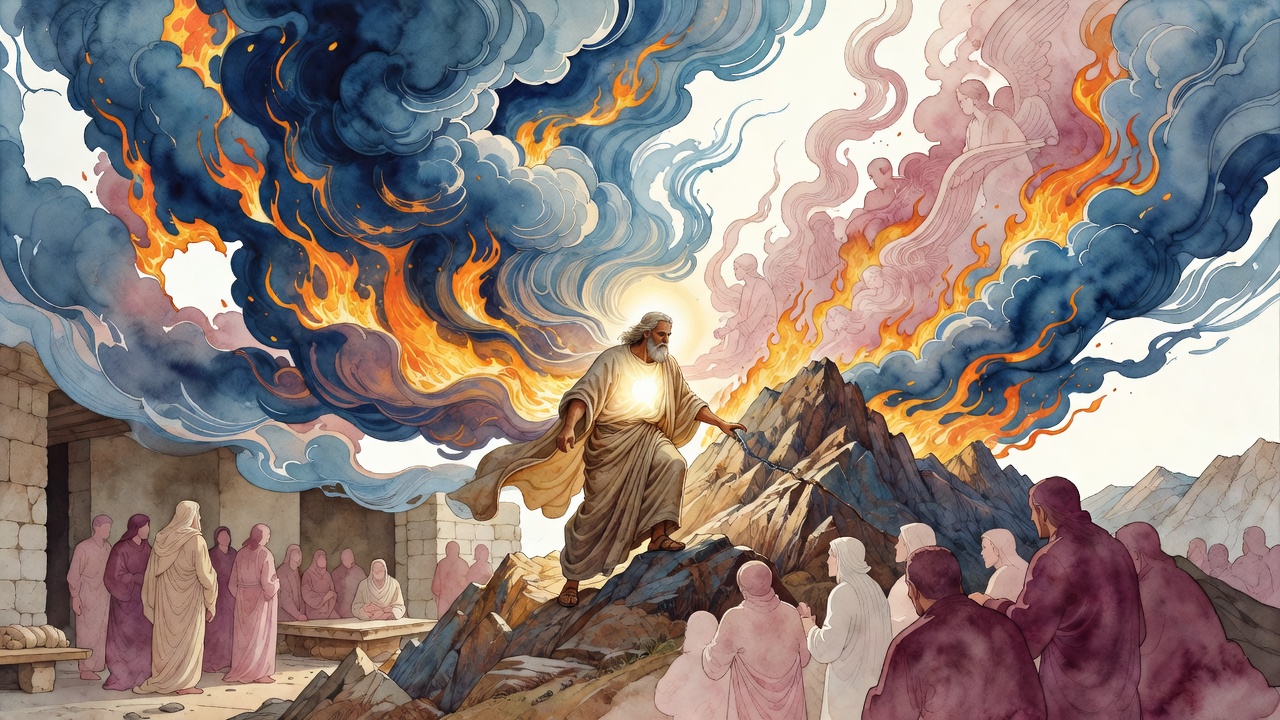
Moses climbed past the last ledge a goat could hold and kept going. Below him the mountain burned. The fire had weight. It leaned on the rock, it stood upright in the air the way water stands in a jar, and it ate nothing at all.
The voice was not in the fire. It came from over the top of the sky and arrived inside the flame the way a man's breath arrives in a room he has already walked out of.
Israel argued about that for generations. Some swore the Holy One had come down onto Sinai, feet on the summit, and they had words to point at. Others swore He never left heaven and only spoke down into the smoke, and they had words for that too. Rabbi Yishmael ended the quarrel by producing a third line the way a man produces a deed at a boundary dispute. "From the heavens He made you hear His voice to exhort you, and on the earth He showed you His great fire, and His words you heard from the midst of the fire." (Deuteronomy 4:36)
The voice above, the fire below, and running between them a seam no wider than a man, belonging to neither side. Moses was standing in it.
God Quoted a Man Not Yet Born
He had expected thunder.
What came instead was a lesson, delivered at the pace of a teacher in no hurry, and the teacher was Ha-Kadosh Baruch Hu, the Holy One blessed be He. He was working through the parah adumah, the red heifer burned outside the camp whose ashes turn the unclean clean again (Numbers 19). The measurements, the years of the animal, the exact age at which a red cow stops being a calf.
And the voice was quoting somebody.
"Rabbi Eliezer says: a calf within its first year, a heifer within its second year."
Moses did not move. The Master of the universe was crediting a ruling to a man by name, and the man had not been born, and would not be born for more than a thousand years.
He spoke before he could stop himself. "Master of the universe, may it be Your will that he come from my descendants."
"As you live," the voice said, "he is from your descendants."
Moses already had a son by that name (Exodus 18:4). The bargain had been closed before he thought to ask for it.
Moses Caught the Angels' Answer
Then the lesson stopped, and something else started up above his head.
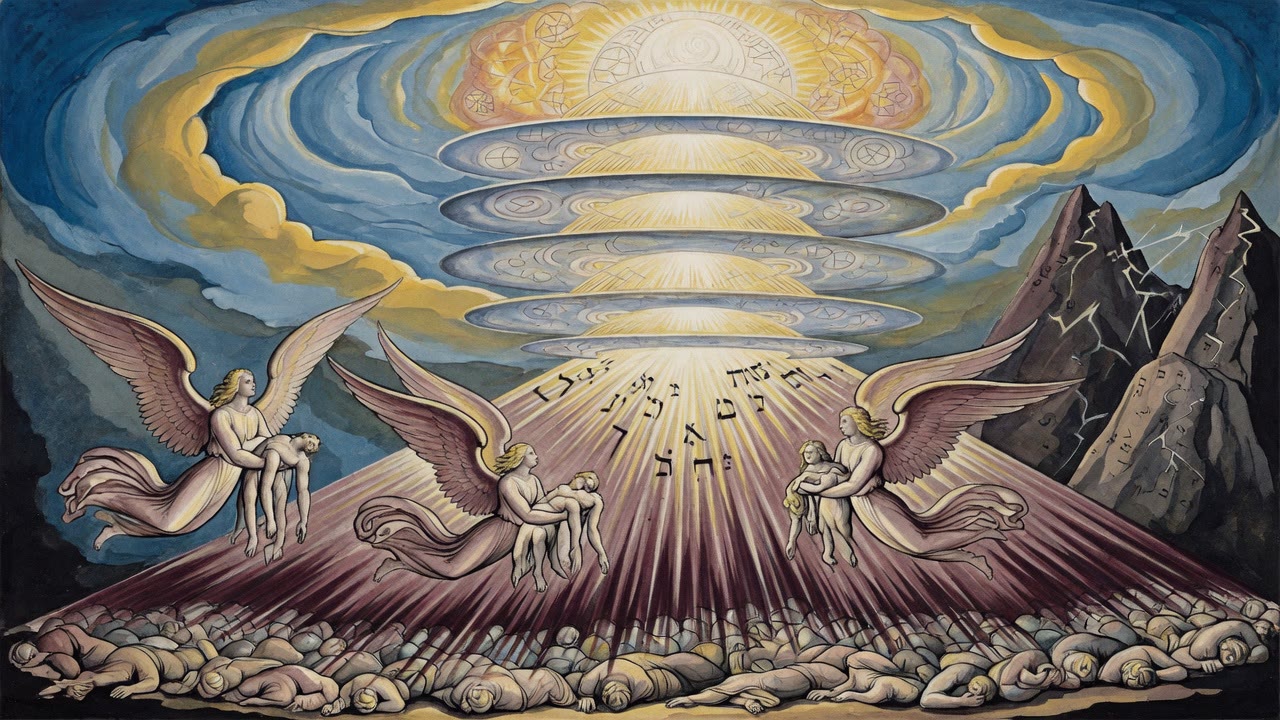
The ministering angels turned toward the glory and answered it. No shout. Praise worn smooth by use, the sound of household servants answering a master they have served since before there was a house. "Baruch shem k'vod malchuto l'olam va'ed." Blessed be the name of His glorious kingdom for ever and ever.
Nobody handed it to him. Not one of them turned to check whether the man wedged in the seam was listening. The angels said it because that is what they say when the glory answers, and Moses stood close enough to catch every syllable, and he took it.
He walked down the mountain with it in his mouth.
A Thief Put Jewels in His Wife's Hands
Israel learned the line and would not say it out loud.
Six words of the Shema (Hear O Israel) go up plainly, full voice, in the street, in the field, in the doorway of the house. Then the second line comes and the whole congregation drops into a murmur, and a stranger standing at the door hears nothing.
Rabbi Asi was asked why, and he answered with a thief.
A man walked out of the king's palace with jewelry under his coat. He got it home. He put the stones into his wife's hands and closed her fingers over them. "Wear them," he said. "In the house. Never in the street, never at a wedding, never where a neighbor can look at your throat." She wore them at night with the shutters barred, and the stones threw little scraps of light onto the walls of a room nobody visited. She was never once caught. She was never once anything other than a woman wearing what her husband had lifted from a king.
Israel wears the angels' praise the same way. Indoors only, under the breath, behind the shutters, a treasure in the hands of people who cannot prove it belongs to them.
One Day a Year the Line Is Sung Aloud
Ten days after the new year, the arrangement breaks.
Nobody eats. Nobody drinks. The leather comes off the feet and the white goes on, and the fasting bodies stand in a room they have not left since dawn. By the middle of the afternoon a congregation of Israel has gotten as close to the ministering angels as flesh gets on a working calendar.
So on Yom Kippur they say it aloud. Full voice, the whole room at once, the line Moses lifted off the mountain without asking, sung by people standing inside their own hunger with nothing in their stomachs to soften it.
By the next evening the bread is back and the shoes are back and the line has gone under the breath again for another year.
The King has never once sent for His jewels.
← All myths