Retold in our words. Read the original at the link below.Townsend 1989 translation of Midrash Tanhuma, S. Buber Recension · CC-BY
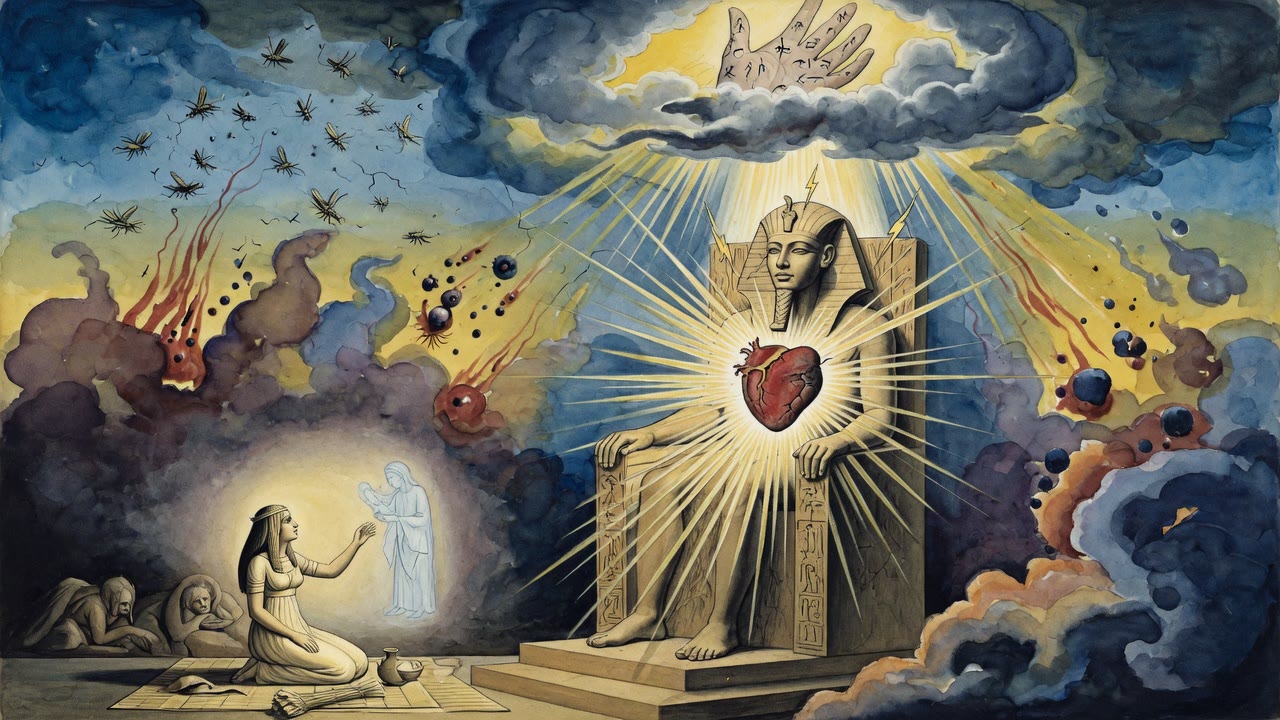
And the Lord said unto Moses: “Rise up early in the morning, and stand before Pharaoh; lo, he cometh from the water” (Exod. 8:16). Why did Pharaoh go to the waters early in the morning? Because the wicked one boasted that since he was a god, he had no need to go to the water to relieve himself. Therefore he went out early in the morning so that no one would see him performing a demeaning act. That is why the Holy One, blessed be He, said to Moses: Rise up early in the morning, when he must (go out), and say unto him: Thus saith the Lord, the God of the Hebrews … for I will this time send all My plagues upon thy person, etc. (Exod. 9:14). Ordinarily, when a man desires to harm his enemy, he does so unexpectedly lest he be forewarned, but the Holy One, blessed be He, warned the wicked Pharaoh before each plague, as it is said: Behold, I will cause it to rain (ibid., v. 18), Behold, tomorrow will I bring locusts into thy border (ibid. 10:5). And He did so in each instance.
Scripture says elsewhere: Behold, God doeth loftily in His power. Who is a teacher like unto Him? (Job 36:22); that is, He instructed the wicked ones to do penance. To Pharaoh He said: Now therefore, hasten in thy cattle (Exod. 9:19), and He warned him, For behold, I will cause it to rain (ibid., v. 18), and after that it is written: Behold, tomorrow will I bring locusts into thy border (ibid. 10:4). Each plague followed a warning.
Each of the ten plagues was imposed for a specific reason. The plague of blood was inflicted upon them because they would not permit the daughters of Israel to bathe after their menstrual period lest they increase and multiply.
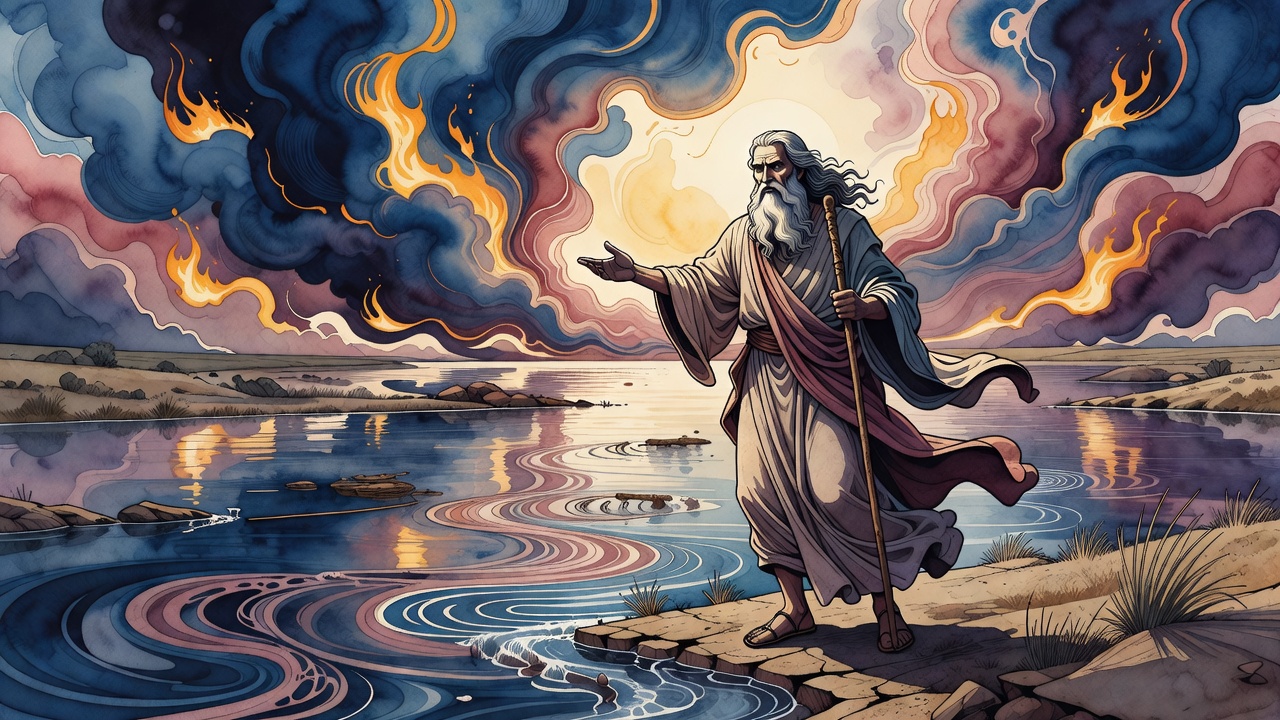
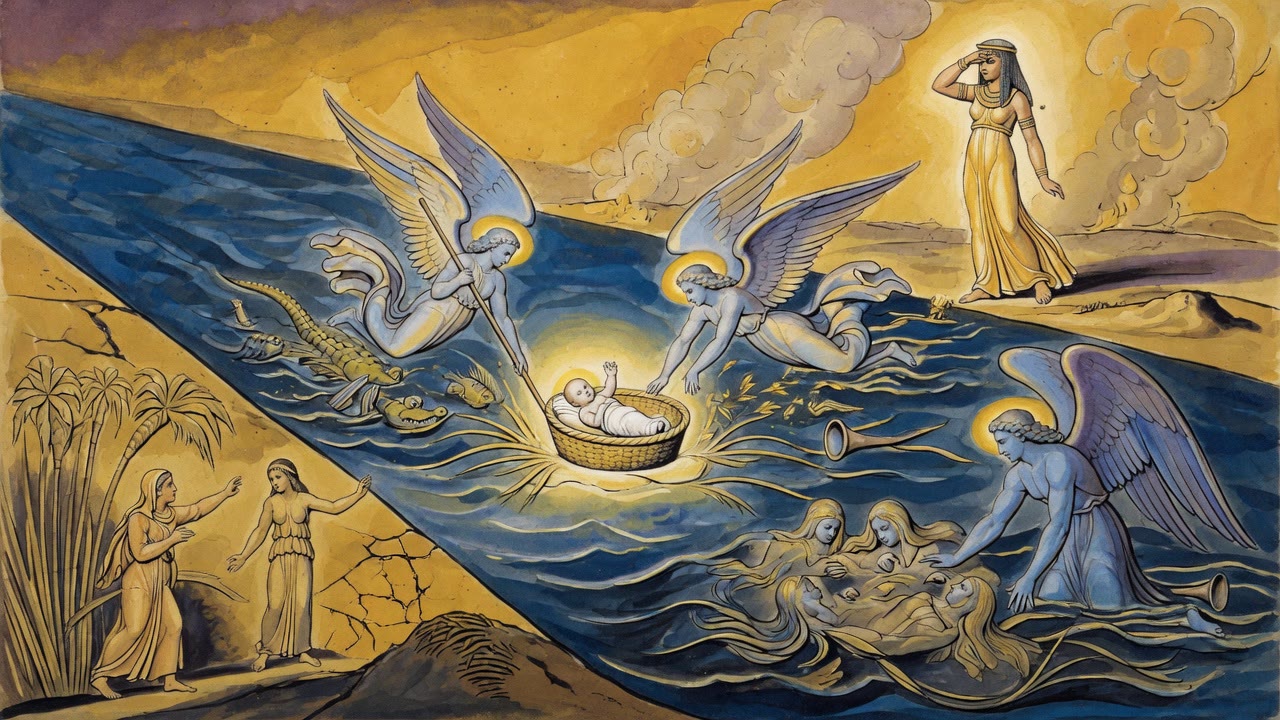
Why were the water and the dust smitten with the rod by Aaron, as it is written: Say unto Aaron: “Take thy rod” (ibid. 7:9)? R. Tanhum stated: The Holy One, blessed be He, said to Moses: Since the water guarded you when you were placed in the Nile, and the dust protected you when you killed the Egyptian, it would not be proper for your hand to smite them with the plague. Therefore they were inflicted by Aaron.
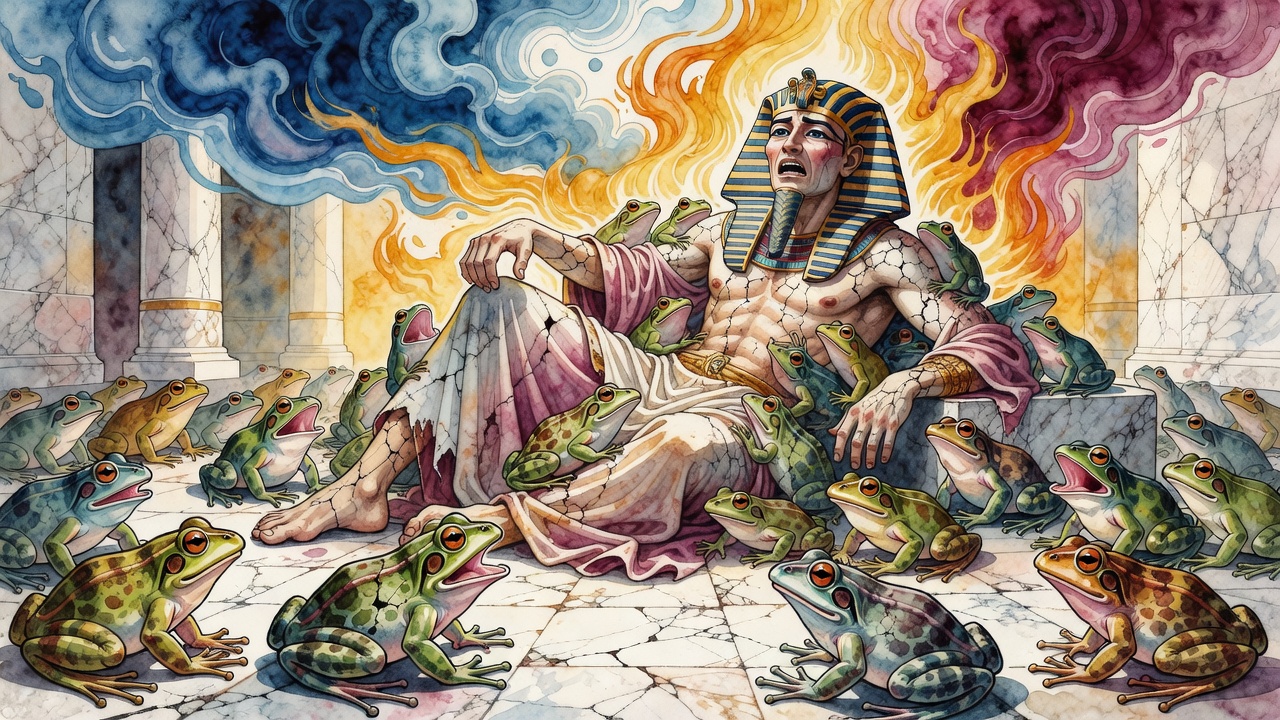
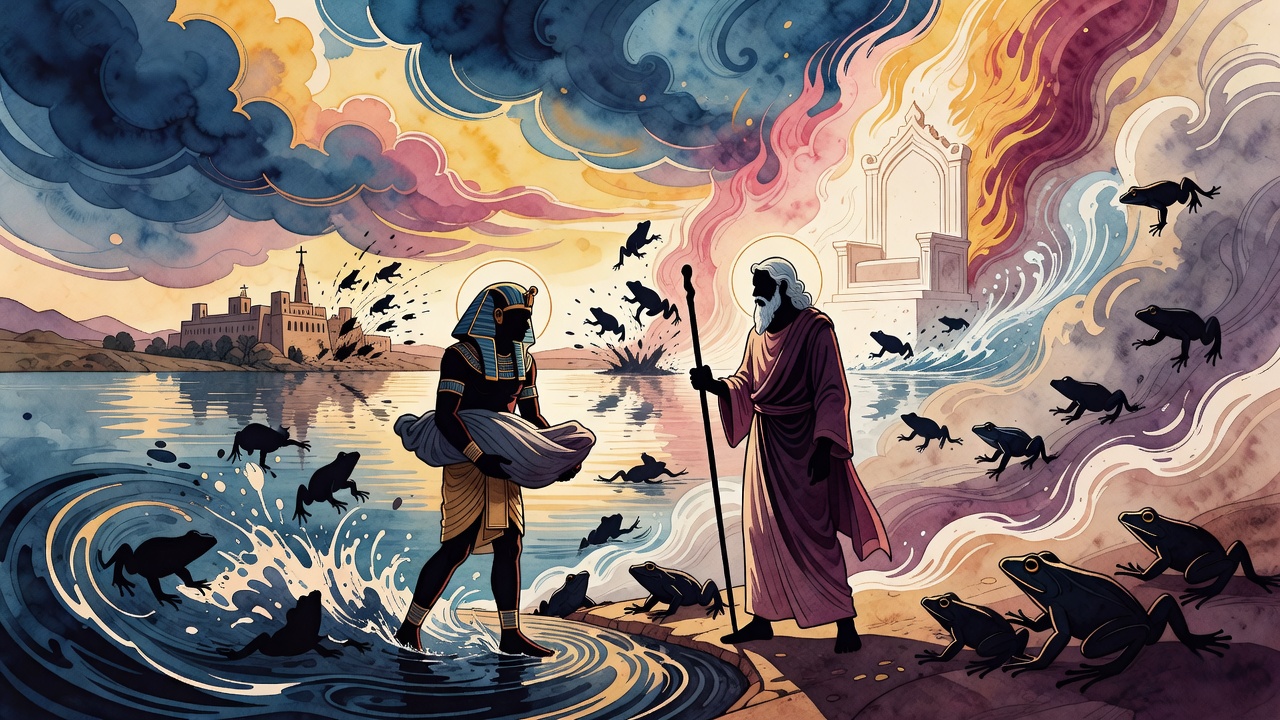
He brought the plague of frogs upon them because they had enslaved Israel and had commanded them to bring reptiles and creeping things to them. That was the reason the frogs came up (ibid. 8:2). Whenever they filled their drinking cups, they found them full of frogs, as it is said: And they shall go and come unto thy house, and into thy kneading troughs (ibid. 7:29). When is the kneading trough near the oven? It is placed there when the oven is hot. Why did all of this happen? To fulfill the wishes of their Creator. One verse states: And the river shall swarm with frogs (ibid. 7:28), while another says: And the frog came up (ibid. 8:2). R. Akiba explained it as follows: At first there was only one frog, but after the Egyptians struck it, many frogs sprang from it.
Why were the gnats brought upon them? Because they had forced Israel to become sweepers in their streets and their marketplaces. Therefore He turned the dust into gnats so that even though they dug many cubits into the earth, they found no soil. As it is said: And all the dust of the earth became gnats (ibid., v. 13). And the magicians did so with their secret arts … but they could not (ibid., v. 14). R. Johanan said: Belateihem (“with their secret arts”) refers to the work of demons, and the belehatim (ibid. 7:11) refers to works of sorcery. Then the magicians said unto Pharaoh: “This is the finger of God” (Exod. 8:14), since no demon can produce anything smaller than the size of a barley.
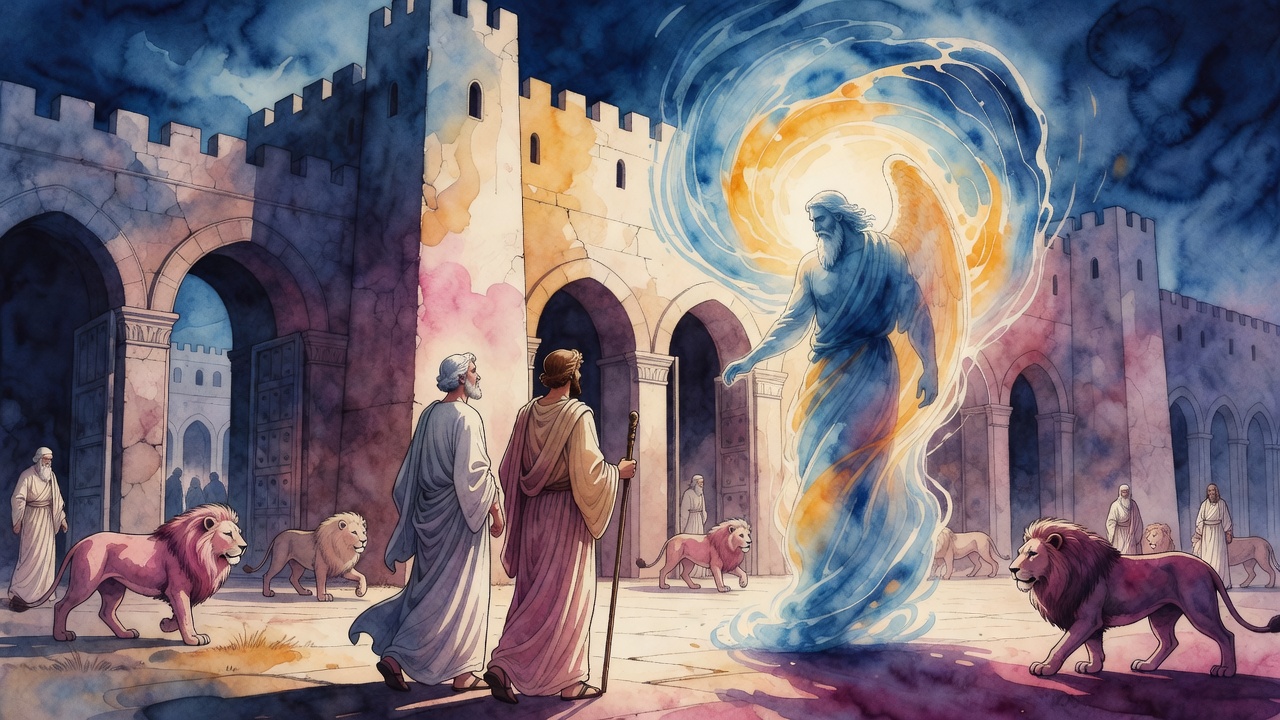
Why were swarms of wild beasts sent? Because they had told the Israelites, “Go, bring us bears and lions,” so that they could torment them with these beasts. Therefore the Holy One, blessed be He, turned many kinds of wild beasts against them to confound them, as it is said: And there came grievous swarms of beasts (ibid., v. 20). This is the opinion of R. Judah. However, R. Nehemiah said: These were various kinds of hornets and mosquitos. R. Judah’s opinion appears most likely to be correct. In the case of the frogs, it is written: And they gathered them together in heaps (ibid., v. 10), but in reference to the swarms, it is written: And the Lord did according to the word of Moses, and He removed the swarms of beasts (ibid., v. 9). The frogs, which had nothing pleasant about them, remained and made Egypt smell bad, but the beasts, whose skins were useful, did not remain. If they had been hornets and mosquitos, when they died, they too would have (made Egypt) smell bad. And there came grievous swarms of beasts into the house of Pharaoh (ibid., v. 20). They came to Pharaoh first because he was the first to counsel evil against them, as it is said: And Pharaoh charged all his people (ibid., v. 18). After that it is written: And in all the land of Egypt the land was ruined.
Why did He bring murrain upon them? Because they had forced the Israelites to pasture their oxen, sheep, and cattle in the valleys, the hills, and the deserts, so that the Israelites would not be able to increase and multiply. The Holy One, blessed be He, said to them: I will bring you an excellent shepherd, as it is said: Behold, the hand of the Lord is upon thy cattle (ibid. 9:3). And Pharaoh sent, and, behold, there was not so much as one of the cattle of the Israelites dead (ibid., v. 7)., even the animals that were owned jointly by Israelites and Egyptians did not die.
Why did He afflict them with boils? Because they had compelled the Israelites to keep warm the things that were warm, and to keep cold the things that were cold. Therefore they were smitten with boils so that they would be unable to touch their own bodies (and derive any pleasure from such touch). R. Joshua the son of Levi declared that a great miracle took place in connection with the boils. If a man shoots an arrow upwards, it cannot travel more than a hundred cubits, yet Moses cast a handful of soot from a furnace heavenward, and though it is almost impossible to grasp a handful of soot, since it has no body, it soared upward until it reached the throne of glory. Another great miracle happened in connection with the boils. Moses took a handful of soot and filled Aaron’s hand as well as his own with it. Still another miracle occurred in connection with the boils. A man cannot possibly scatter a measure of dust more than four cubits, yet Moses took a mere handful and spread it over the land of Egypt, four hundred by four hundred parasangs in area.
Why was the hail brought upon them? Because they had made Israel plant gardens, trees, parks, and vineyards. Hence they afflicted them with hail, which destroyed their trees, as it is said: So there was hail, and fire flashing up amidst the hail (ibid., v. 24). This was an instance of a miracle transpiring within another miracle. R. Judah and R. Nehemiah discussed this matter. The former said: The fire flashing up amidst the rain appeared like a split pomegranate whose seeds are visible from without, while the latter said: It was like a light burning in a glass that contained a mixture of water and oil.
What may this be compared to? To two powerful legionaries who have despised each other for a long time. When their king became involved in a war, he made peace between them so that they would go forth together to fulfill the king’s command. Similarly, though fire and hail are hostile to each other, when the time for war with Egypt came, the Holy One, blessed be He, made peace between them and they smote Egypt. Hence it is said: The fire flashing up amidst the hail. When an Egyptian was seated he would be pummeled by hail; when he arose he would be scorched by fire in conformity to the punishments meted out to wicked men in the netherworld, as it is said: He destroyed their vines with hail, and their sycamore trees with frost (Ps. 78:47). R. Judah the son of Shalum said: What is the meaning of their sycamore trees with frost (ba-hanamal)? Ba indicated that it came; han, that it alighted upon them; mal, that it cut everything down. R. Phinehas declared: It descended like an axe cutting down the trees.
Why were locusts inflicted upon them? Because they had compelled the Israelites to sow wheat and grain. For that reason the Holy One, blessed be He, brought locusts upon them to consume everything that the Israelites had sown. R. Johanan said: When the locusts came, the Egyptians rejoiced, saying: “We will collect them, boil them, and fill our barrels with them.” The Holy One, blessed be He, said: Wicked ones, would you obtain an advantage from a plague that I have brought upon you? Whereupon the Holy One, blessed be He, brought a very strong west wind that drove the locusts into the Red Sea; There remained not one locust in all the border of Egypt (ibid. 10:19). Even those that were in jars and in barrels sprouted wings and flew away.
Why was darkness inflicted upon them? Because the King of Kings, the Holy One, blessed be He, shows no partiality, and searches the heart and tries the kidneys of all. He brought darkness upon them because there were sinners in Israel who had Egyptian patrons, and enjoyed honor and wealth, and were unwilling to leave. And the Holy One, blessed be He, said: If I bring a plague upon them in broad daylight, from which they will die, the Egyptians will say that just as it passed over us, so does it pass over them. Hence, He brought darkness upon the Egyptians for three days, and they saw not one another (ibid., v. 23). The children of Israel had light in their dwellings, so that they could bury their dead without being seen by their enemies. Even darkness which may be felt (ibid., v. 21) is written. R. Abdimi the son of Hama said: The darkness was doubled and redoubled. An Egyptian who was standing was unable to sit, while one who was sitting was unable to stand, and one lying down could not rise. Three of the plagues were brought by Aaron, three by Moses, three by God, and one through the combined efforts of all of them. The blood, frogs, and gnats, which came from the earth, were brought by Aaron; the hail, locusts, and darkness, which came out of the air, were brought about by Moses, for he had power over earth and heaven; the swarms, the murrain, and the plague of the firstborn were brought about by God; while the boils were brought about by all of them.
During the three days of darkness, the Holy One, blessed be He, made the Egyptians feel kindly toward the Israelites, and they loaned them many things. When an Israelite entered an Egyptian’s home and tried to borrow utensils of silver or gold, or garments, they would reply: “We have nothing to loan you.” Whereupon the Holy One, blessed be He, would illumine their dwellings, and the Israelite would say to them: “There it is, in that place.” This happened in order to fulfill the verse And afterwards shall they come out with great substance (Gen. 15:14).

 Click for full size