The Word That Waited Beside Abraham's Tent
Abraham was ninety-nine and still sore from circumcision when three travelers came. He asked God to wait at the tent door until he had fed them.
Table of Contents
 Click for full size
Three Strangers in the Heat of the Day
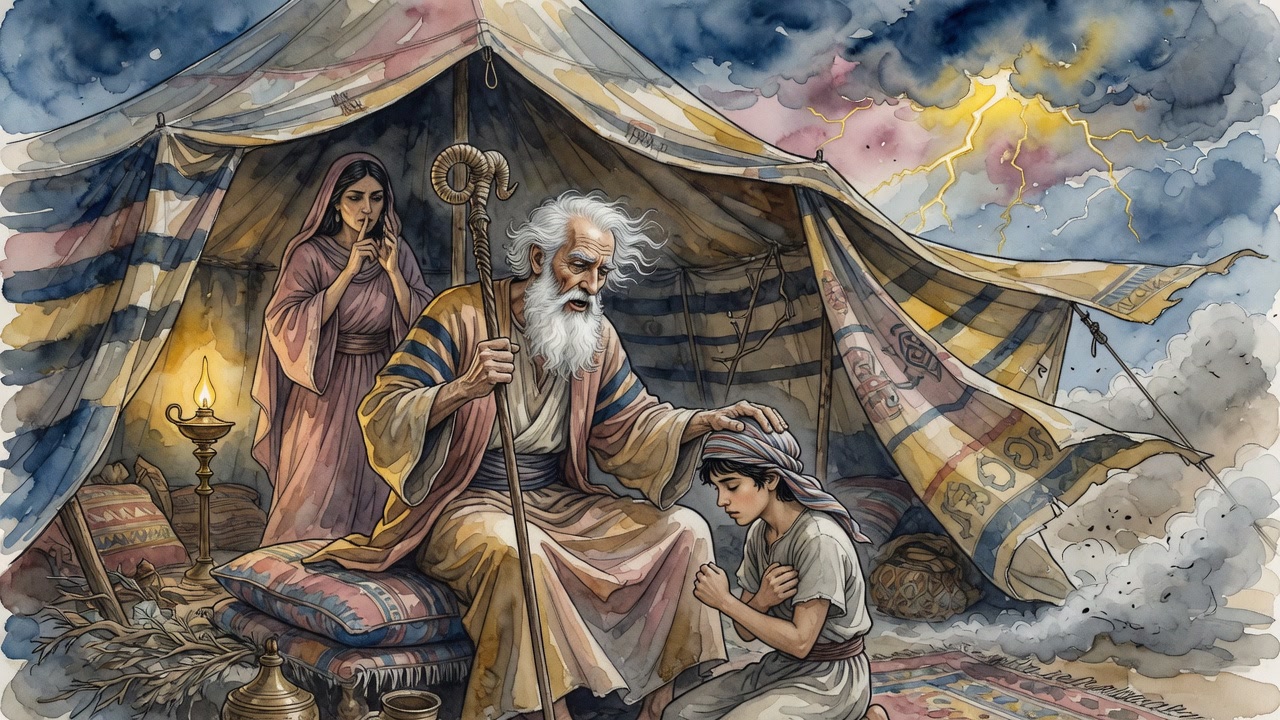
Abraham was still weak from circumcision, sitting at the entrance of his tent while the day burned white. He was ninety-nine years old, three days past a wound that would have stopped a younger man indoors, and he sat at the door because hospitality was not something he practiced when circumstances permitted. It was what he did.
Then three men appeared in the distance. Dust on their feet. The posture of travelers in the desert heat who are not sure of their welcome. Abraham looked at them and moved. Not walked. Ran. Bowed to the ground. Asked them not to pass him by.
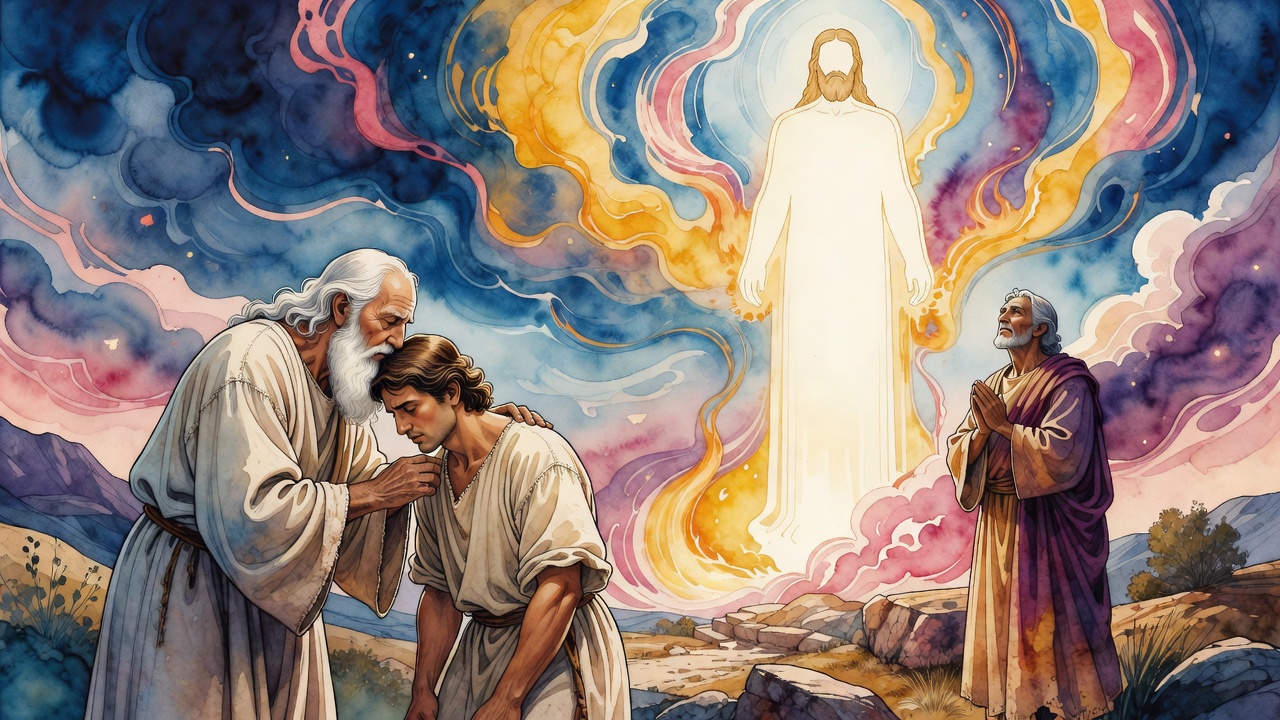
Targum Pseudo-Jonathan, the Aramaic Torah translation whose final form settled in the late antique or early medieval world, catches what happens in the breath between the sitting and the running. Abraham was not alone at the tent door. The Shekhinah, God's indwelling presence, was resting beside him. And Abraham, turning from the visitors to the presence and back again, asked the Shekhinah (the Divine Presence) to wait.
Do Not Let the Glory Ascend
The Torah's text in Genesis 18:3 says "My lord" but leaves the referent famously ambiguous: is Abraham addressing one of the visitors, or is he addressing God? Targum Pseudo-Jonathan resolves the ambiguity by splitting the speech. Abraham says upward: do not let the glory of Your Shekhinah ascend from Your servant until I have set food before these men.
That is a remarkable request. Abraham is asking the presence of God to remain patient while he attends to the needs of three dusty strangers who have arrived uninvited in the middle of the afternoon. He is asking the holy and eternal to wait for the ordinary and immediate.
The audacity of the request was deliberate. For Abraham, the holiness of the moment was not diminished by the arrival of hungry travelers. It was concentrated in them. Sending the travelers away to remain with the divine presence would have been a failure of the very quality that had made the divine presence rest beside him in the first place. Abraham's hospitality was not a distraction from his relationship with God. It was the expression of it. He could ask the Shekhinah to wait because the Shekhinah had come to rest with a man who understood that God is not diminished by the service of guests.
The Glory Returns After Abraham Heals
The Targum preserves a separate scene: the glory of the Lord appearing at Abraham's recovery. The Shekhinah had been present at his circumcision and returned in the aftermath of his healing. The divine presence that waited at the tent door while Abraham served food, that rested with him in his weakness, was not a visitation reserved for moments of strength and ritual completion. It came during recovery. It came while the body was still mending. It came in the heat of the day to a man sitting at a tent door because sitting was what he could manage.
The Targum's reading of Genesis 18:1 insists that the Shekhinah appeared to Abraham specifically in the context of his healing, as if the divine presence had come to check on him, or to honor what he had endured in obedience, or to be present with him in vulnerability rather than only in triumph. Either way, the Shekhinah chose to rest beside a wounded man who was still watching the road.
The God Whose Word Was My Companion on the Road
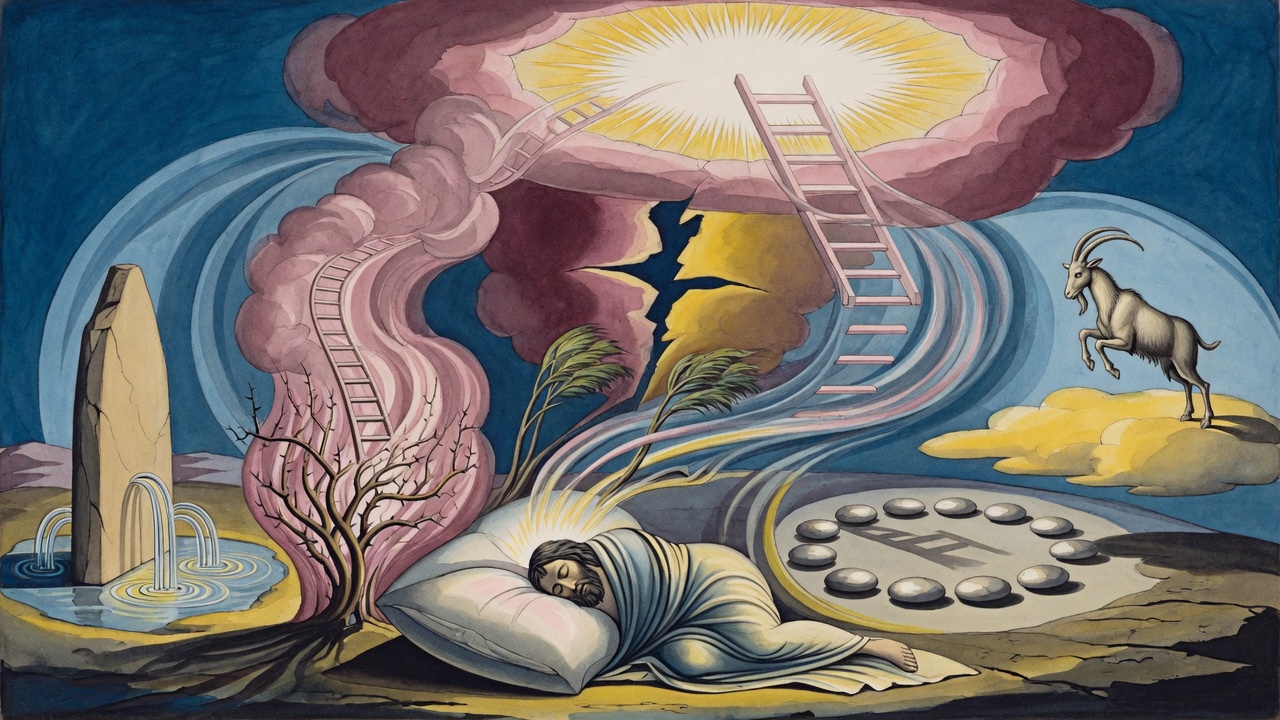
Decades later and hundreds of miles north, Jacob stood at Bethel on his way out of the land. He was alone. He had left Beer-sheba with nothing but a staff and the memory of a blessing his father had given him. He lay down with a stone under his head and dreamed of a ladder and heard a voice saying: I am with you and will guard you wherever you go.
When Jacob woke, he made a vow. The Targum on Genesis 28 preserves the specific language of that vow: if the God whose Word was my helper on the way will be my companion, if the Word will keep me on this road I am walking, then the Lord will be my God.
The Word that Jacob calls his helper is the Memra, the divine Word in Targumic theology, the same presence that Abraham had asked to wait at the tent door rendered in a different register. For Abraham, the presence was the Shekhinah resting at the threshold. For Jacob, it is the Word walking alongside on the road. Both are the same intimacy described from different angles: God not distant and removed but present, attendant, specifically there at the tent door and on the road north of Beer-sheba.
Five Miracles at Bethel
Targum Pseudo-Jonathan preserves a tradition about five miracles that happened to Jacob at Bethel on that night. The stone beneath his head became smooth for him. The stars that should have continued in their courses gathered above him to honor him. The angels ascending and descending on the ladder were the angels who had accompanied him from his father's house, going up to announce his presence in heaven, and the angels of the land he was entering, coming down to accompany him forward. The divine presence closed over him like a tent.
The five miracles are the Targum's way of saying that the ladder dream was not a reassurance sent to a frightened man to help him feel better. It was an event in the structure of creation. Jacob at Bethel was not a fugitive receiving comfort from a sympathetic God. He was a patriarch whose journey had been prepared, whose road had a companion, whose stone pillow had been made smooth by attention that preceded his arrival.
Abraham asked the Shekhinah to wait and served three strangers in the afternoon heat. Jacob called the Word his companion on the road north in the dark. Both men understood that the presence which accompanied the covenant was not occasional or distant. It waited at tent doors. It walked on roads. It came to sit with a man recovering from a wound in the heat of the day. It did not leave when the conversation turned from prayer to hospitality. It was exactly as present in the serving of food as in the dream of a ladder, because it was the same presence, and it did not keep office hours.
← All myths