Parshat Vayishlach5 min read

Young Joseph Hid Rachel Behind His Own Body

When the family bowed before Esau, Joseph stepped in front of Rachel and used his small body as a shield for his mother.

Curated by Arthur · Told by Maggid ·
Table of Contents
  1. The Line of Bows
  2. Souls, Not Inventory
  3. The Gift That Was Never Really His
  4. Tender Feet on a Hard Road
  5. A Shield That Outgrew the Moment
  6. Why the Youngest Wall Mattered
Young Joseph Hid Rachel Behind His Own Body Click for full size

The Line of Bows

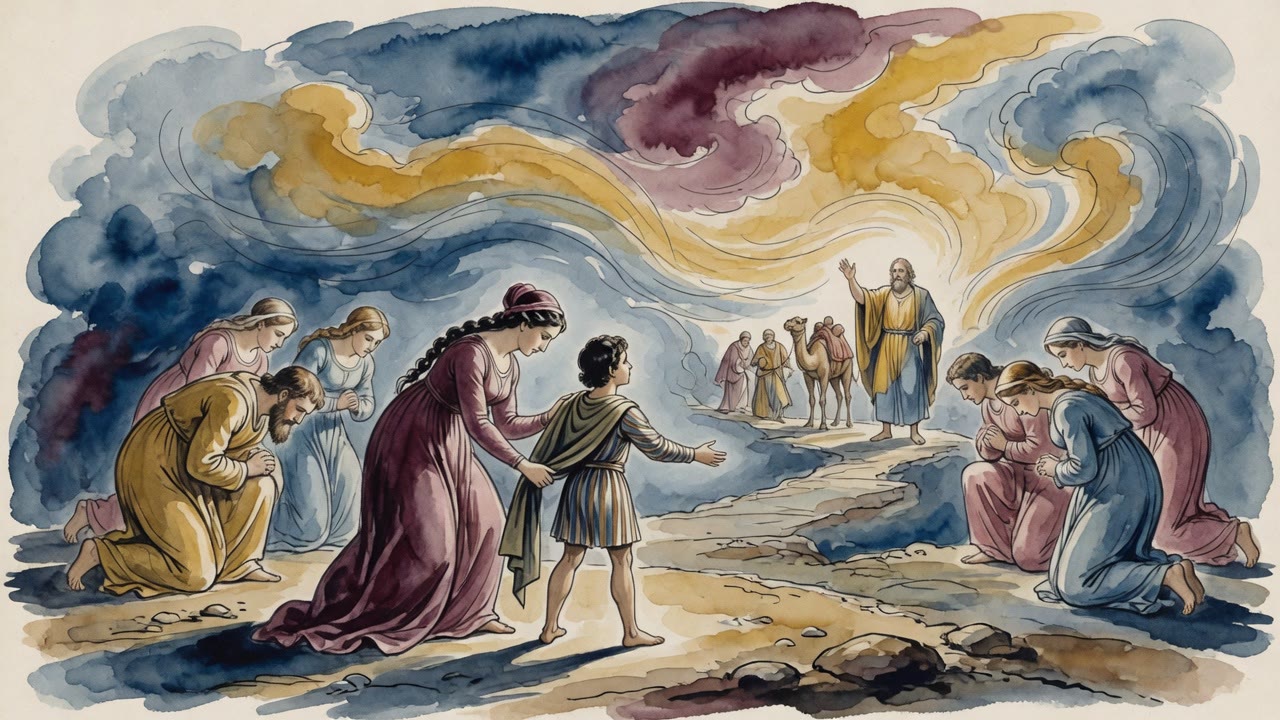
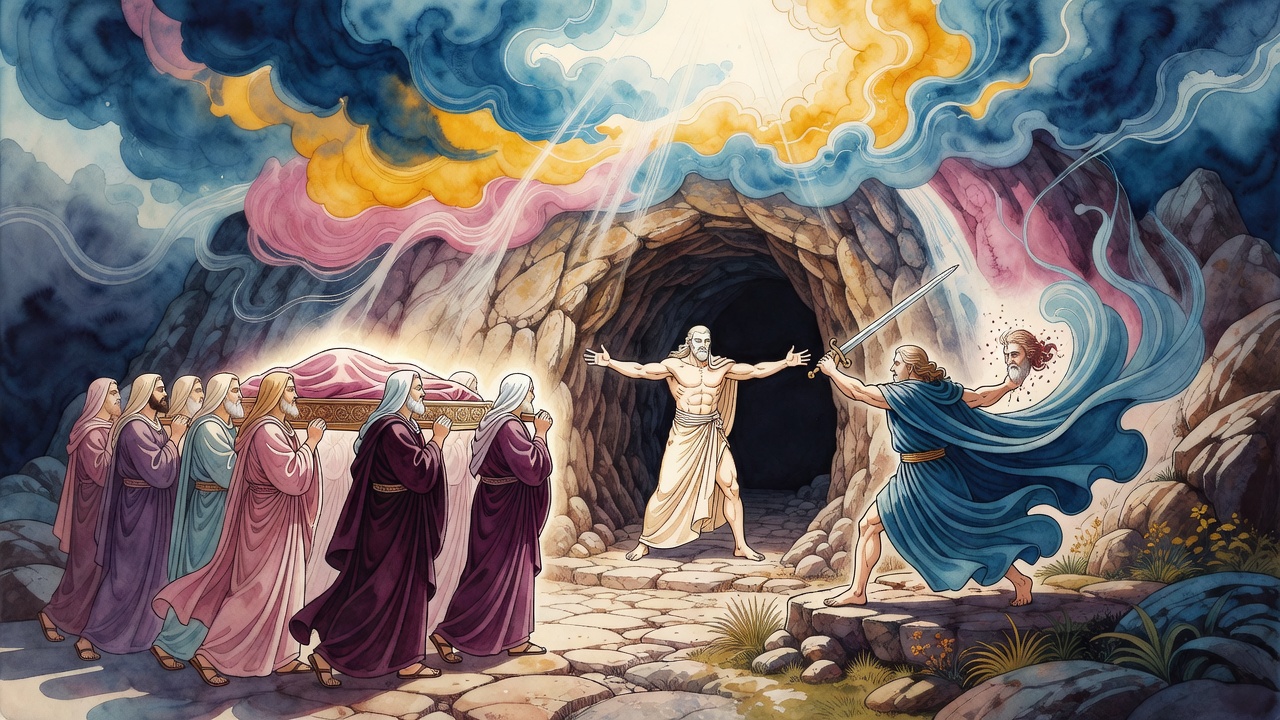
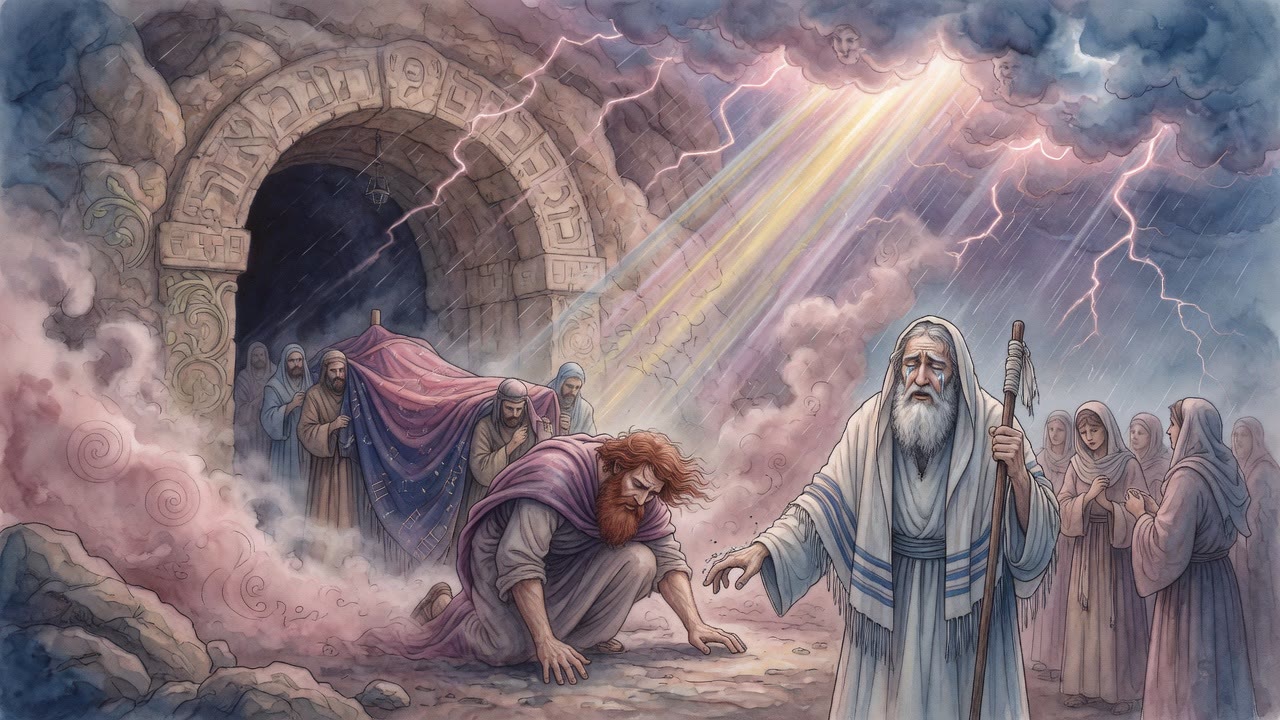
The handmaids went forward with their children and bowed. Leah went forward with her children and bowed. Then came Rachel, last and most precious, and a boy moved before she could. Joseph came near and stood before Rachel, and hid her by his stature, and they bowed. He was young enough that his height was still a child's height, yet he used that small body as a wall between his mother's beauty and Esau's eyes.

No one had ordered him. The Targum keeps the gesture as his own. In a family that had already lost enough to envy, the favorite wife's son decided that looking was a kind of taking, and he would not allow the taking.

Souls, Not Inventory

Esau looked at the caravan and asked the ordinary question. Who are these with you? Jacob did not answer with a count of sons like a man boasting of wealth. They are the souls which have been given to me through mercy from before the Lord. Souls. Gifted. Mercy-shaped. The children behind Joseph and Rachel were not trophies from Haran. They were lives Heaven had allowed a frightened man to keep while four hundred riders approached.

Joseph heard that language in his bones before he could parse it. Later he would call brothers and strangers by the same grammar of mercy. Here he only knew to stand between danger and his mother.

The Gift That Was Never Really His

Jacob pressed the present on Esau with a claim that emptied his own hands. Receive now the present which is brought to you, because it has been given me through mercy from before the Lord. Flocks and servants and abundance had arrived as kindness, not as wages Jacob could clutch. To refuse the gift would be to refuse the story of how he survived Laban. To force the gift was to confess that everything in his camp still belonged first to Heaven.

Esau took it. The road between them grew a little less sharp.

Tender Feet on a Hard Road

Esau offered to travel alongside. Jacob declined with a shepherd's almanac in his mouth. My lord knows that the children are tender, and the flocks and cattle giving milk are with me; and if I overdrive them one day, all the flock will die. He would not match a war party's pace with nursing animals and small legs. Protection had more forms than a boy's body in front of a mother. Protection was also the refusal to hurry.

I will lead on quietly alone, according to the foot of the work which is before me, and according to the foot of the instruction of the children, until the time that I come to my lord at Seir. At the pace of the work. At the pace of the children. Joseph, still tasting dust from the seven bows, walked in that slow column and kept glancing back as if Esau might change his mind.

A Shield That Outgrew the Moment

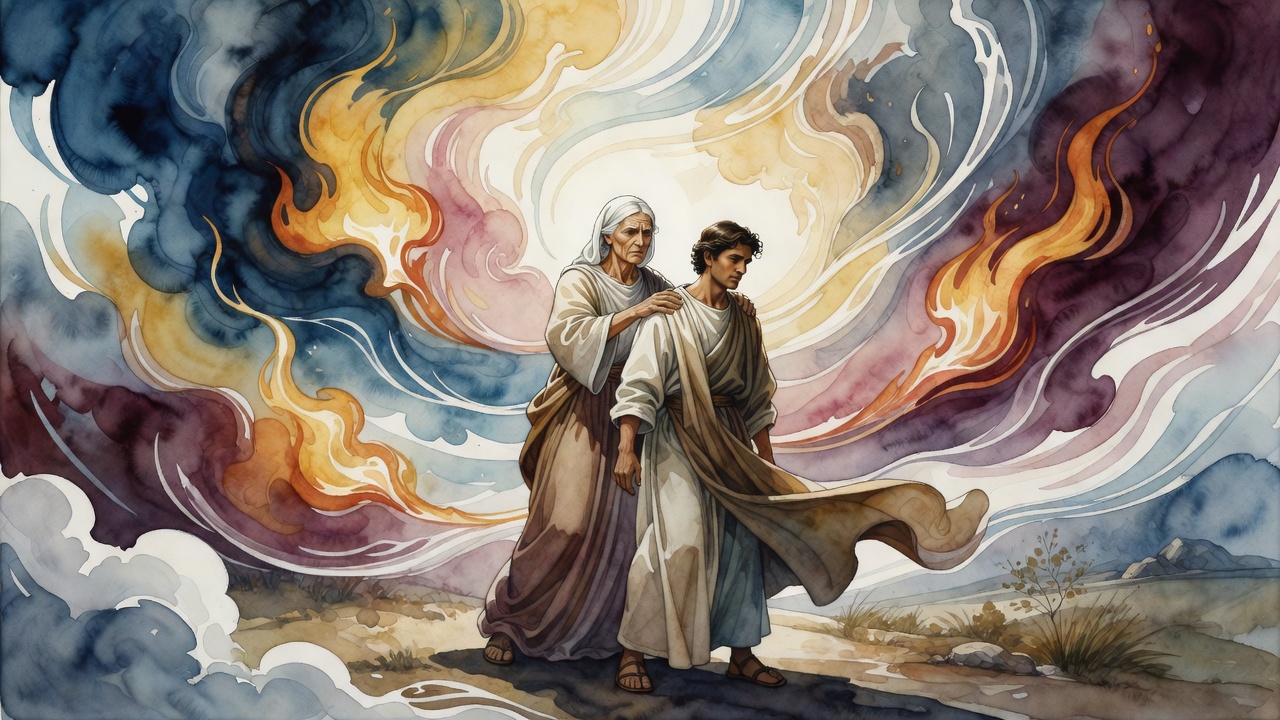
Years later Joseph would stand in Egypt as a wall between famine and nations. The first time he practiced the stance was on a road of reconciliation, hiding Rachel with nothing but his own small frame. Jacob called the children souls of mercy. Joseph treated his mother as a soul worth blocking for. The family that had almost shattered under Esau's old vow moved on at the speed of the weakest, which is how mercy travels when it is more than a word.

Why the Youngest Wall Mattered

Rachel had been the reason Jacob served doubled years and felt cheated in the dark of a wedding tent. To put her last in the bowing line was already a kind of ranking. To let Esau's gaze rest on her without a barrier was, in Joseph's instinct, a second risk layered on the first. He did not have a sword. He had height enough to interrupt a line of sight. That was the weapon he chose.

Jacob's language of souls given through mercy trained the boy whether Jacob knew it or not. Children were not ornaments for a peace parade. They were entrusted lives. Joseph applied the same grammar to his mother. If the children were souls, Rachel was a soul. If mercy had given them, mercy might also demand a body willing to stand in the way.

Later, when Joseph ruled Egypt, he would again place himself between danger and the vulnerable, between famine and the hungry, between his brothers' guilt and their total destruction. The seed of that posture was a dusty road and a small step sideways in front of Rachel. Esau kissed and wept and went toward Seir. Jacob's camp crept at the pace of nursing animals. Joseph kept the memory of being a shield before he ever became a throne.


← All myths
From the tradition

Sources

5 sources

The texts behind this telling. Some cards carry a translation of the source; others are our own retelling of it, and each card says which. Every card links out to the original.

Targum Pseudo-Jonathan on Genesis 33:7Targum Pseudo-Jonathan on Genesis

Retold in our words. Read the original at the link below.The Targum of Jonathan ben Uzziel, trans. J. W. Etheridge, London, 1862 · Public Domain

Targum Pseudo-Jonathan preserves a small, piercing detail from the moment the family bowed before Esau (Genesis 33:7). The handmaids and their children came forward. Leah and her children came forward. And then came Rachel. But not first.

"Joseph came near and stood before Rachel, and hid her by his stature, and they bowed."

A boy's shadow over his mother

Joseph was perhaps six or seven years old. He was not a tall man. And yet the Targum insists that he placed himself in front of his mother and covered her with his body, shielding her from Esau's gaze. The rabbis read this as the first stirring of the Joseph who would one day stand before pharaohs and rise as a savior in Egypt. Even at six, he was already a protector.

There is also a theological reading. Rachel was the most beautiful of the matriarchs, and Jacob feared Esau would take her. Joseph's small frame stretching to eclipse his mother's face was a prayer in motion: do not let him see her. And the prayer was answered. Esau did not look.

The takeaway: even the smallest body can become a shield for someone it loves, and sometimes the whole future begins with a child standing in front of his mother.

Full source
Targum Pseudo-Jonathan on Genesis 33:5Targum Pseudo-Jonathan on Genesis

Retold in our words. Read the original at the link below.The Targum of Jonathan ben Uzziel, trans. J. W. Etheridge, London, 1862 · Public Domain

Esau looked at the caravan and asked the question any returning brother might ask: "Who are these with you?" (Genesis 33:5). In the plain text Jacob answers simply, "the children whom God has graciously given your servant." But Targum Pseudo-Jonathan gives him a richer phrasing.

"They are the souls which have been given to me through mercy from before the Lord upon Your servant."

Souls, not just children

The Targum's word choice, nafshata, souls, does something important. Jacob does not say "these are my sons." He does not list tribal futures or boast of his fertility. He calls his children souls, and he frames every one of them as a gift of mercy he did not earn.

The rabbis treasured this formulation. Every child is, at the most fundamental level, a soul entrusted to a parent by God. You do not own them. You steward them. And when a brother who once wanted you dead asks who they are, the truthful answer is not "mine" but "gifts to me", gifts that could have been withheld, gifts that arrived through mercy and not through merit.

The takeaway: the parent who knows his children are souls before they are his sons has the best chance of raising them well.

Full source
Targum Pseudo-Jonathan on Genesis 33:11Targum Pseudo-Jonathan on Genesis

Retold in our words. Read the original at the link below.The Targum of Jonathan ben Uzziel, trans. J. W. Etheridge, London, 1862 · Public Domain

"Receive now the present which is brought to you, because it has been given me through mercy from before the Lord." Jacob's insistence in Targum Pseudo-Jonathan (Genesis 33:11) rests on a subtle theological claim.

The gift was not really Jacob's. The flocks and the servants and the abundance had been given to him, by mercy, from the Holy One, during his twenty years with Laban. When he now pressed it into Esau's hand, he was not parting with his own property. He was passing along something that had arrived at his door through grace.

The chain of mercy

The rabbis noticed how this framing disarms the transaction. Esau could have refused out of pride (I have enough). Jacob removed the pride by removing the ownership. These gifts did not begin with me, he said; they came from a higher source, and now they continue on to you. You are not taking from your younger brother; you are receiving from the same merciful hand that gave them to me.

"And he urged upon him, and he received." Esau relented. The gift flowed on. And the pattern became a model for Jewish giving: you do not give from what is yours; you pass along what was never fully yours in the first place.

The takeaway: when you know your wealth came through mercy, you give it away more easily.

Full source
Targum Pseudo-Jonathan on Genesis 33:13Targum Pseudo-Jonathan on Genesis

Retold in our words. Read the original at the link below.The Targum of Jonathan ben Uzziel, trans. J. W. Etheridge, London, 1862 · Public Domain

Esau offered to travel alongside Jacob, and Jacob declined. The reason he gave, preserved in Targum Pseudo-Jonathan (Genesis 33:13), sounds like a note from a shepherd's almanac. "My lord knows that the children are tender, and the flocks and cattle giving milk are with me; and if I overdrive them one day, all the flock may die."

Children at the pace of warriors. Nursing mothers at the pace of raiders. It would not work.

The ethics of pace

The rabbis treasured this verse as the foundation of an entire ethic: you cannot push the weak at the pace of the strong. Gidullei habanim, the rearing of children, sets its own clock. Inuk, the nursing of flocks, sets another. A leader who ignores those clocks will arrive at his destination alone, because everything gentle behind him will have died along the way.

This principle echoes through later Jewish law. Parents are commanded to teach Torah to their children according to the child's capacity (Proverbs 22:6). A community must move at the pace of its most vulnerable members. A shepherd is judged not by how fast he travels but by whether his flock arrives intact.

The takeaway: leadership is measured by the slowest person in your care, not the fastest one you could be.

Full source
Targum Pseudo-Jonathan on Genesis 33:14Targum Pseudo-Jonathan on Genesis

Retold in our words. Read the original at the link below.The Targum of Jonathan ben Uzziel, trans. J. W. Etheridge, London, 1862 · Public Domain

"I will lead on quietly alone, according to the foot of the work which is before me, and according to the foot of the instruction of the children; until the time that I come to my lord at Gabla." Targum Pseudo-Jonathan (Genesis 33:14) puts into Jacob's mouth a phrase rich with meaning: leregel hamelakhah, at the pace of the work, and leregel hayeladim, at the pace of the children.

Two clocks, side by side. The flocks have their own rhythm. The children have theirs. Jacob will honor both.

The promise he would not keep

Jacob told Esau he would meet him in Gabla (Seir, Esau's territory). The rabbis noticed, with some unease, that Jacob never actually made that trip. He went to Succoth, then Shechem, then Bethel, not south to his brother's country.

Some commentators read this as Jacob quietly keeping distance. Others say the promise was for the messianic future, when the descendants of Jacob and Esau would truly meet (Obadiah 1:21). Both readings assume Jacob was not lying, he was simply deferring. Reconciliation had been achieved; integration was for another era.

The takeaway: sometimes peace between brothers means parting respectfully, not merging. The promise to meet at Gabla is a promise the future still holds open.

Full source