5 min read

The Temple Rested Between Benjamin's Shoulders

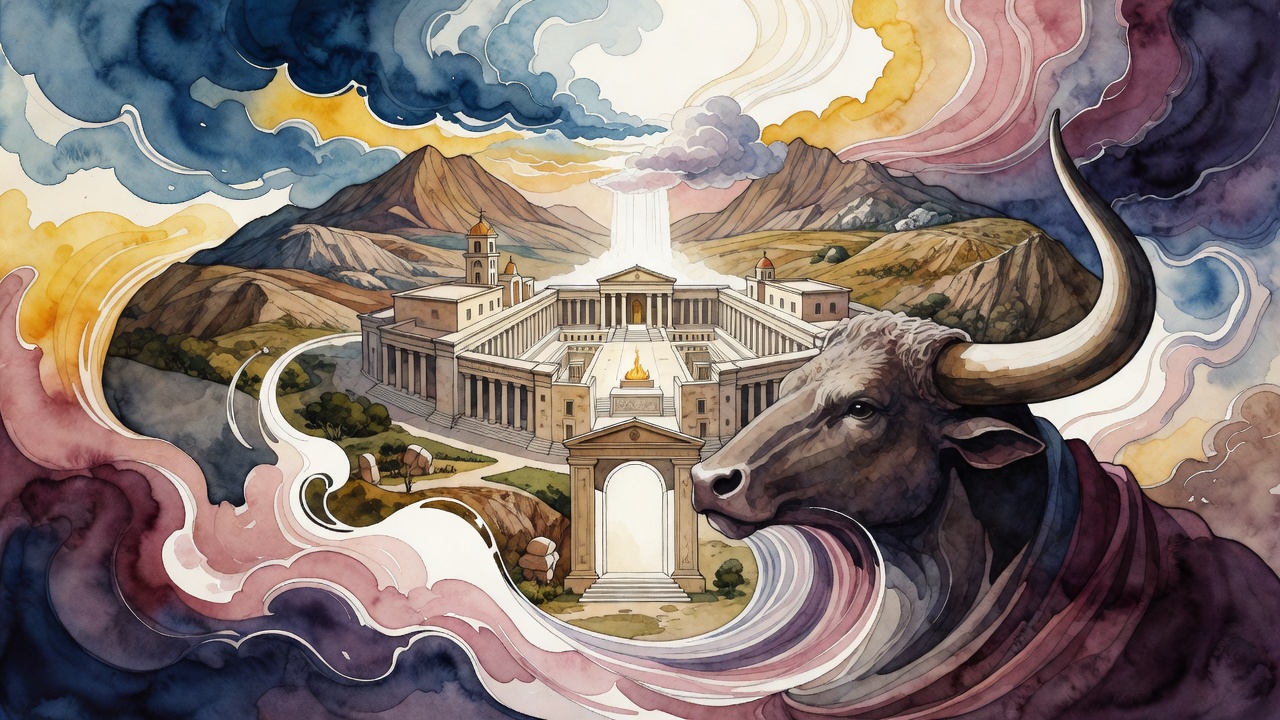
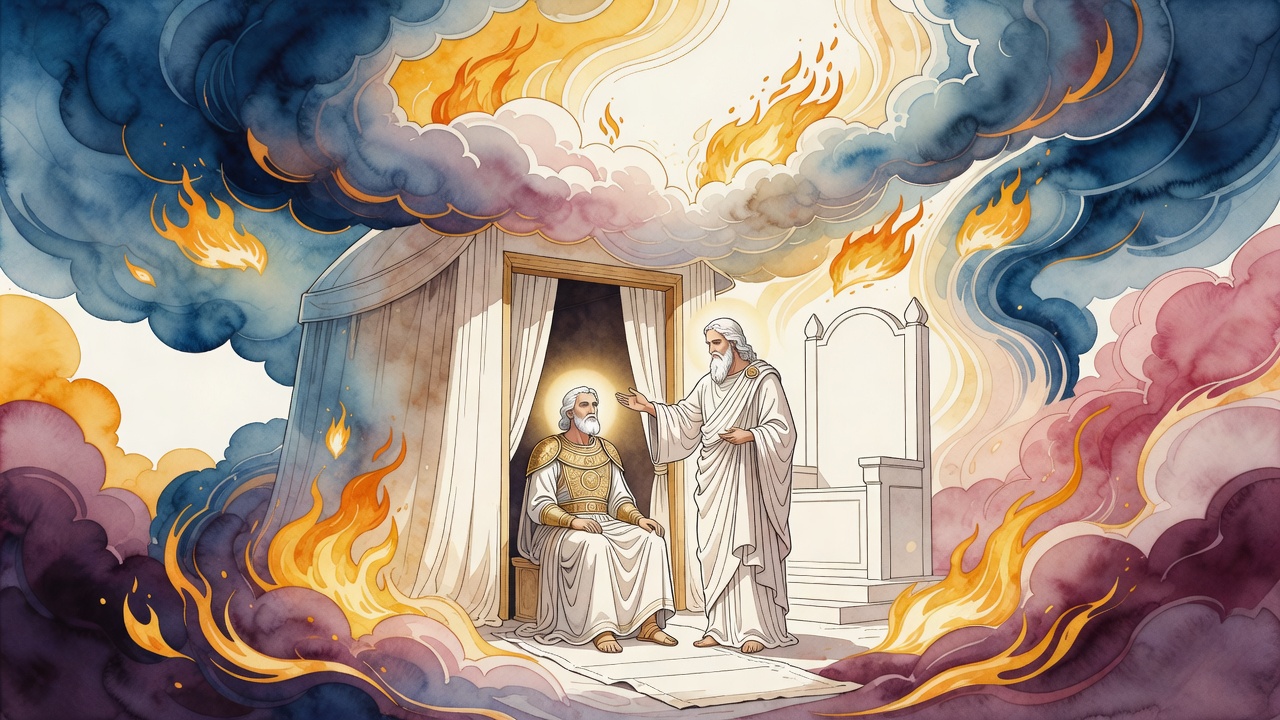
The sanctuary nested in Benjamin's land like a head between shoulders, while Judah's portion pressed the courts like an ox's horn.

Curated by Arthur · Told by Maggid ·
Table of Contents
  1. Two Maps Claim One Mountain
  2. Between the Shoulders
  3. High Places of the Earth
  4. Why the Border Matters
  5. Smoke Rises from a Shared Line
The Temple Rested Between Benjamin's Shoulders Click for full size

Two Maps Claim One Mountain

Surveyors of the tribes could feel the argument under their sandals. Judah held the scepter promise: the rod of rule would not depart. Benjamin held a fold of high ground with a depression between rises that looked like shoulders waiting for a head if a person stared long enough with the right kind of memory. Where would the House sit when both claims pressed the same ridge?

Men from Judah pointed at kingship. Men from Benjamin pointed at the contour of the land. The mountain did not speak. It only stayed high, the place a hard case climbs toward when it needs a harder court, the place peoples would one day name when they said, Come, we will go up.

At stake was not real estate vanity. At stake was whether rule and worship would share a border or tear the people into two capitals of meaning.

Between the Shoulders

The teaching settled into a picture. The Temple rests between Benjamin's shoulders, nestled in that slight depression on the highest part of his portion, as if the smallest tribe carried the heaviest head. Benjamin, son of the right hand, son of sorrow renamed strength, became the living yoke for the sanctuary.

Judah was not locked out. The structure extended into Judah's portion like the head of an ox, horn and power pressing into the courts, so that scepter and altar touched without either tribe swallowing the other. Kingship leaned in. Holiness sat centered. The border ran through sacrifice.

Priests walking the stones walked two inheritances at once. A private from Benjamin could say the House is ours. A captain from Judah could say the House leans into us. Both were telling a truth the map had been built to hold.

High Places of the Earth

Another verse named the mountain without naming tribes: He made him ride on the high places of the earth. The high place was not only altitude. It was the Temple as the world's spiritual summit, the spot from which instruction and judgment flowed downhill into ordinary fields.

Honey from the rock and oil from flint were not only desert miracles of the past. They were the sweetness and richness that come when a people is seated near a House that turns bare stone into provision. Fathers who walked with God had already treated certain ridges as meeting grounds. This ridge gathered their memory into architecture.

Pilgrims climbing the road felt their calves burn and their arguments thin. By the time they reached the gates, tribal slogans had to share breath with awe. The mountain made small men of big talkers, which is work the mountain has always done without charging fees.

Why the Border Matters

If the Temple had sat entirely in Judah, worship might have become a palace chapel. If it had sat entirely in Benjamin without Judah's horn, rule might have drifted from offering. The shared seam kept throne and altar in conversation, sometimes tense, often holy, never fully privatized.

Benjamin's shoulders remembered Rachel's last road and Jacob's long fear. Judah's ox-head remembered leadership that must serve what it cannot own. Together they taught a nation that the center is not a prize for one banner. The center is a weight distributed across a family that has already failed at unity and must keep practicing.

Smoke Rises from a Shared Line

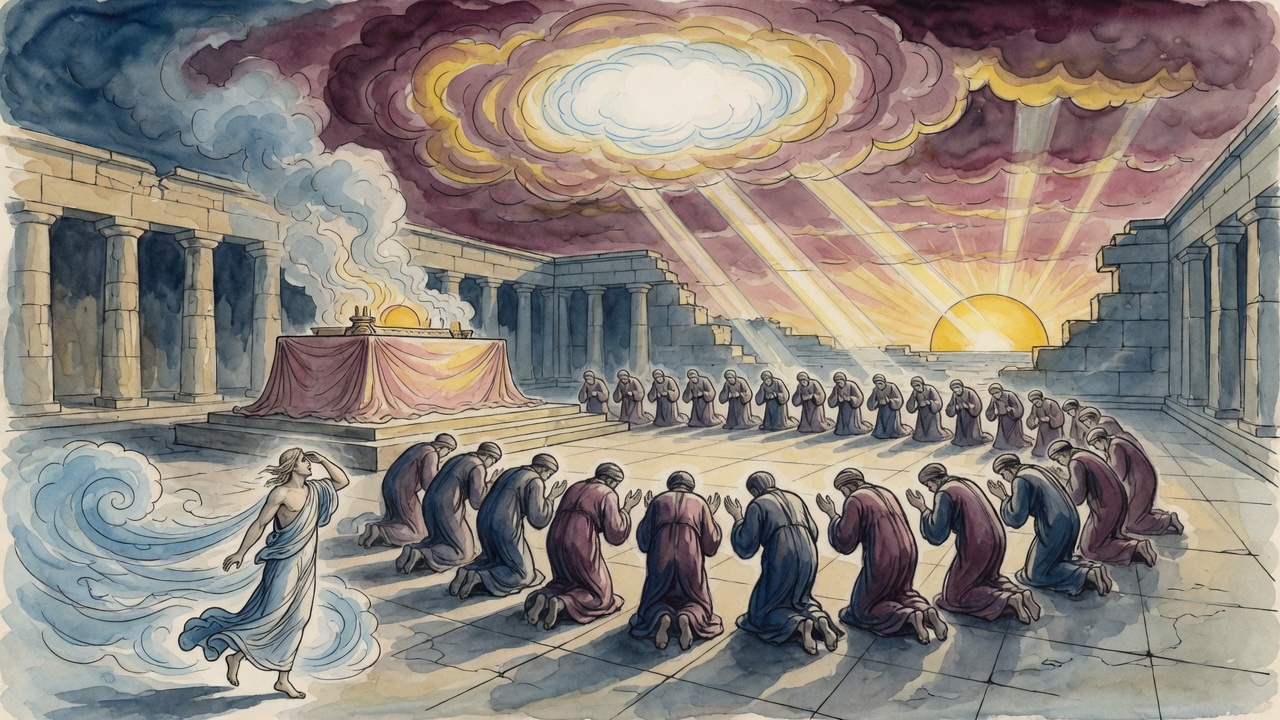
On an ordinary morning, smoke rose from the altar and drifted across both portions. A Benjaminite farmer smelled it over his field. A Judean officer smelled it from a barracks. Neither owned the column of scent. Both were claimed by it.

Children learned the border the way they learned songs, not as a lawsuit but as a story: the House sits between shoulders, and the scepter leans in like an ox. When enemies later burned the beams, they burned a shared inheritance. When mourners faced the ruin, they faced a loss that no single tribe could monopolize.

The high place remained high even as rubble. Maps changed. Empires renamed the ridge. The old teaching kept its geometry: holiness nested in the small tribe's land, power touching from the side, and the people of Israel forever going up toward a line where two brothers' portions refused to divorce the presence of God.

Old men from Benjamin told a joke that was not quite a joke: our shoulders were shaped for this. They flexed nothing. They pointed at the depression in the ridge where courts would sit like a head that never quite crushed the neck beneath it. Judah's young men answered with their own half-joke about ox horns, power that gores only in defense of what it leans toward. At festival time the jokes thinned into silence when the choir began.

A woman climbing with a firstborn lamb felt the border under her feet without owning a surveyor's chain. She only knew that the air changed, that arguments about tribes sounded smaller near the smoke. High places of the earth, the phrase said. She believed it because her knees believed it. By the time she reached the gate, Benjamin and Judah were no longer two slogans. They were two sides of the same ascent.


← All myths
From the tradition

Sources

2 sources

The texts behind this telling. Some cards carry a translation of the source; others are our own retelling of it, and each card says which. Every card links out to the original.

Sifrei Devarim 352:10Sifrei Devarim

Retold in our words. Read the original at the link below.Sifrei by Rabbi Shraga Silverstein · CC-BY

Our tradition teaches us it's literally built on the border between two tribal territories: Benjamin and Judah.

How can that be? We read in Genesis (Bereshit) 49:10, "The scepter shall not depart from Judah." Doesn’t that imply the seat of power, the Temple, should be firmly within Judah's territory? It's a question that's occupied Jewish thinkers for centuries.

The Sifrei Devarim (a legal midrash on the Book of Deuteronomy) offers a beautiful explanation. It tells us that the Temple is built in the portion of Benjamin, but it extends, "like the head of an ox," into the portion of Judah.

Where do we find this alluded to in scripture? "And between his (Benjamin's) shoulders.. does it (the Temple) rest." This verse, says the Sifrei Devarim, speaks of a slight depression on the highest part of Benjamin's land, the perfect spot for the Temple.

So, what about Judah? The Sifrei clarifies that the "scepter" mentioned in Genesis refers to the lishkat hagazit, the Chamber of Hewn Stone, a crucial part of the Temple complex where the Sanhedrin (high court) would convene. This chamber, according to the Sifrei, was indeed located within the portion of Judah.

(Psalm 78:67-68) reinforces this idea: "And He rejected the tent of Joseph and did not choose the tent of Ephraim. He chose the tribe of Judah, Mount Zion, which He loves." Here, Mount Zion, associated with the Davidic line and therefore Judah, is explicitly chosen.

But hold on, doesn't that contradict the idea of the Temple being in Benjamin's territory? Not necessarily.

Remember, we're talking about a border, a place where two territories meet. And the Sifrei subtly points us to another layer of meaning, referencing Rachel's burial place: "And Rachel died, and she was buried on the way to Efrath, which is Bethlehem" (Genesis 35:19). Rachel was Benjamin's mother, and her presence, even in death, connects Benjamin to the very land upon which the Temple would eventually stand.

So, what does it all mean? Perhaps it’s a reminder that true holiness arises from the union of different strengths, different perspectives. Judah, representing kingship and law, and Benjamin, providing the foundation and connection to the land. It's a partnership, a sacred collaboration that allows the Divine Presence to dwell among us.

Next time you think about Jerusalem, remember the ox's head, stretching across boundaries, uniting two tribes in a shared sacred space.

Full source
Sifrei Devarim 317:2Sifrei Devarim

Retold in our words. Read the original at the link below.Sifrei by Rabbi Shraga Silverstein · CC-BY

The Sifrei Devarim, a fascinating work of halakhic Midrash (a legal interpretation of the Torah), tackles this very question, offering us a glimpse into the symbolic richness of the text. In (Deuteronomy 32:13), we read, "He made him ride on the high places of the earth, and he ate the shoots of the field; and He gave him to seek honey from the rock…" What are we to make of these powerful images?

In Sifrei Devarim, "He made him ride on the high places of the earth" refers to the Temple in Jerusalem. the Temple wasn't just a building; it was considered the highest point, spiritually and physically, in the world. This idea is supported by verses like (Deuteronomy 17:8), "then you shall arise and go up to the place," referring to the Temple. And (Isaiah 2:3) echoes this, saying, "And many peoples will go and say: 'Come, let us go up to the mountain of the L-rd, to the Temple of the G-d of Jacob.'" So, to "ride on the high places" is to be connected to the divine presence, accessible through the Temple.

What about eating "the shoots of the field"? That's the Sifrei Devarim's gentle way of referring to the bikkurim, the first fruits that were brought as offerings. These weren't just any fruits; they were the very best, a symbol of gratitude and connection to the land and to G-d’s bounty. It was a mitzvah to bring them to the Temple as an offering.

"honey from the rock"? This is interpreted as the oil libations that were part of the Temple service. Think about how precious oil was in ancient times, and how vital it was for light and anointing.

But the imagery doesn't stop there. The verse continues, painting a picture of abundance: "Cream from the herd and milk from the flock with fat of lambs and rams of the breed of Bashan and he-goats." The Sifrei Devarim sees these as allusions to the various animal offerings brought in the Temple: the sin-offering, the burnt-offering, peace-offerings, the guilt-offering, the thank-offering, and even lower-order offerings. It’s a whole sacrificial menu!

Then, "with wheat (as fat as) the fat of kidneys" is understood to mean the meal-offerings that accompanied the animal sacrifices. And finally, "the blood of the grape did you drink (as choice) wine" refers to the wine libations, completing the picture of a Temple overflowing with offerings and gratitude.

So, what's the takeaway? This passage isn’t just about food and drink. It's about connection, gratitude, and the central role the Temple played in ancient Jewish life. The Sifrei Devarim helps us understand the deep meaning embedded within the seemingly simple words of the Torah, revealing a world rich in symbolism and spiritual significance.

Full source